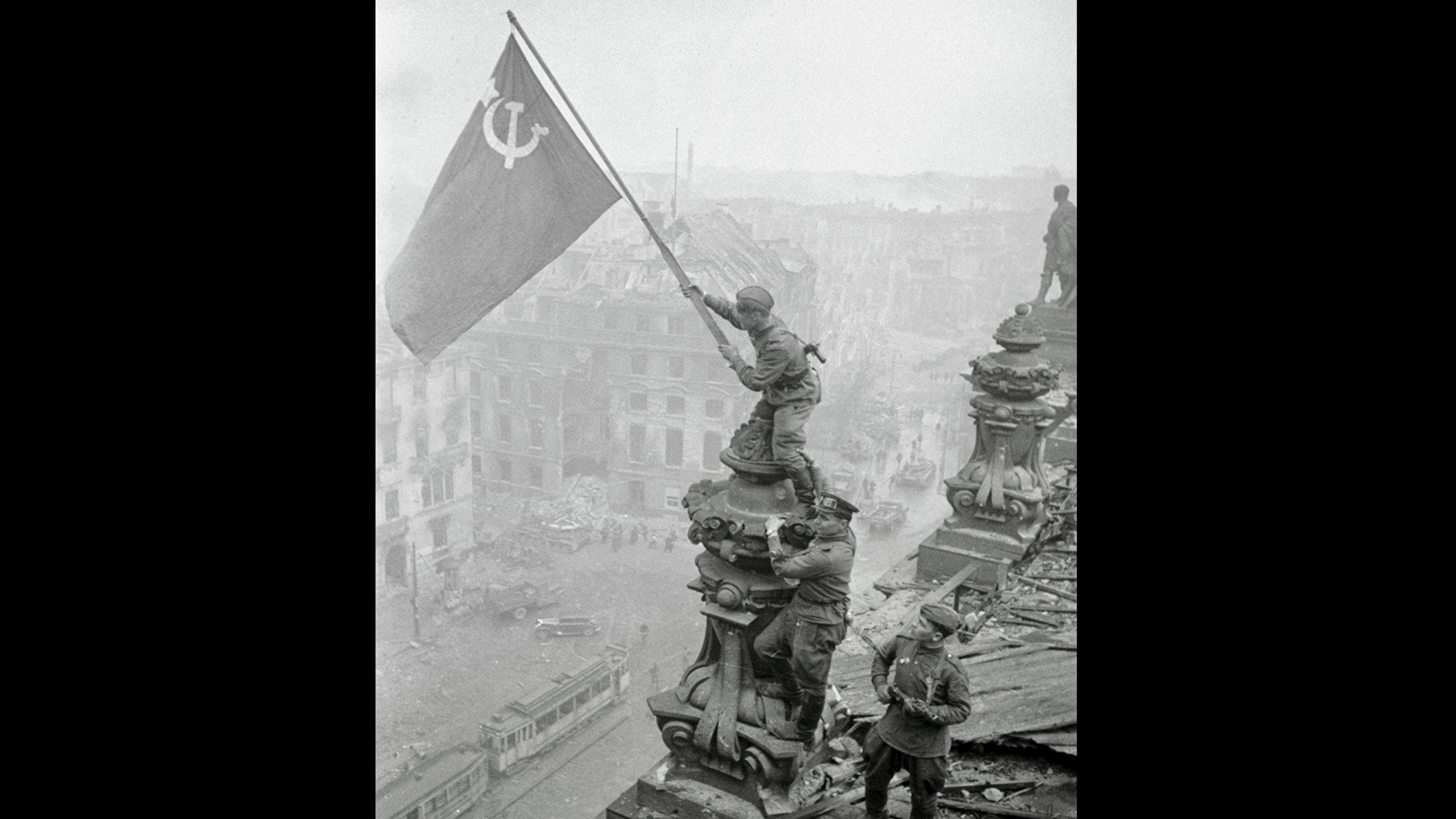
On May 2, 1945, Berlin fell to Soviet forces, marking one of the most decisive moments of the Second World War and bringing Nazi Germany to the brink of total collapse. This matters now because it represents the definitive end of Hitler’s regime in Europe, a turning point that reshaped global power structures, ended years of devastation on the continent, and set the stage for the modern geopolitical order that still influences international relations today.
By the spring of 1945, the war in Europe had reached its final phase. Allied forces had advanced from the west following the liberation of France, while Soviet troops pushed relentlessly from the east after a series of major offensives across Eastern Europe. Berlin, the symbolic and political heart of Nazi Germany, became the final objective. Its capture would not only end organized resistance but also dismantle the command structure of the regime itself.
The Battle of Berlin began in mid-April 1945, as Soviet forces launched a massive assault involving hundreds of thousands of troops, tanks, and artillery units. The operation was one of the largest and most intense urban battles in history. Soviet troops encountered fierce resistance from German soldiers, remaining SS units, and hastily assembled civilian militias. Despite the desperate defence, German forces were increasingly disorganized, undersupplied, and cut off from any realistic reinforcement.
As Soviet forces advanced into the city, fighting shifted street by street and building by building. Key government structures, including the Reichstag, became focal points of symbolic and strategic importance. The Soviet push into central Berlin represented not only a military objective but also a political statement, demonstrating the decisive role of the Soviet Union in defeating Nazi Germany.
Inside the city, conditions deteriorated rapidly. Infrastructure had been heavily damaged by sustained bombing and artillery fire, and civilian casualties mounted. Food and medical supplies were scarce, and communication between German command units broke down. The collapse of organized defence became inevitable as Soviet troops closed in on remaining strongholds.
Adolf Hitler, who had remained in Berlin during the final stages of the battle, died on April 30, 1945, as Soviet forces neared his bunker. His death effectively removed any remaining centralized leadership. In the days that followed, German resistance within Berlin fragmented further, with many units surrendering or abandoning their positions.
On May 2, 1945, the city officially surrendered to Soviet forces. The fall of Berlin marked the end of large-scale combat operations in Germany. Within days, Nazi Germany would formally capitulate to Allied forces, bringing the war in Europe to an end on May 8, 1945, known as Victory in Europe (VE) Day.
The capture of Berlin had immediate and long-term consequences. In the short term, it ended the Nazi regime and halted further destruction across Europe. It also solidified the division of Germany into occupation zones controlled by Allied powers, including the Soviet Union, the United States, the United Kingdom, and France. This division would later evolve into the separation of East and West Germany during the Cold War.
In a broader context, the fall of Berlin marked a shift in global power. The Soviet Union emerged as a dominant force in Eastern Europe, establishing influence over countries liberated or occupied during its advance. This expansion contributed to the formation of the Eastern Bloc and intensified tensions between the Soviet Union and Western Allies, eventually leading to decades of geopolitical rivalry.
The battle also left a lasting historical legacy. It is remembered as one of the most destructive urban conflicts ever fought, highlighting both the scale of the war and the human cost involved. The fall of Berlin became a symbol of the end of authoritarian rule in Germany and the beginning of a long process of reconstruction, accountability, and political transformation.
Today, May 2 serves as a reminder of how quickly power structures can collapse under sustained pressure and how pivotal moments in history can redefine the global landscape. The events in Berlin not only ended one of the most devastating conflicts in human history but also shaped the political and social framework of the modern world.
About the Author Brad Socha is the founder of The Universal Record, an independent platform dedicated to sourced, factual reporting on global events. The publication focuses on delivering verified information without opinion or editorial bias. Based in Canada, the publication covers international news, geopolitics, technology, and global developments.