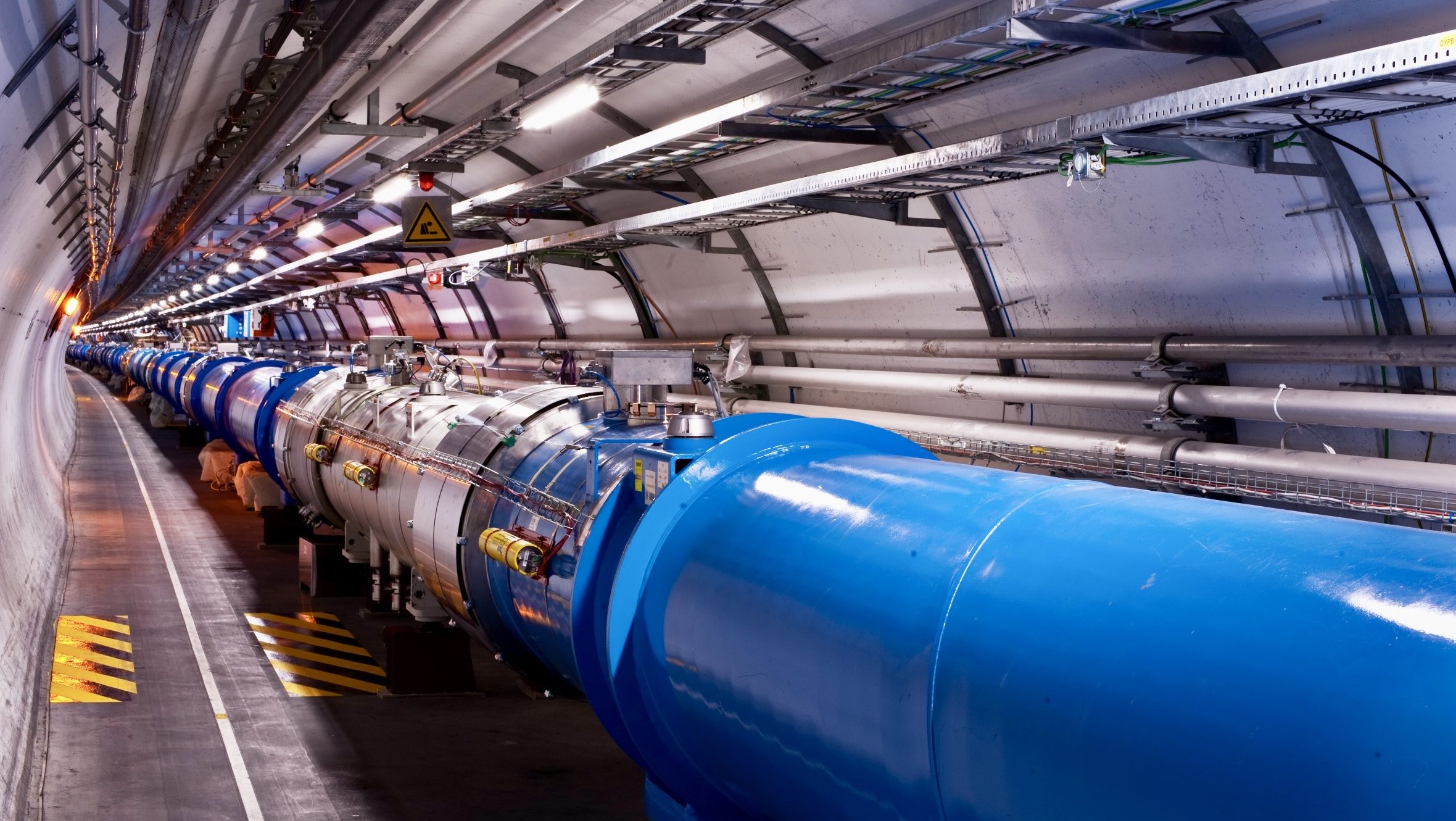
Scientists at CERN have reported a series of recent breakthroughs from the Large Hadron Collider (LHC), including the discovery of a new subatomic particle and significant progress in the ongoing search for dark matter.
One of the most notable recent findings comes from the LHCb experiment, where researchers identified a previously unobserved particle known as the Ξcc⁺ (Xi-cc-plus). This particle is considered a heavy cousin of the proton and is composed of two charm quarks and one down quark. Its structure differs from ordinary protons, which contain lighter quarks, making it substantially heavier and extremely short-lived.
The particle was detected through its decay products following high-energy collisions inside the LHC. Its existence had been predicted for decades, and confirming it helps resolve a long-standing question in particle physics about how quarks combine to form matter.
Researchers say this discovery provides new insight into the strong nuclear force, one of the fundamental forces of nature responsible for binding quarks together inside protons and neutrons. Observations of this particle allow scientists to test and refine models of how matter is held together at the smallest scales.
Dark Matter Search: No Direct Detection, But Major Progress
Alongside new particle discoveries, CERN experiments continue to focus on identifying dark matter, which is believed to account for the majority of matter in the universe but has never been directly observed.
At the LHC, scientists are searching for dark matter by analysing collisions where energy appears to be missing. This missing energy could indicate that invisible particles were produced and escaped detection.
Recent results from the ATLAS experiment have placed new limits on theoretical particles, including supersymmetric candidates such as neutralinos, which remain one of the leading dark matter possibilities.
These results do not confirm dark matter, but they significantly narrow the range of where and how such particles could exist. Scientists emphasize that ruling out possibilities is a critical step toward eventual discovery.
In parallel, CERN-supported experiments are also exploring alternative dark matter candidates, including axions, hypothetical particles that could explain both dark matter and unresolved issues in fundamental physics.
New Insights Into Matter Formation
Recent work from CERN’s ALICE experiment has also improved understanding of how matter forms under extreme conditions. Scientists found that certain fragile atomic nuclei are not formed during the hottest phase of collisions, but instead emerge later as conditions cool.
This finding helps explain how matter behaved in the early universe and may provide indirect clues about cosmic processes linked to dark matter and high-energy particle formation.
Expanding Capabilities of the Large Hadron Collider
The recent discoveries are partly attributed to upgrades to the LHC and its detectors, particularly the LHCb experiment. These improvements allow scientists to capture more precise data and detect rare particle interactions that were previously beyond reach.
CERN has also confirmed progress toward future upgrades, including the High-Luminosity LHC, which is expected to produce significantly larger datasets and increase the chances of detecting rare phenomena.
Broader Significance
The latest results highlight both progress and remaining challenges in modern physics. While no direct detection of dark matter has yet been confirmed, the discovery of new particles and increasingly precise measurements are helping to refine the boundaries of known physics.
Scientists note that each discovery contributes to a larger effort to understand the fundamental structure of the universe, including why matter exists, how forces operate at the smallest scales, and what unseen components may still remain undiscovered.
About the Author Brad Socha is the founder of The Universal Record, focused on sourced, factual global reporting. Coverage includes international news, geopolitics, technology, and major developments.