March 20, 2003 — “Shock and Awe” Air Campaign Begins Over Baghdad
THE UNIVERSAL RECORD
Sourced reporting. No opinions.
A defining moment in modern warfare as the United States launched a massive aerial assault to rapidly dismantle Iraq’s military and leadership structure
On March 20, 2003, the United States, supported by coalition forces, initiated the opening phase of the Iraq War with a large-scale military operation targeting the regime of Iraqi President Saddam Hussein. This marked the beginning of one of the most significant conflicts of the early 21st century, rooted in escalating tensions following the September 11, 2001 attacks and ongoing disputes over Iraq’s alleged weapons programs.
The initial military action began with targeted strikes aimed at Iraqi leadership, often referred to as a “decapitation strike.” These early attacks were designed to eliminate key command figures and disrupt Iraq’s ability to coordinate a response. Ground forces simultaneously began advancing into Iraq from Kuwait, signalling the start of a full-scale invasion.
Within hours and into the following day, the operation expanded into what became widely known as the “Shock and Awe” campaign. This strategy, based on the military doctrine of rapid dominance, sought to overwhelm Iraqi forces through an intense and highly coordinated display of military power. The goal was to break the enemy’s will to fight by demonstrating overwhelming force, speed, and technological superiority.
Baghdad became the central focus of the aerial bombardment. Coalition forces launched a sustained series of precision-guided strikes targeting government buildings, military installations, communication networks, and infrastructure considered vital to the Iraqi regime. Advanced weaponry, including cruise missiles and precision-guided munitions, played a key role in the campaign, reflecting a shift toward modern, technology-driven warfare.
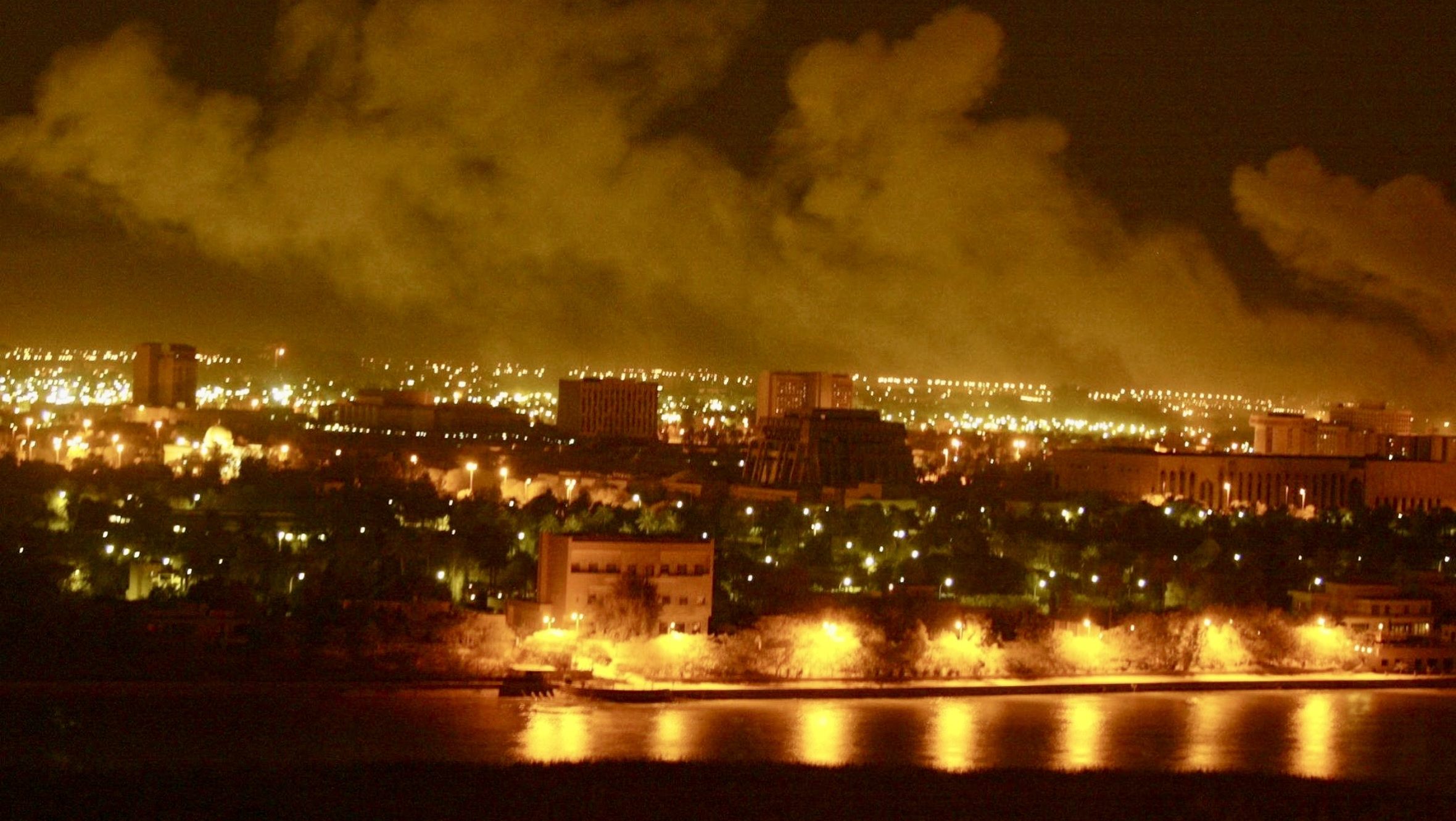
The scale and visibility of the bombardment were unprecedented at the time. Night skies over Baghdad were illuminated by explosions and anti-aircraft fire, images that were broadcast globally and became symbolic of the campaign. The operation demonstrated a new approach to warfare, combining psychological impact with precision targeting.
Despite the intensity of the assault, the campaign was only one part of a broader military strategy. Coalition ground forces advanced rapidly toward Baghdad, encountering varying levels of resistance. Within weeks, the Iraqi government’s control collapsed, and Baghdad fell in April 2003, leading to the end of Saddam Hussein’s rule.
The justification for the invasion centred on concerns that Iraq possessed weapons of mass destruction and posed a threat to international security. However, no stockpiles of such weapons were found following the invasion, leading to widespread debate and criticism of the intelligence and decision-making behind the war.
The conflict had far-reaching consequences. The removal of the Iraqi government created a power vacuum that contributed to prolonged instability, sectarian violence, and the emergence of insurgent groups. The war reshaped regional dynamics in the Middle East and had lasting effects on global geopolitics, military strategy, and international relations.
Civilian impacts were significant, with infrastructure damage, displacement, and long-term humanitarian challenges affecting millions of Iraqis. The war also influenced global discussions on the use of military force, intervention policies, and the balance between security and sovereignty.
The events of March 20, 2003, remain a pivotal moment in modern history. The “Shock and Awe” campaign not only demonstrated the capabilities of modern military technology but also highlighted the complex and often unpredictable consequences of large-scale conflict.
About the Author Brad Socha is the founder of The Universal Record, an independent platform dedicated to sourced, factual reporting on global events. The publication focuses on delivering verified information without opinion or editorial bias. Based in Canada, the publication covers international news, geopolitics, technology, and global developments.



Leave a Reply