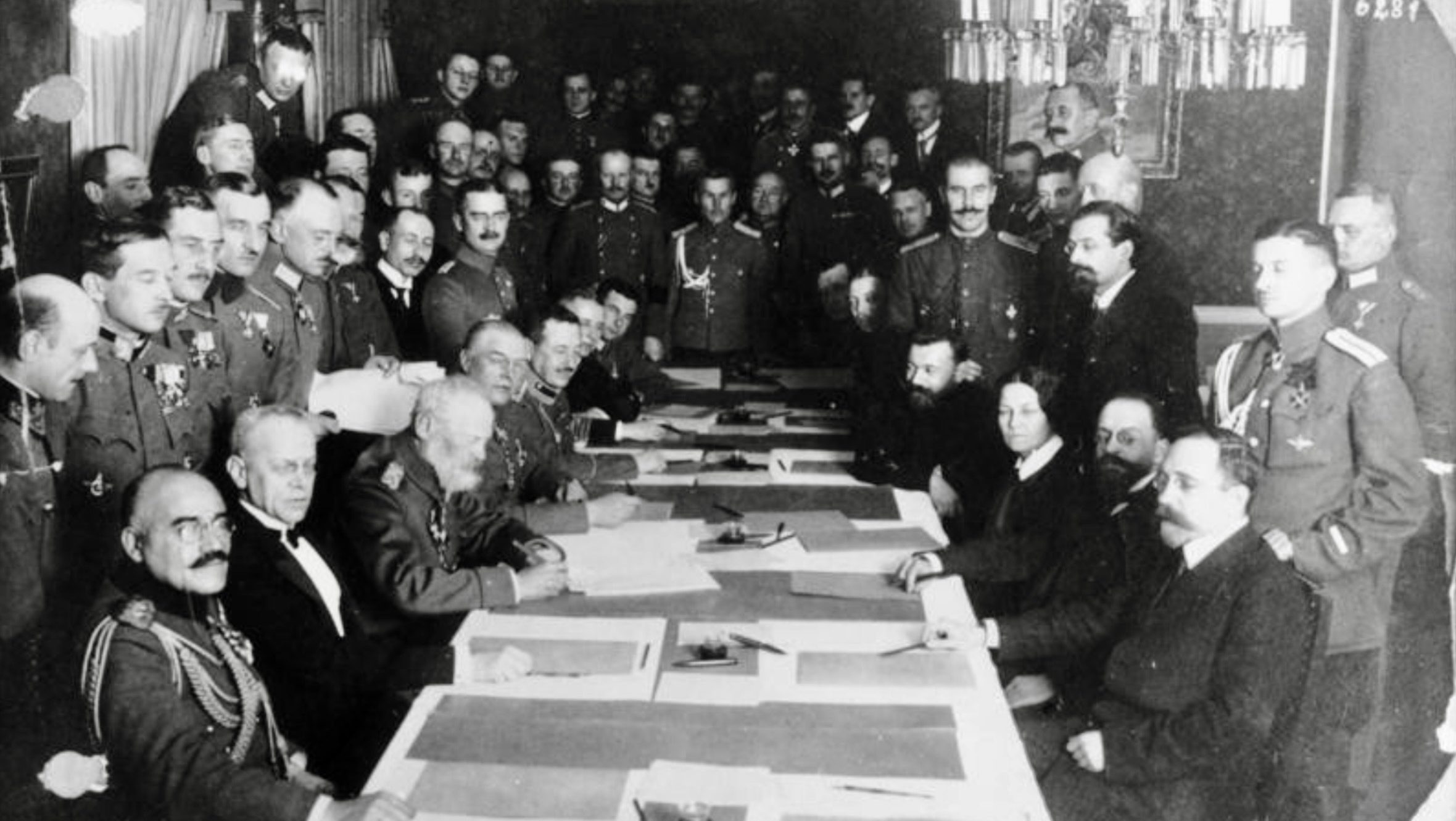
On March 3, 1918, Soviet Russia signed the Treaty of Brest-Litovsk with the Central Powers, formally withdrawing from World War I.
The treaty was signed in the city of Brest-Litovsk (now Brest, Belarus) between representatives of the Bolshevik government and the German Empire, Austria-Hungary, the Ottoman Empire, and Bulgaria. The agreement marked a decisive geopolitical shift during the final year of the war.
Background
Following the Russian Revolution in November 1917, the Bolsheviks, led by Vladimir Lenin, prioritized ending Russia’s participation in the war. The country faced internal instability, economic collapse, and military exhaustion.
Negotiations began in December 1917. The Central Powers, particularly Germany, sought to secure territorial concessions and free up troops from the Eastern Front for redeployment to the Western Front.
Terms of the Treaty
Under the treaty, Russia ceded vast territories, including:
• Finland
• Estonia
• Latvia
• Lithuania
• Parts of Poland
• Ukraine
• Portions of Belarus
The agreement resulted in the loss of approximately one-third of Russia’s population, agricultural land, and industrial capacity at the time.
The treaty effectively removed Russia from the war but imposed significant territorial and economic concessions.
Military and Strategic Impact
The treaty allowed Germany to shift substantial military forces from the Eastern Front to the Western Front in early 1918. This redeployment contributed to Germany’s Spring Offensive later that year.
However, the Central Powers’ advantage proved temporary. By November 1918, Germany signed the Armistice ending hostilities on the Western Front.
The Treaty of Brest-Litovsk was annulled later in 1918 following Germany’s defeat.
Historical Significance
The treaty reshaped Eastern Europe and accelerated political transformations across the region. It marked:
• The formal end of Imperial Russia’s role in World War I
• The consolidation of Bolshevik control
• The beginning of new national movements in Eastern Europe
• A temporary expansion of German influence
The treaty remains one of the most consequential diplomatic agreements of World War I, reflecting how revolutionary political change can directly alter global conflict dynamics.
About the Author Brad Socha is the founder of The Universal Record, focused on sourced, factual global reporting. Coverage includes international news, geopolitics, technology, and major developments.