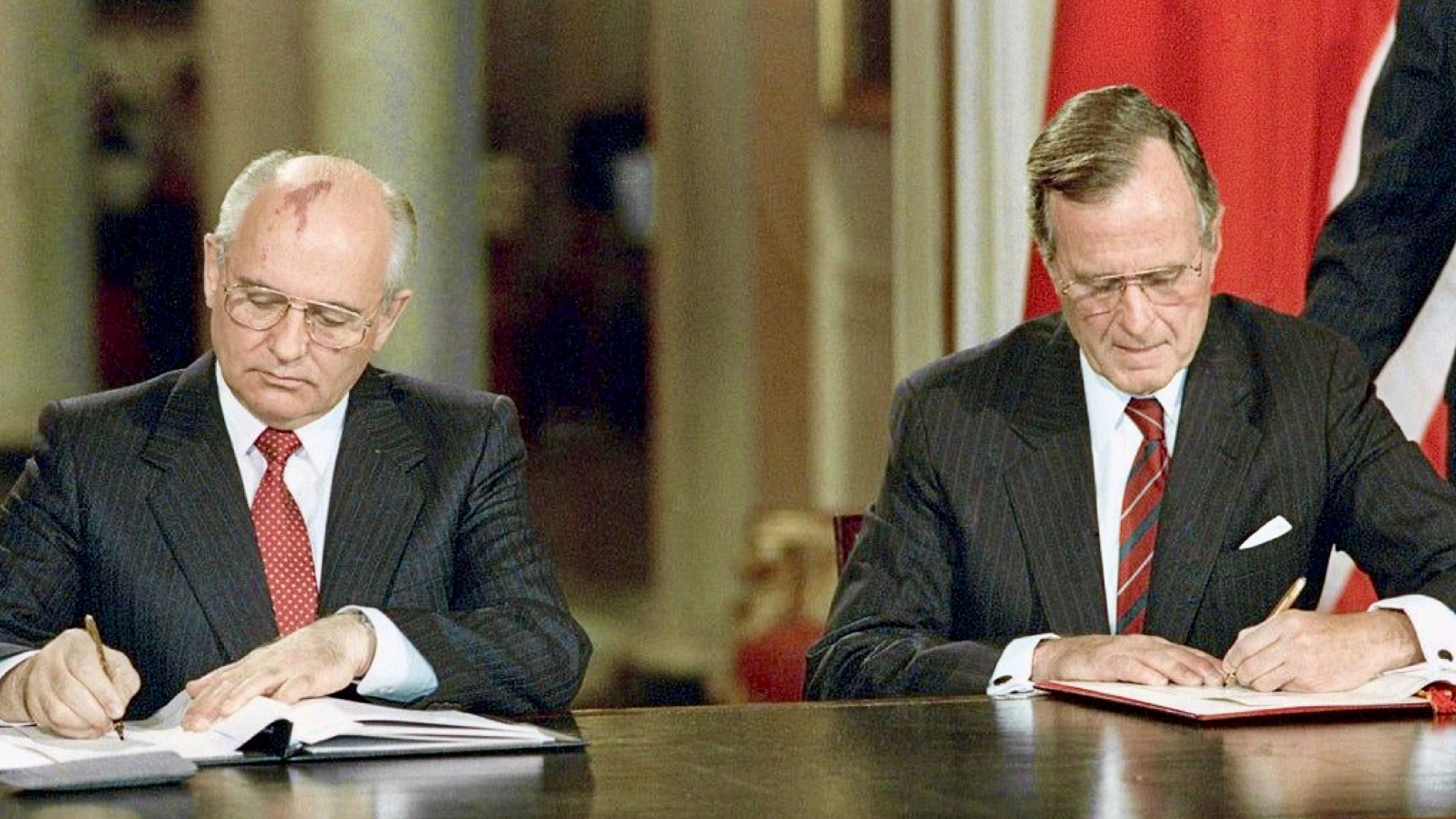
The landmark treaty between the United States and the Soviet Union began the largest verified reduction of strategic nuclear weapons in history, reshaping global security after the Cold War
On July 31, 1991, the United States and the Soviet Union signed the Strategic Arms Reduction Treaty (START I), a landmark agreement that fundamentally changed the direction of global nuclear policy. Coming after decades of escalating tensions and an unprecedented nuclear arms race, the treaty established deep reductions in strategic nuclear weapons while introducing one of the most comprehensive verification systems ever negotiated.
More than three decades later, START I remains a defining moment in international diplomacy. Its verification methods continue to influence modern arms-control agreements, while the principles behind the treaty remain central to discussions about nuclear stability in an increasingly uncertain geopolitical landscape.
From Competition to Cooperation
The Cold War had driven both superpowers to build enormous nuclear arsenals.
By the late 1980s, the United States and the Soviet Union collectively possessed tens of thousands of nuclear warheads capable of destroying civilization many times over. Strategic bombers, intercontinental ballistic missiles (ICBMs), and submarine-launched ballistic missiles formed the backbone of each nation’s nuclear deterrent.
Although earlier agreements such as the Strategic Arms Limitation Talks (SALT I and SALT II) placed limits on certain weapons systems, they did little to reduce the overall number of deployed strategic nuclear arms.
Negotiations for a more ambitious treaty began in 1982 under U.S. President Ronald Reagan. Reagan argued that genuine security required reducing, not merely limiting, the world’s most destructive weapons. His proposal marked a significant shift in American nuclear policy.
Years of negotiations followed as political leadership changed on both sides. President George H. W. Bush continued the talks after taking office in 1989, while Soviet President Mikhail Gorbachev pursued reforms that encouraged greater cooperation with the West.
A Historic Signing
On July 31, 1991, President Bush and President Gorbachev met in Moscow to sign START I.
The agreement required each country to reduce its deployed strategic nuclear delivery systems to no more than 1,600 and limit accountable strategic nuclear warheads to 6,000.
The treaty covered three primary categories of strategic delivery systems:
Intercontinental ballistic missiles (ICBMs)
Submarine-launched ballistic missiles (SLBMs)
Heavy bombers capable of carrying nuclear weapons
Rather than relying on trust alone, START I introduced an unprecedented inspection and verification regime that allowed both countries to monitor compliance directly.
Verification Changed Everything
One of START I’s greatest achievements was its verification system.
The treaty required extensive data exchanges detailing the size and location of nuclear forces. Both countries agreed to regular on-site inspections, continuous monitoring at designated facilities, notifications whenever missiles or bombers moved, and the use of national technical means such as reconnaissance satellites.
These measures dramatically increased transparency between two nations that had spent decades viewing each other with deep suspicion.
Verification became just as important as the reductions themselves. Military planners no longer had to rely solely on intelligence estimates when evaluating the other’s strategic capabilities.
The framework established by START I became the foundation for later arms-control agreements and remains one of the most influential verification systems ever developed.
The Soviet Union Collapses
Only months after START I was signed, history took another dramatic turn.
In December 1991, the Soviet Union dissolved into fifteen independent republics.
Suddenly, thousands of strategic nuclear weapons were located not only in Russia but also in Ukraine, Belarus, and Kazakhstan.
This unexpected geopolitical transformation required significant diplomatic effort to preserve the treaty’s objectives.
The Lisbon Protocol, signed in 1992, committed the newly independent states to join the Nuclear Non-Proliferation Treaty as non-nuclear weapons states and transfer strategic nuclear weapons to Russia for dismantlement or control.
The process became one of the largest and most successful examples of nuclear disarmament in modern history.
A Lasting Reduction
START I officially entered into force on December 5, 1994.
Implementation required years of dismantling missiles, eliminating launchers, retiring bombers, and destroying associated infrastructure.
By the treaty’s implementation deadline in December 2001, both nations had met their required reductions.
Thousands of strategic nuclear warheads had been removed from deployment, while hundreds of missiles, bombers, and launch facilities had been eliminated under international verification.
Although both countries retained powerful nuclear deterrents, the treaty significantly reduced the likelihood of accidental escalation during a period of major political change.
Legacy in Today’s World
START I expired in December 2009 after successfully meeting its objectives, but its influence continued through subsequent agreements.
The 2002 Strategic Offensive Reductions Treaty (SORT), followed by the 2010 New START Treaty, both built upon many of the verification concepts pioneered under START I.
Today, however, the future of nuclear arms control faces new uncertainty.
Growing tensions between nuclear powers, modernization of strategic arsenals, emerging missile technologies, and the expiration or suspension of several Cold War-era agreements have renewed concerns about strategic stability.
Many diplomats and security experts continue to point to START I as an example of what sustained negotiation and verification can achieve, even between geopolitical rivals.
A Turning Point in Nuclear History
The signing of START I represented far more than a treaty between two governments.
It demonstrated that decades of confrontation could give way to cooperation when political leaders were willing to pursue diplomacy supported by rigorous verification.
While nuclear weapons remain a defining feature of international security, START I showed that meaningful reductions were possible without abandoning national defense.
More than thirty-five years later, the treaty remains one of the most significant achievements in the history of nuclear arms control, a reminder that dialogue, transparency, and verification can reduce some of the world’s greatest security risks.
About the Author Brad Socha is the founder of The Universal Record, focused on sourced, factual global reporting. Coverage includes international news, geopolitics, technology, and major developments.