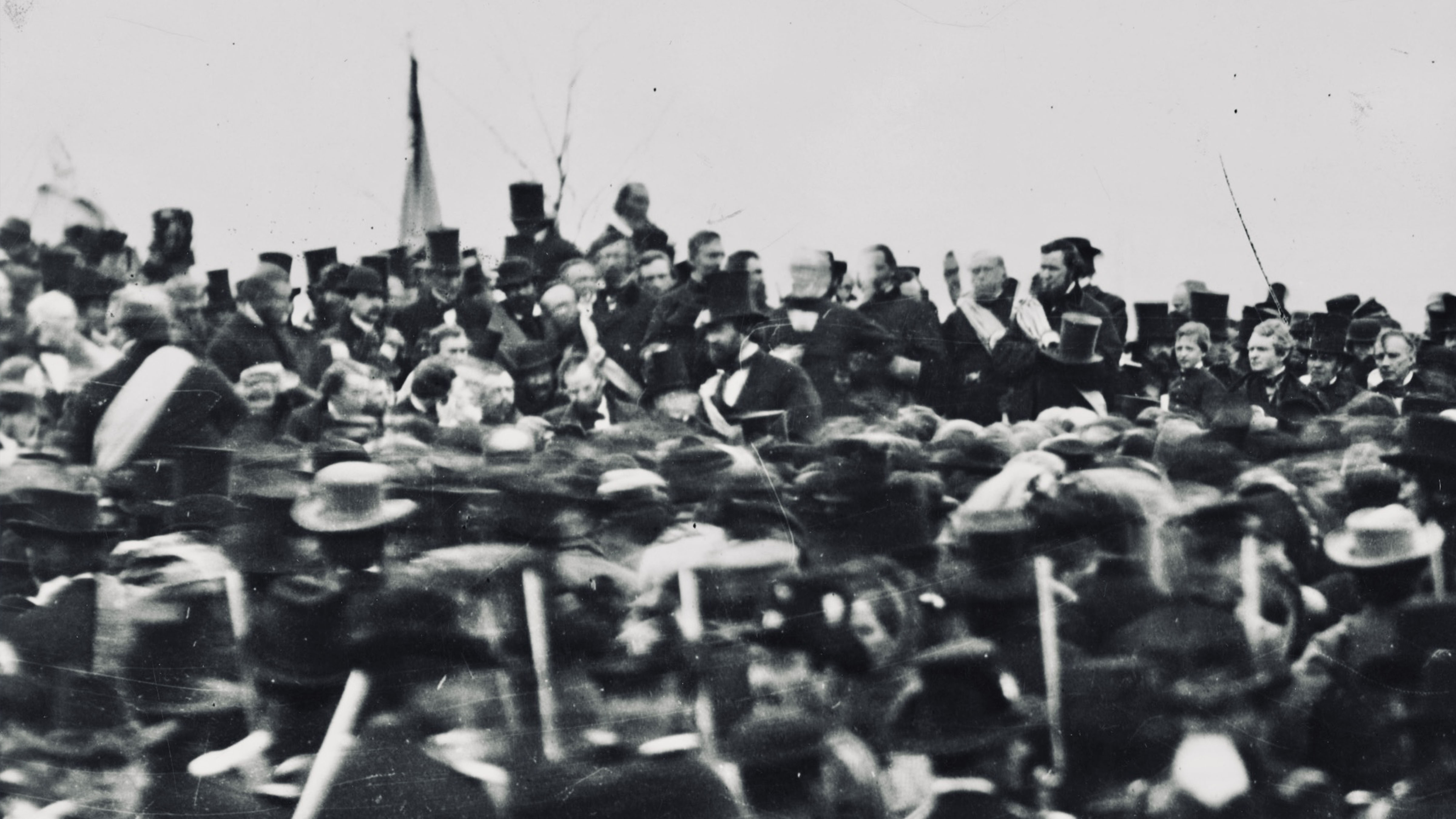
In a nation divided by civil war, Abraham Lincoln delivered a speech lasting just two minutes that would redefine the meaning of the American struggle and leave a lasting mark on democracy.
Feature Image: Historic photograph of the Gettysburg cemetery dedication on November 19, 1863.
On November 19, 1863, President Abraham Lincoln delivered the Gettysburg Address at the dedication of the Soldiers’ National Cemetery in Gettysburg, Pennsylvania. Speaking just months after one of the bloodiest battles of the American Civil War, Lincoln used a remarkably brief speech to connect the preservation of the United States with the founding principles of liberty and equality.
The address lasted approximately two minutes, yet its significance extended far beyond the ceremony. Rather than simply honouring the soldiers who had died, Lincoln presented the Civil War as a test of whether a nation founded on democratic principles could survive.
His words would eventually become among the most widely recognized statements of American national purpose.
A Nation Divided by Civil War
By November 1863, the United States had been at war for more than two years.
The conflict began in April 1861, following the secession of Southern states seeking to preserve slavery and resist the election of Lincoln, who opposed its expansion into new territories.
The Union fought to preserve the United States, while the Confederacy sought independence. Slavery was central to the causes of secession and the conflict that followed.
From July 1 to July 3, 1863, Union and Confederate armies fought at Gettysburg, Pennsylvania, in a major confrontation involving tens of thousands of soldiers.
Union forces under Major General George G. Meade defeated the Confederate Army of Northern Virginia, commanded by General Robert E. Lee.
The battle resulted in approximately 51,000 casualties, including soldiers killed, wounded, captured or missing. It became one of the war’s most consequential engagements.
The scale of the losses created an urgent need for a suitable burial ground for Union soldiers.
Gettysburg attorney David Wills helped organize the establishment of a national cemetery, and a dedication ceremony was scheduled for November 19.
The principal speaker was Edward Everett, a former United States senator, governor of Massachusetts and president of Harvard University. Everett was widely recognized as one of the country’s leading public speakers.
Lincoln was invited to deliver a few appropriate remarks as part of the ceremony.
Thousands gathered at Gettysburg, where the consequences of the battle remained visible.
Everett spoke for approximately two hours, delivering a detailed account of the conflict and its historical significance.
When Lincoln rose to speak, his address was dramatically shorter.
Rather than recounting military movements or battlefield tactics, the president turned to the fundamental question of what the nation represented.
The Gettysburg Address and Its Meaning
Lincoln began by looking back 87 years to 1776, when the Declaration of Independence established the principles upon which the United States had been founded.
His opening invoked the creation of a nation dedicated to liberty and the proposition that all people were created equal.
The reference was significant.
The Constitution had established the structure of the federal government, but Lincoln chose the Declaration of Independence as the foundation of his argument.
He presented the Civil War not merely as a struggle to preserve territory or political institutions, but as a test of whether a nation committed to equality and representative government could endure.
Lincoln also emphasized that the soldiers who had fought at Gettysburg had already given the battlefield its lasting significance through their sacrifice.
The responsibility of the living, he argued, was to continue the unfinished work for which those soldiers had died.
His call for a renewed commitment to freedom came during a period of profound political and social change.
Earlier that year, on January 1, 1863, Lincoln’s Emancipation Proclamation had declared enslaved people in areas under Confederate rebellion to be free.
Although the proclamation did not immediately abolish slavery throughout the United States, it marked a major transformation in the Union’s war policy.
At Gettysburg, Lincoln connected the sacrifices of the war with the possibility of a country more fully committed to its founding ideals.
He concluded with a statement about representative government that would become one of the most frequently cited passages in American political history.
The speech was not intended as a detailed plan for rebuilding the nation. It was a concise declaration of purpose at a moment when the outcome of the Civil War remained uncertain.
Contemporary reactions were mixed, reflecting both political divisions and differing expectations about presidential speeches.
Everett, however, recognized the effectiveness of Lincoln’s remarks. The following day, he wrote to the president expressing admiration for the simplicity and substance of the address.
The speech gradually acquired a central place in American public memory.
Lincoln did not live to see the full development of its legacy. He was assassinated in April 1865, shortly after the Confederate military collapse brought the Civil War toward its end.
The abolition of slavery was formally established through the ratification of the Thirteenth Amendment in December 1865.
The struggle over equality and citizenship continued through Reconstruction and subsequent generations, demonstrating the distance between the principles Lincoln invoked and their full realization.
The Gettysburg Address has since become a foundational text in American civic education and public remembrance.
Five handwritten versions of the address survive, each containing small differences in wording and punctuation. Historians continue to examine these manuscripts to understand how Lincoln prepared and refined his remarks.
The version commonly reproduced today is the Bliss copy, written by Lincoln in 1864.
The speech is also inscribed inside the Lincoln Memorial in Washington, D.C., where it remains a prominent expression of the ideals associated with his presidency.
More than 160 years after its delivery, the Gettysburg Address continues to be studied for its interpretation of democratic government, national unity and the relationship between liberty and equality.
Delivered during a ceremony intended to honour the dead, Lincoln’s brief remarks became an enduring statement about the responsibilities of the living and the principles upon which the United States was founded.
About the Author Brad Socha is the founder of The Universal Record, focused on sourced, factual global reporting. Coverage includes international news, geopolitics, technology, and major developments.