Antarctica’s buried lakes contain microorganisms surviving without sunlight. Scientists are investigating whether similar environments beneath distant icy moons could also support life.
Beneath kilometres of Antarctic ice, microorganisms survive in environments isolated from sunlight and exposed to extreme cold. Their existence has helped scientists reconsider where alien life might be found, including beneath the frozen surfaces of moons orbiting Jupiter and Saturn.
Europa, Enceladus and Ganymede are among the most compelling places to investigate. Evidence indicates that these icy worlds contain vast reservoirs of liquid water beneath their surfaces, raising the possibility that some may possess conditions suitable for life.
No extraterrestrial organism has been discovered. However, research on Earth’s hidden aquatic environments offers important clues about how life might survive far from the warmth and light of the Sun.
What Antarctica Reveals About Life Without Sunlight
Antarctica contains hundreds of lakes beneath its ice sheet, some separated from the atmosphere and surface ecosystems for exceptionally long periods.
One of the most significant discoveries came from Lake Whillans in West Antarctica. In research published in Nature in 2014, scientists reported an active microbial ecosystem in water and sediments collected from beneath approximately 800 metres of ice.
The microorganisms did not depend on sunlight for their primary energy supply. Instead, the community included organisms capable of obtaining energy through chemical reactions involving substances such as ammonium, iron and sulphur.
This process, known as chemosynthesis, allows certain microorganisms to support biological activity using chemical energy rather than photosynthesis.
Similar principles operate in Earth’s deep oceans, where microbial communities can thrive around hydrothermal vents and other chemically active environments.
These discoveries demonstrate that sunlight is not an absolute requirement for life.
They do not, however, establish that organisms could survive under every icy world’s conditions. Water chemistry, temperature, pressure, available nutrients and long-term energy supplies all influence whether an environment can support biology.
Antarctic ecosystems also developed on a planet already inhabited by life. Their existence does not explain whether life could originate independently on another world.
That distinction is central to the search for extraterrestrial organisms.
Alien Life in the Oceans of Distant Moons
Europa, one of Jupiter’s largest moons, has an icy exterior covering what scientists believe is a global saltwater ocean.
Evidence from spacecraft observations and models of its interior suggests that the ocean may interact with a rocky seafloor. Such contact could potentially supply chemical ingredients and energy sources relevant to life.
Europa’s interior is warmed partly by tidal forces generated through its gravitational interactions with Jupiter and neighbouring moons.
NASA’s Europa Clipper spacecraft, launched in October 2024, is designed to investigate whether Europa has environments capable of supporting life.
The mission is scheduled to reach Jupiter in 2030 and conduct dozens of close flybys of Europa, studying its ice shell, ocean-related characteristics, surface composition and geology.
Europa Clipper is not designed to detect living organisms directly. Its purpose is to assess habitability and provide information that could guide future exploration.
Saturn’s moon Enceladus offers another particularly interesting opportunity.
NASA’s Cassini spacecraft discovered plumes of water vapour and ice particles erupting from fractures near the moon’s south pole. The material originates from a subsurface ocean and escapes into space.
Cassini measurements identified organic compounds, salts and molecular hydrogen associated with the plumes. Researchers have also reported phosphorus-containing compounds in ice grains originating from Enceladus’s ocean.
These findings indicate that the moon possesses several ingredients considered important for life as we know it.
Molecular hydrogen is especially relevant because certain microorganisms on Earth use it as an energy source.
Nevertheless, organic molecules and potentially usable chemical energy are not evidence that life exists. Nonbiological processes can also produce many of these substances.
Ganymede, Jupiter’s largest moon, is another candidate for subsurface water. Magnetic-field measurements and observations of auroral activity support the existence of a buried saltwater ocean.
The European Space Agency’s Jupiter Icy Moons Explorer, known as JUICE, launched in April 2023. It is scheduled to arrive at Jupiter in 2031 and eventually enter orbit around Ganymede.
JUICE will investigate Ganymede’s ocean, magnetic environment, surface and internal structure while also studying Europa and Callisto.
Together, these missions are expanding scientific understanding of environments that may contain liquid water despite receiving relatively little solar energy.
How Scientists Could Search Beneath the Ice
Finding convincing evidence of extraterrestrial life will require more than demonstrating the presence of water and organic chemistry.
Researchers must determine whether an environment has sufficient energy, appropriate chemical conditions and a history compatible with biological activity.
Future spacecraft could search for complex organic patterns, chemical imbalances, microscopic structures or other potential biosignatures. Each finding would require careful examination to rule out nonbiological explanations.
Enceladus offers a possible advantage because its plumes carry ocean material into space. A suitably equipped spacecraft could collect and analyse samples without drilling through the moon’s ice.
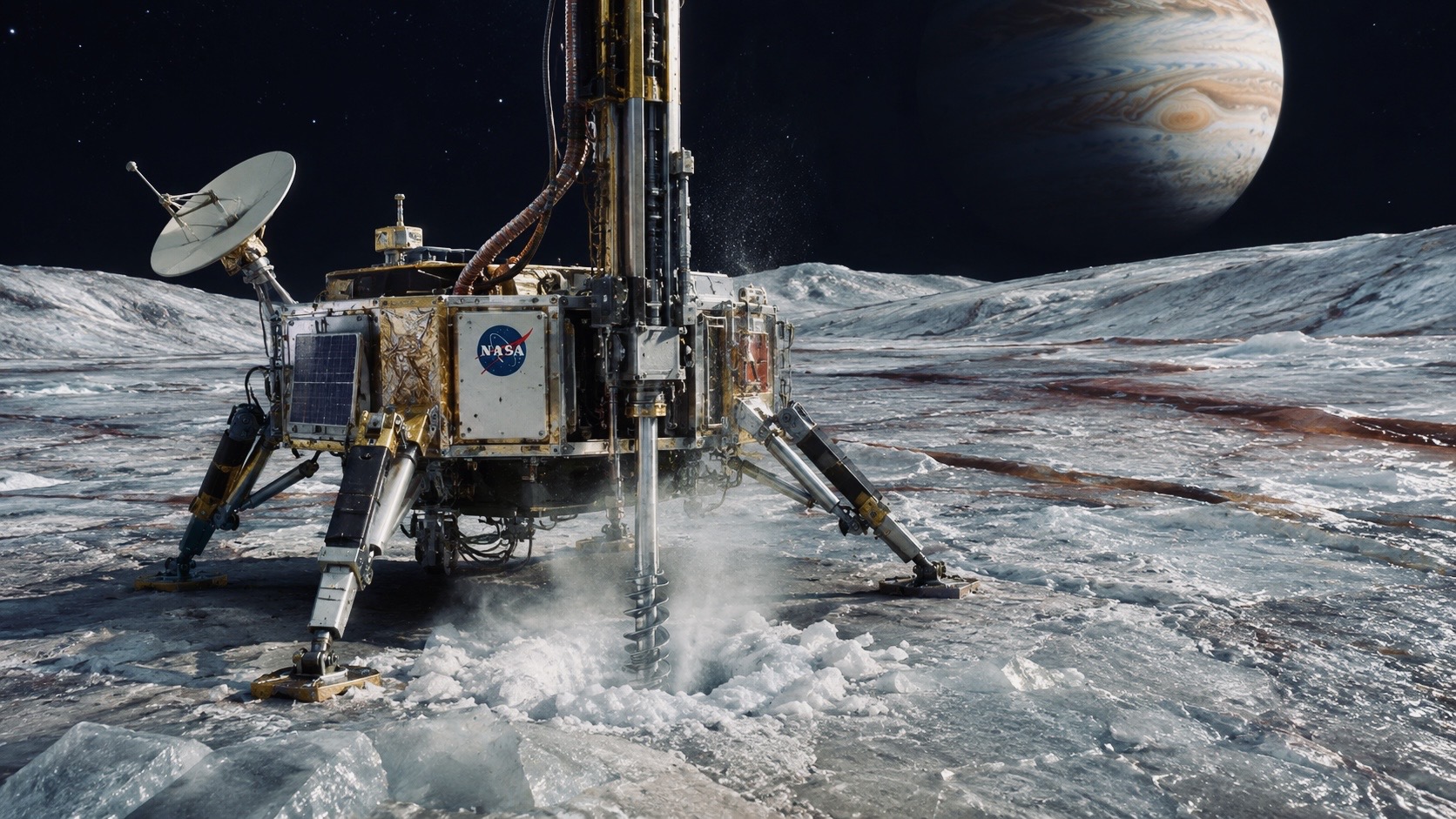
For Europa, scientists have studied concepts involving robotic landers capable of examining surface materials for signs of biology.
More ambitious proposals include cryobots: robotic probes designed to melt or otherwise travel through thick ice toward an underlying ocean. Underwater vehicles could eventually investigate the liquid environment directly.
These concepts face substantial engineering obstacles. A probe would need to survive intense cold, communicate through thick ice, operate reliably far from Earth and avoid contaminating a potentially habitable environment with terrestrial microorganisms.
Radiation around Jupiter presents additional challenges for spacecraft operating near Europa.
Although several exploration concepts are under study, no mission has yet been approved to drill through Europa’s ice and explore its ocean directly.
The next major steps are therefore focused on understanding habitability, identifying promising sampling locations and developing instruments capable of distinguishing biological evidence from ordinary chemistry.
Antarctica has established that life can remain active in dark, isolated aquatic environments on Earth. The icy moons of the outer Solar System may contain some of the necessary ingredients for similar ecosystems.
Whether those environments actually harbour organisms remains unanswered.
The most significant discovery may not be an immediately recognizable creature, but a carefully verified chemical or microscopic signature showing that biology has developed somewhere beyond Earth.
About the Author Brad Socha is the founder of The Universal Record, focused on sourced, factual global reporting. Coverage includes international news, geopolitics, technology, and major developments.