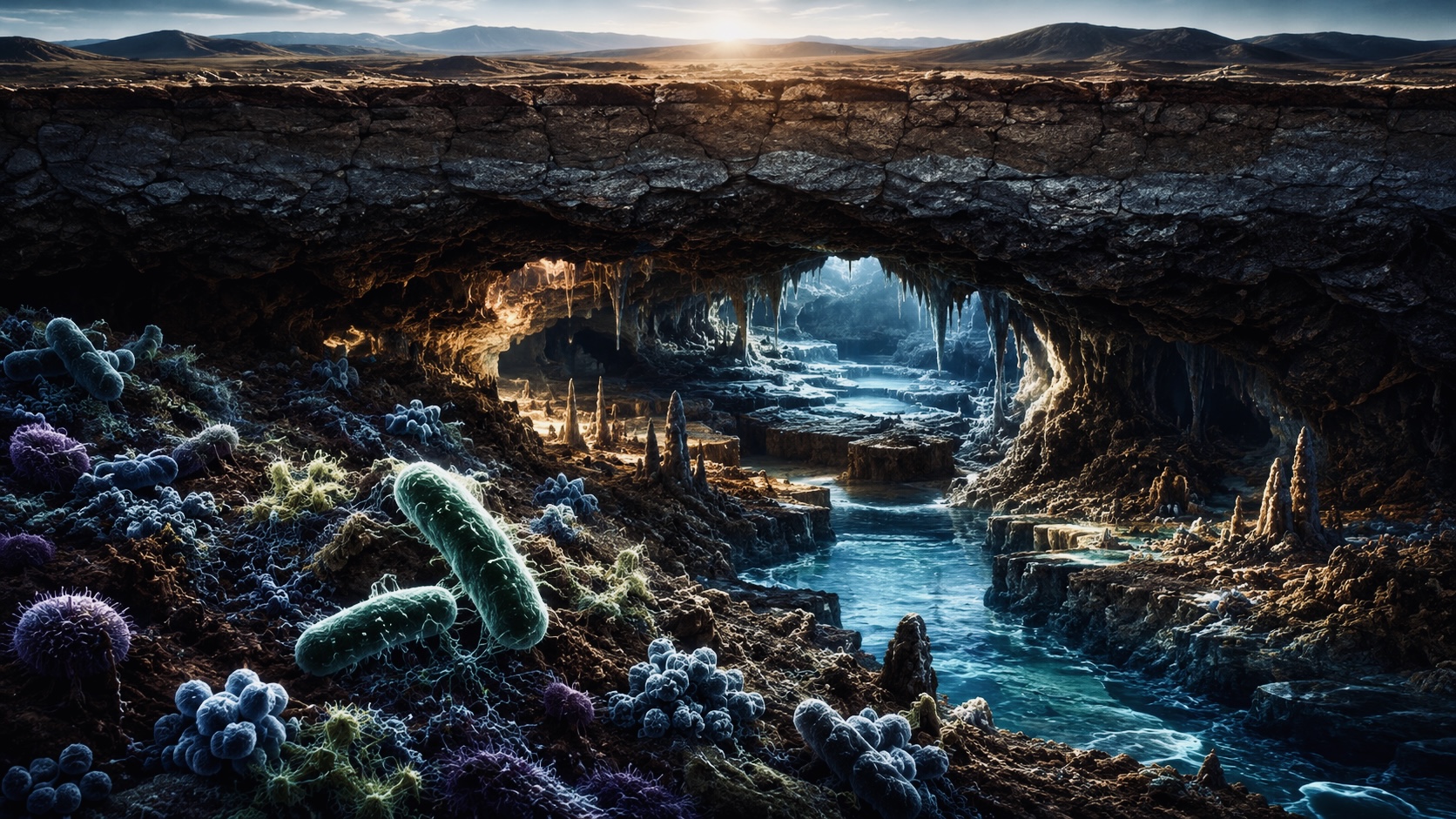
Massive underground ecosystems thriving without sunlight are reshaping scientific understanding of life on Earth, and raising new questions about life beyond our planet
Far beneath Earth’s surface, hidden beneath continents, oceans, mines, and deep rock formations, scientists say an enormous underground biosphere may contain some of the planet’s oldest and most resilient forms of life. Recent studies and deep-drilling research projects are continuing to reveal microbial ecosystems living kilometres underground in complete darkness, surviving without sunlight, oxygen, or traditional food chains once believed necessary for life.
The findings are drawing renewed global scientific attention because they challenge long-standing assumptions about where life can exist and how it can survive. Researchers studying these underground organisms say the discoveries may help explain how life first emerged on Earth billions of years ago and could also influence future missions searching for microbial life on Mars, Europa, and other planetary bodies.
Scientists involved in international deep biosphere projects estimate that underground microbial ecosystems may contain billions of tonnes of carbon-based life spread through fractures in rock, subterranean water systems, and deep ocean crust. Some microbes appear capable of surviving entirely on chemical reactions generated by radioactive decay, hydrogen production, or mineral interactions within Earth’s crust.
The hidden biosphere exists in conditions previously considered almost uninhabitable. Temperatures can exceed 100 degrees Celsius in some regions, while pressure levels deep underground are immense. Yet microbial organisms have been identified living several kilometres beneath the surface in environments isolated from sunlight for millions of years.
Researchers from institutions including the Deep Carbon Observatory, Woods Hole Oceanographic Institution, and multiple international geology programs have spent years investigating these underground ecosystems through drilling projects, deep mine exploration, and subseafloor sampling missions. Their work has gradually expanded scientific understanding of Earth’s total biosphere.
Some of the most surprising discoveries involve microorganisms surviving with extraordinarily slow metabolic rates. In some cases, scientists believe certain microbes may divide only once every few hundred or even thousand years due to limited energy availability deep underground. Despite this, the organisms remain alive and biologically active.
The discoveries are also changing scientific conversations surrounding planetary habitability. Astrobiologists increasingly believe underground environments may offer one of the best chances of finding extraterrestrial microbial life elsewhere in the solar system. Unlike planetary surfaces exposed to radiation, extreme temperature swings, or atmospheric loss, subsurface environments may provide long-term protection and stable chemical energy sources.
NASA and European space researchers have repeatedly pointed to subsurface exploration as a priority for future planetary missions. Underground oceans beneath the icy crusts of Jupiter’s moon Europa and Saturn’s moon Enceladus are considered among the most promising locations for discovering microbial life beyond Earth.
The idea that life could survive without sunlight represents a major shift from earlier biological assumptions centred around photosynthesis. Instead, many underground organisms rely on chemosynthesis, a process in which microbes obtain energy from chemical reactions involving sulfur, hydrogen, iron, methane, or radioactive minerals.
Scientists say these mechanisms may resemble some of the earliest life processes on primitive Earth before oxygen-rich atmospheres and complex ecosystems developed. This has made the deep biosphere increasingly important to researchers studying the origins of life itself.
Interest in subterranean ecosystems has also expanded as scientists continue investigating Earth’s extreme environments. Similar research into hydrothermal vents and isolated Antarctic ecosystems has reinforced the idea that life may be far more adaptable than previously believed. Related scientific interest can also be seen in AI Disease Prediction Detects Illness Years Earlier, where researchers are using advanced computational systems to uncover hidden biological patterns previously impossible to detect.
Deep underground microbes may also play a larger role in Earth’s long-term climate and geological cycles than scientists once realized. Some organisms interact with methane, carbon dioxide, sulfur compounds, and underground minerals in ways that could influence carbon storage and subsurface chemistry over geological timescales.
While many questions remain unanswered, scientists say the underground biosphere may represent one of the largest unexplored ecosystems on Earth. Researchers continue debating the total size of the deep biosphere, how interconnected various underground ecosystems may be, and how long certain organisms have survived in isolation.
The research has required increasingly advanced drilling technologies capable of extracting uncontaminated samples from extreme depths. Preventing surface contamination remains one of the biggest scientific challenges because even small amounts of introduced bacteria can compromise findings.
In South Africa’s deep gold mines, scientists have discovered microbial communities living more than three kilometres underground in ancient water systems isolated for vast periods of time. Similar discoveries have been reported beneath ocean floors, Arctic permafrost, and deep continental rock formations.
Some underground microbes have demonstrated extraordinary resistance to heat, radiation, salinity, and nutrient scarcity. These findings continue influencing biotechnology, geology, environmental science, and astrobiology research programs worldwide.
The broader implications extend beyond space exploration. Scientists studying underground ecosystems believe the discoveries may eventually improve understanding of climate resilience, long-term biological survival, and the adaptability of microbial systems under extreme stress conditions.
The discoveries are also contributing to a growing scientific reevaluation of how much of Earth remains unexplored. While humanity has extensively mapped the planet’s surface and oceans, vast underground biological systems remain only partially understood.
Some researchers describe the deep biosphere as a “second world” existing largely beyond ordinary human observation. Unlike surface ecosystems driven by sunlight and seasonal cycles, these underground communities operate according to geological and chemical processes unfolding over immense timescales.
The scientific fascination surrounding hidden underground life has increasingly captured public attention because the discoveries feel almost alien while remaining entirely real. The existence of thriving ecosystems in darkness beneath Earth’s crust continues challenging assumptions about biology, habitability, and the boundaries of life itself.
As global research continues, scientists believe future drilling missions, improved genomic sequencing, and expanded planetary exploration programs may reveal even more about Earth’s hidden biosphere — and perhaps provide humanity’s best clues yet about whether life exists elsewhere in the universe.
About the Author Brad Socha is the founder of The Universal Record, focused on sourced, factual global reporting. Coverage includes international news, geopolitics, technology, and major developments.