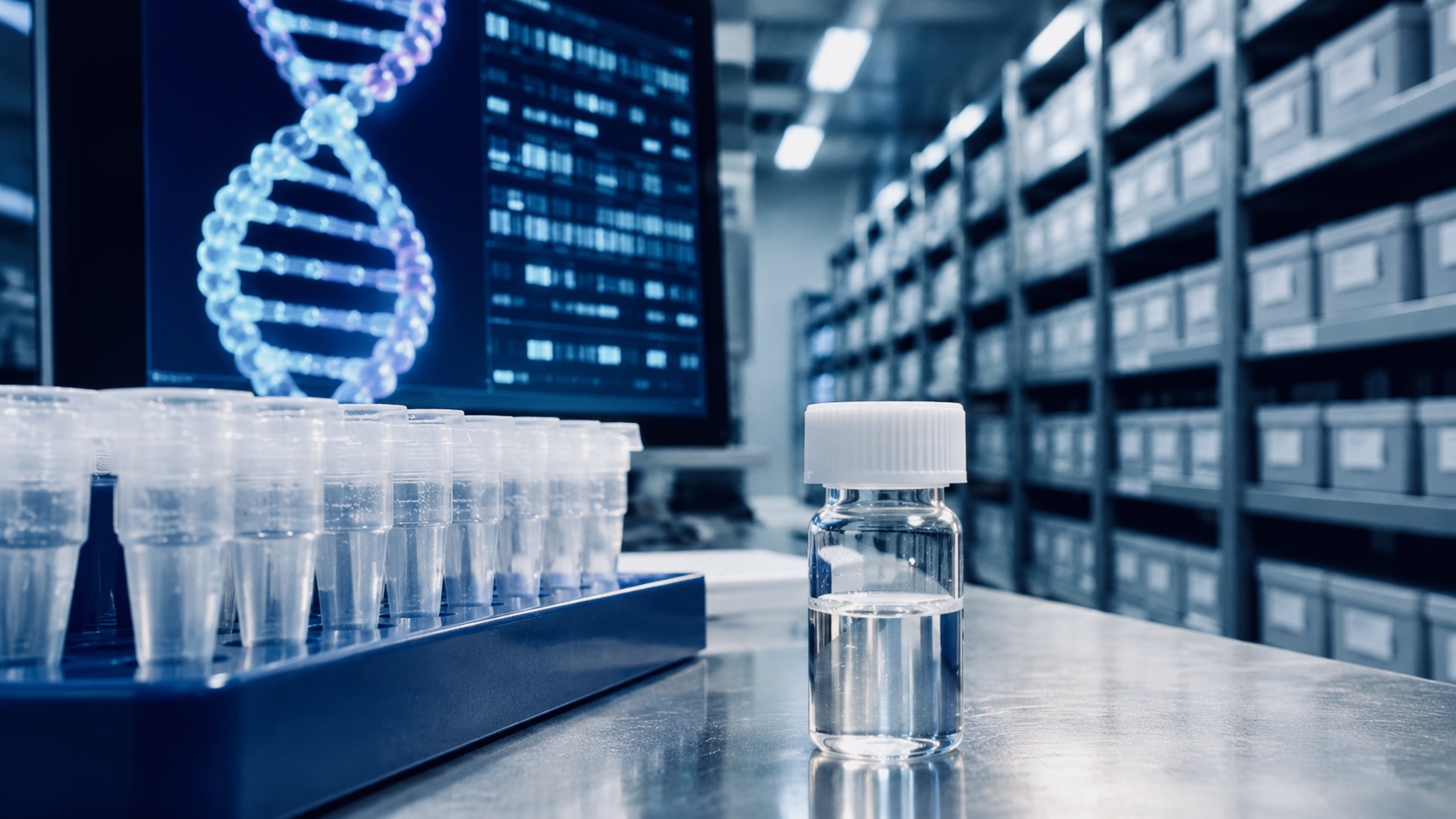
Scientists are exploring a way to preserve enormous amounts of digital information in molecules smaller than the eye can see. Could DNA become humanity’s next great archive?
Humanity produces enormous quantities of digital information, from scientific discoveries and historical records to photographs, books, and government archives. Preserving that knowledge requires storage systems that must be maintained, replaced, and protected against technological failure.
Researchers are investigating an alternative: storing digital information inside DNA, the same molecule that carries genetic instructions in living organisms.
Unlike conventional storage devices, DNA can hold extraordinary amounts of information in a remarkably small physical space. Under suitable conditions, it may also remain readable for centuries or longer.
The technology has already moved beyond theory. Scientists have successfully encoded computer files, images, and other digital records into synthetic DNA and recovered them.
However, turning those laboratory achievements into a practical system capable of preserving humanity’s accumulated knowledge presents substantial technical and economic challenges.
How DNA Could Become a Digital Archive
DNA consists of four chemical building blocks, commonly represented by the letters A, T, C, and G. Their sequence carries biological information, but researchers can also use these letters to represent computer data.
Digital files normally consist of binary information expressed as zeros and ones. Specialized software can convert that information into sequences of DNA letters.
Scientists then manufacture synthetic DNA molecules containing those sequences. To recover the information, sequencing equipment reads the DNA, and software reconstructs the original digital files.
The process does not require living organisms. Information can be stored in manufactured DNA molecules held in controlled laboratory containers.
One of the technology’s most significant advantages is its information density.
In a 2017 study published in Science, researchers Yaniv Erlich and Dina Zielinski demonstrated a DNA storage method capable of retrieving information at a density of 215 petabytes per gram of DNA.
A petabyte equals one million gigabytes. At that demonstrated density, a single gram could theoretically hold the equivalent of millions of high-capacity consumer storage devices, depending on their size.
However, this figure describes information density within the DNA itself. It does not include the equipment, containers, chemical materials, or additional redundancy required for a functioning archive.
DNA also offers potential advantages in durability.
Hard drives contain mechanical or electronic components that can fail. Magnetic tapes and optical discs deteriorate over time, while modern data centres require ongoing electricity, maintenance, and equipment replacement.
DNA has a different preservation profile. Properly protected from moisture, heat, ultraviolet radiation, and chemical damage, it can remain stable for extended periods.
Researchers have investigated preservation methods that isolate DNA from damaging environmental conditions, potentially allowing information to survive far longer than many conventional storage devices.
Yet DNA is not indestructible. Its longevity depends heavily on preparation, packaging, and storage conditions.
The ability to preserve DNA for centuries would not automatically guarantee that future generations could recover the information. They would also need appropriate sequencing technology and instructions explaining how the encoded files should be reconstructed.
Why DNA Storage Has Not Replaced Conventional Technology
Despite its potential, DNA storage remains far more complicated than saving information to a computer.
The first major obstacle is writing data.
Conventional DNA storage methods generally require synthesizing new molecules with precisely arranged chemical sequences. This process is expensive and relatively slow compared with electronic storage.
Reading the information presents another challenge.
Retrieving a digital file requires extracting or sampling the DNA, sequencing it, identifying errors, and reconstructing the original data.
DNA synthesis and sequencing can introduce mistakes, including missing, duplicated, or incorrectly identified chemical building blocks.
To protect against information loss, researchers incorporate error-correction systems and redundant sequences. These improve reliability but also increase the amount of DNA and processing required.
A 2024 study published in Nature demonstrated an alternative approach that uses chemical modifications to existing DNA rather than manufacturing entirely new sequences for every piece of information.
Researchers encoded approximately 275,000 bits using a technique inspired by epigenetics, the chemical processes that can modify how DNA functions without changing its underlying sequence.
The experiment demonstrated another possible route toward more accessible molecular storage, although its capacity remained modest compared with conventional digital archives.
Further progress followed in 2025, when researchers publishing in Nature Machine Intelligence demonstrated improved methods for reconstructing DNA-encoded information using error-correcting codes and deep learning.
Their experiments involved 3.1 megabytes of information, illustrating both the continuing technical advances and the limited scale of many research demonstrations.
A 2026 review in the Journal of Biotechnology identified synthesis costs, sequencing performance, error correction, and long-term preservation as continuing barriers to widespread adoption.
Another fundamental issue is accessibility.
Modern computers can retrieve and modify stored information almost instantly. DNA storage generally involves laboratory processes that are much slower and more difficult to automate.
Researchers must also develop efficient ways to locate individual files within enormous collections of DNA molecules without reading an entire archive.
These limitations make DNA unsuitable for most applications requiring frequent updates or immediate access.
Preserving Knowledge for Future Generations
DNA storage may ultimately find its greatest value in preserving information that rarely needs to change.
Historical documents, scientific datasets, cultural records, and important institutional archives could be candidates for molecular storage once the technology becomes sufficiently reliable and economical.
Such archives might complement existing systems rather than replace them.
Frequently accessed information could remain on conventional electronic devices, while selected records intended for very long-term preservation could be stored in DNA.
This approach could reduce the need to repeatedly transfer some archival information onto new generations of physical storage media.
However, maintaining a reliable archive involves more than preserving the molecules.
Institutions would need to retain information about file formats, decoding methods, error-correction systems, and the organization of stored records.
They would also need procedures for checking whether archived information remains recoverable.
Security, privacy, and authenticity would remain important. DNA can preserve encoded data, but the molecule itself does not guarantee that information is accurate, protected against unauthorized access, or free from manipulation.
There is also the question of scale.
Preserving a representative collection of humanity’s most important knowledge is a different challenge from storing every digital file produced worldwide.
Even with DNA’s extraordinary density, the cost and time required to manufacture and retrieve vast quantities of encoded information remain significant obstacles.
For now, DNA storage is an emerging archival technology rather than a practical replacement for hard drives, magnetic tape, or cloud infrastructure.
Its long-term potential depends on whether researchers can make writing, reading, and managing molecular information sufficiently affordable and dependable.
The central question is no longer whether digital knowledge can be stored inside DNA. Laboratory experiments have established that it can.
What remains uncertain is whether the technology can advance far enough to preserve substantial portions of humanity’s knowledge reliably, economically, and accessibly for generations that may live centuries from now.
About the Author Brad Socha is the founder of The Universal Record, focused on sourced, factual global reporting. Coverage includes international news, geopolitics, technology, and major developments.