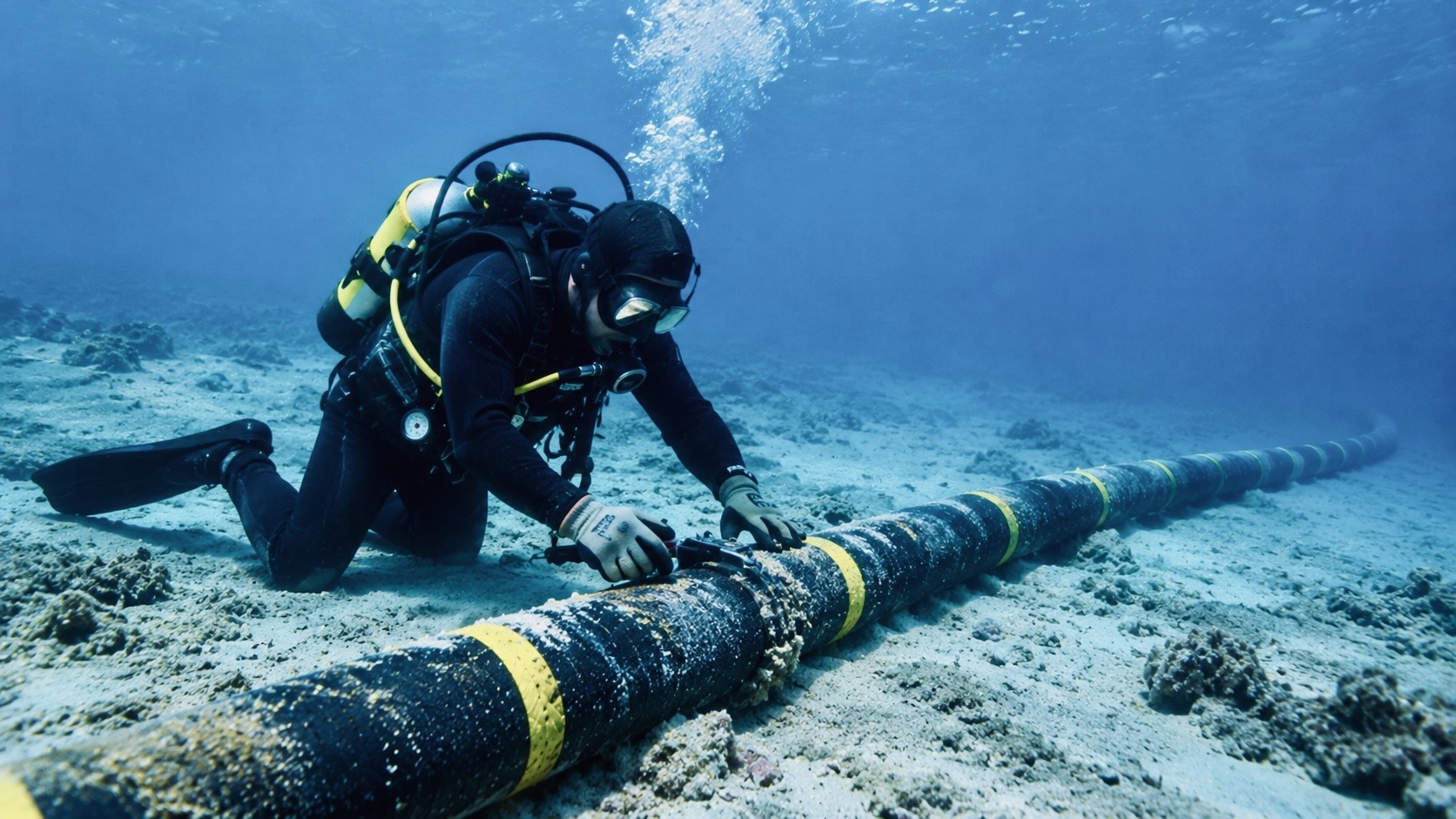
Thousands of kilometres beneath the oceans lies the infrastructure connecting continents. How much disruption could the global internet withstand if several critical routes failed together?
The global internet depends on infrastructure that most people never see. Beneath the world’s oceans, an extensive network of undersea cables carries the overwhelming majority of data exchanged between continents, connecting businesses, governments, financial institutions, and billions of internet users.
These submarine cables are responsible for more than 99% of intercontinental data traffic, according to international telecommunications research. Despite the growing number of satellites orbiting Earth, fibre-optic cables remain the foundation of global digital communications.
But what would happen if several major cables were damaged simultaneously? Would the internet stop working, or could existing networks keep the world connected?
The answer depends on where the damage occurs, how many alternative routes remain available, and how quickly repairs can be completed.
Why Undersea Cables Are Vulnerable
Submarine telecommunications cables contain thin strands of optical fibre that transmit information as pulses of light. They stretch across ocean floors, connecting continents through coastal landing stations linked to national and international networks.
Although modern cables have protective layers, they remain vulnerable to physical damage.
According to the International Cable Protection Committee (ICPC), approximately 150 to 200 submarine cable faults occur worldwide each year. Around 70% to 80% result from accidental human activities, particularly commercial fishing and ships’ anchors.
Natural events, including earthquakes, underwater landslides, and powerful seafloor currents, can also damage cables. Deliberate interference is another potential threat, although accidental damage accounts for most recorded incidents.
The consequences vary considerably.
Large telecommunications networks generally operate multiple connections between major destinations. If one cable fails, network operators can redirect traffic through alternative submarine or terrestrial routes.
This process, known as rerouting, helps maintain connectivity without requiring individual internet users to take action.
However, alternative routes do not necessarily have unlimited capacity.
If substantial traffic is redirected through fewer connections, congestion can develop. Internet speeds may decrease, latency can increase, and certain online services may become temporarily unavailable.
Countries with numerous independent international connections are generally better positioned to withstand individual cable failures than isolated nations relying on only a few routes.
The risks become more serious when multiple cables are damaged in the same region.
On May 12, 2024, the SEACOM and EASSy submarine cable systems were damaged off South Africa’s KwaZulu-Natal coast. According to an Internet Society investigation, the failures significantly reduced connectivity across several East African countries.
Both cables were repaired by June 3, approximately three weeks after the damage occurred.
The incident demonstrated how simultaneous cable failures can affect countries far beyond the immediate location of the damage.
What Happens When Multiple Undersea Cables Fail?
A single damaged cable would not shut down the global internet. Even several failures would not necessarily cause a worldwide outage because the internet operates through interconnected networks rather than one central system.
However, widespread damage across important international routes could create increasingly serious disruptions.
The effects would depend on the number of functioning connections, their available capacity, and the locations of the affected data centres and services.
International communications could slow considerably. Video calls, cloud-based applications, streaming services, and websites hosted overseas could experience delays or become unreachable.
Financial institutions could also face difficulties accessing overseas systems, exchanging information, or completing transactions that depend on international connectivity.
This would not automatically mean that banking systems or financial markets would stop operating. Many institutions maintain backup communications, geographically distributed infrastructure, and contingency procedures.
Nevertheless, prolonged disruption could interfere with some financial operations, particularly where essential systems depend on affected international routes.
Businesses relying on overseas cloud providers could experience similar difficulties. A company might retain access to its local network while losing reliable connections to applications, databases, or services hosted abroad.
The consequences for ordinary internet users would vary.
Domestic websites and services hosted within an unaffected country could remain accessible, even if international connections were severely restricted. Locally stored information and applications capable of operating offline would also remain available.
However, many apparently domestic services depend on infrastructure distributed across several countries. Their operation could still be affected by failures elsewhere.
Countries with limited international connectivity would face greater risks.
Small island nations and geographically isolated regions sometimes depend on only one or a handful of submarine cables. Losing those connections can cause extensive international communication outages.
Satellite communications could provide some backup capacity, particularly for essential services. However, satellite networks cannot currently replace the enormous combined capacity of the world’s submarine fibre-optic infrastructure.
A more extreme scenario involving simultaneous damage to numerous cables across several ocean regions could produce prolonged international connectivity problems.
Such an event would not necessarily eliminate the internet worldwide. Instead, some regions could remain connected internally while experiencing severely reduced or unavailable communications with other parts of the world.
The exact consequences would depend on which cables survived, the capacity of alternative routes, and the ability of network operators to restore service.
Why Repairs Can Take Weeks or Longer
Repairing an undersea cable requires specialized vessels, technical equipment, favourable operating conditions, and permission to work in the affected waters.
Engineers must first identify the approximate location of the fault using diagnostic measurements.
A repair vessel then travels to the damaged section, retrieves the cable where necessary, removes the damaged portion, and joins replacement cable into the existing system.
The repaired connection must be tested before normal operation resumes.
This work becomes more complicated in deep water, difficult weather, or regions with restricted maritime access.
Regulatory requirements can also create delays. Repair vessels may need permits or authorization before entering certain waters or conducting operations.
The International Telecommunication Union (ITU) has identified regulatory obstacles, geographic concentrations of infrastructure, and limited access to repair resources in some regions as important challenges to submarine cable resilience.
Multiple simultaneous failures could place additional pressure on available repair vessels and replacement equipment.
In July 2026, the International Advisory Body on Submarine Cable Resilience approved recommendations intended to strengthen international cooperation, improve protection, and reduce obstacles to repairs.
The effort reflects growing recognition that submarine cables are essential infrastructure supporting much more than everyday internet browsing.
Governments, telecommunications companies, and international organizations are examining ways to strengthen networks through additional cable routes, improved geographic diversity, better protection, and faster repair procedures.
The distinction between redundancy and genuine resilience is particularly important. Several cables may provide backup capacity, but if they pass through the same vulnerable corridor or land at closely situated facilities, a single event could damage multiple connections.
The strongest protection comes from having independent routes, sufficient backup capacity, and the ability to restore damaged infrastructure.
The world’s internet is designed to survive individual failures, and cable damage is already a routine challenge for network operators. What remains harder to predict is how interconnected services would respond to a prolonged disruption affecting several major international routes simultaneously.
The greatest concern is not that every undersea cable could fail at once, but what would happen if several critical connections were lost simultaneously. As governments, businesses, and essential services become increasingly dependent on global connectivity, the ability to withstand a prolonged disruption may prove just as important as the networks themselves.
About the Author Brad Socha is the founder of The Universal Record, focused on sourced, factual global reporting. Coverage includes international news, geopolitics, technology, and major developments.