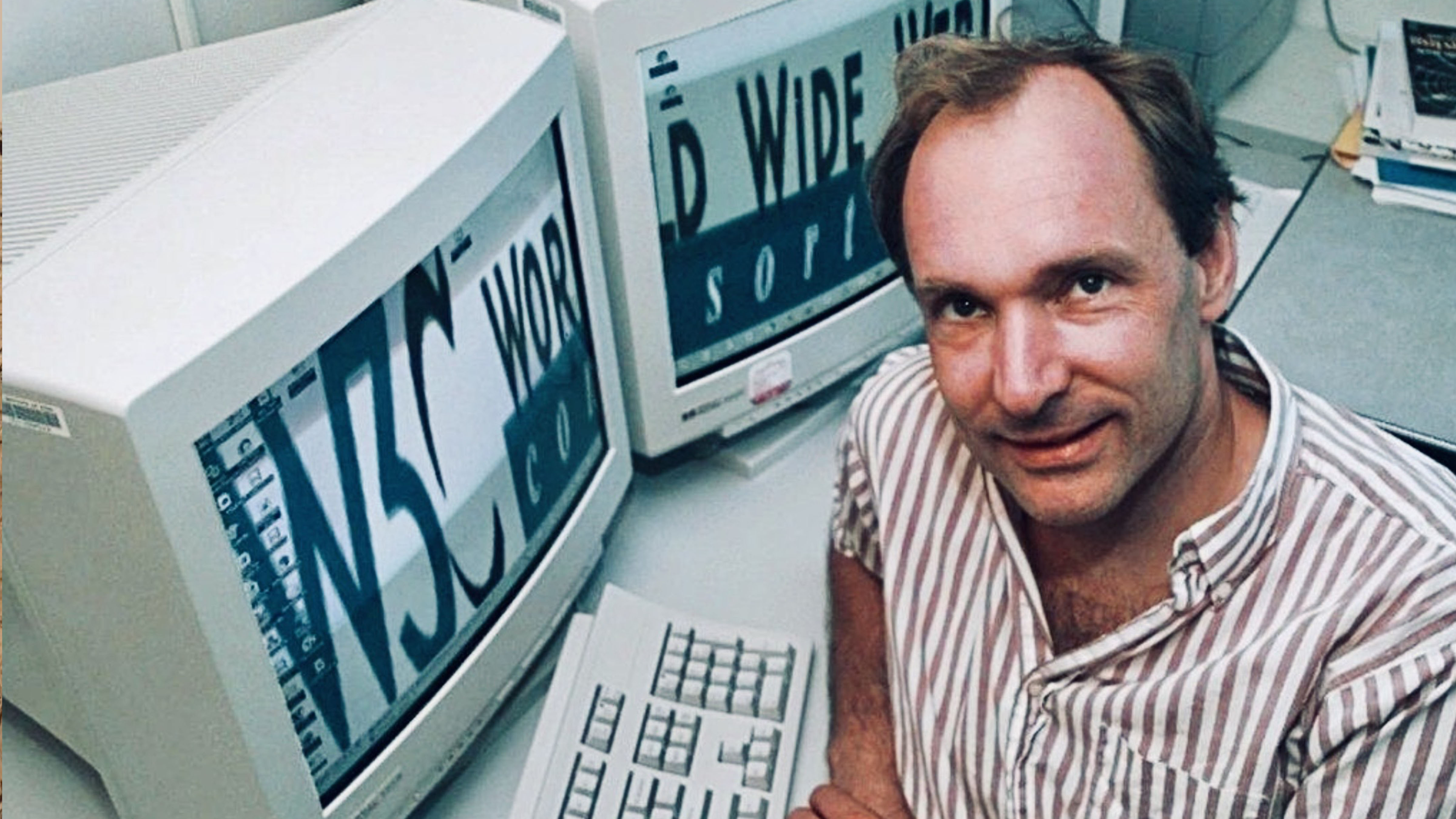
Tim Berners-Lee’s decision to make the World Wide Web publicly available transformed the internet from a specialized research network into the foundation of modern communication, commerce, education, and global information sharing.
Few technological milestones have changed daily life as profoundly as the birth of the World Wide Web. Every online search, digital news article, streaming service, online purchase, and social media post traces its origins to a breakthrough announced on August 6, 1991, when British computer scientist Tim Berners-Lee made the World Wide Web publicly available by publishing information about his project on the internet. That moment marked the beginning of a communications revolution that continues to shape nearly every aspect of modern society.
Although the internet already existed, it was largely a network connecting universities, government agencies, and research institutions. Accessing information often required technical knowledge, and systems were not designed for ordinary users. Berners-Lee’s innovation was not the internet itself, but a simple, standardized method of linking documents that anyone could access through a web browser.
Working at the European Organization for Nuclear Research (CERN) near Geneva, Switzerland, Berners-Lee had spent several years developing a way for scientists to share research more efficiently. Researchers from around the world collaborated on complex projects, yet their information was scattered across incompatible computer systems.
His solution combined three foundational technologies that remain central to the web today: HyperText Transfer Protocol (HTTP), the HyperText Markup Language (HTML), and the Uniform Resource Locator (URL), better known simply as a web address. Together, these standards allowed documents stored on different computers to be connected through clickable hyperlinks, creating an interconnected web of information.
On August 6, 1991, Berners-Lee posted a message to the alt.hypertext newsgroup explaining the World Wide Web project and providing instructions on how others could access it. That announcement effectively opened the web to anyone with internet access, allowing developers and researchers to begin creating websites beyond CERN.
From Research Tool to Global Network
The first website was remarkably simple. Hosted on a NeXT computer at CERN, it explained what the World Wide Web was, how to create a web server, and how users could build their own webpages.
Unlike many later technological innovations, the web was intentionally designed as an open system. Berners-Lee believed its standards should be available to everyone rather than controlled by a single company. That philosophy proved critical to its rapid expansion.
An equally important milestone followed in 1993 when CERN announced that the web’s underlying technology would be available royalty-free. Without licensing fees or proprietary restrictions, universities, businesses, software developers, and individuals could build websites and web browsers without seeking permission or paying royalties.
The decision accelerated innovation at an extraordinary pace.
In the early 1990s, graphical web browsers such as Mosaic made the web accessible to non-technical users. Shortly afterward, browsers including Netscape Navigator introduced millions of people to online navigation through simple point-and-click interfaces.
The number of websites exploded from only a handful in 1991 to thousands within just a few years.
Transforming the Modern World
The web quickly evolved far beyond its original scientific purpose.
Businesses recognized opportunities to sell products directly to consumers, helping establish electronic commerce as an entirely new economic sector. Governments began publishing public records and services online. Schools and universities expanded access to educational materials, while news organizations gained the ability to publish information instantly to global audiences.
Entire industries emerged around website development, digital advertising, search engines, cybersecurity, cloud computing, and online communications.
Search engines dramatically changed how people found information. Instead of navigating through directories or printed reference materials, users could search billions of webpages within seconds.
Healthcare providers adopted online medical resources. Financial institutions introduced internet banking. Entertainment shifted toward digital distribution through streaming platforms and downloadable media.
Perhaps most significantly, the web reshaped communication itself. Email became mainstream, followed by blogs, forums, video sharing, social media platforms, collaborative encyclopedias, and real-time messaging services connecting billions of people across continents.
Challenges Accompanying Opportunity
The same openness that fueled the web’s remarkable success also introduced new challenges.
Cybercrime, identity theft, ransomware attacks, misinformation, privacy concerns, online harassment, and sophisticated scams have become significant issues as more personal, financial, and governmental activity moved online.
Artificial intelligence has added another layer of complexity. AI-generated content, realistic deepfakes, automated phishing campaigns, and synthetic voices are testing society’s ability to distinguish authentic information from fabricated material.
Governments, technology companies, academic institutions, and international organizations continue working to strengthen cybersecurity while balancing privacy, innovation, and freedom of information.
These issues demonstrate that the web’s influence extends far beyond technology, it has become deeply intertwined with politics, economics, education, national security, and everyday life.
A Legacy Still Being Written
More than three decades after the first public announcement, the World Wide Web remains one of humanity’s most influential inventions.
Today, billions of websites operate across virtually every country. The web supports global commerce worth trillions of dollars annually, enables remote work and education, facilitates scientific collaboration, and provides access to an unprecedented volume of knowledge.
Its importance became especially evident during global crises, including the COVID-19 pandemic, when millions relied on the web for healthcare information, online learning, business continuity, government services, and maintaining personal connections.
The web continues to evolve through advances in artificial intelligence, cloud computing, virtual reality, decentralized technologies, and faster global connectivity. Yet its original purpose remains remarkably intact: enabling people everywhere to share knowledge through an open network accessible to anyone.
When Tim Berners-Lee shared his project with the world on August 6, 1991, few could have predicted the scale of its impact. What began as a solution to help scientists exchange information became one of the defining technologies of modern civilization, fundamentally changing how humanity communicates, learns, works, creates, and connects.
About the Author Brad Socha is the founder of The Universal Record, focused on sourced, factual global reporting. Coverage includes international news, geopolitics, technology, and major developments.