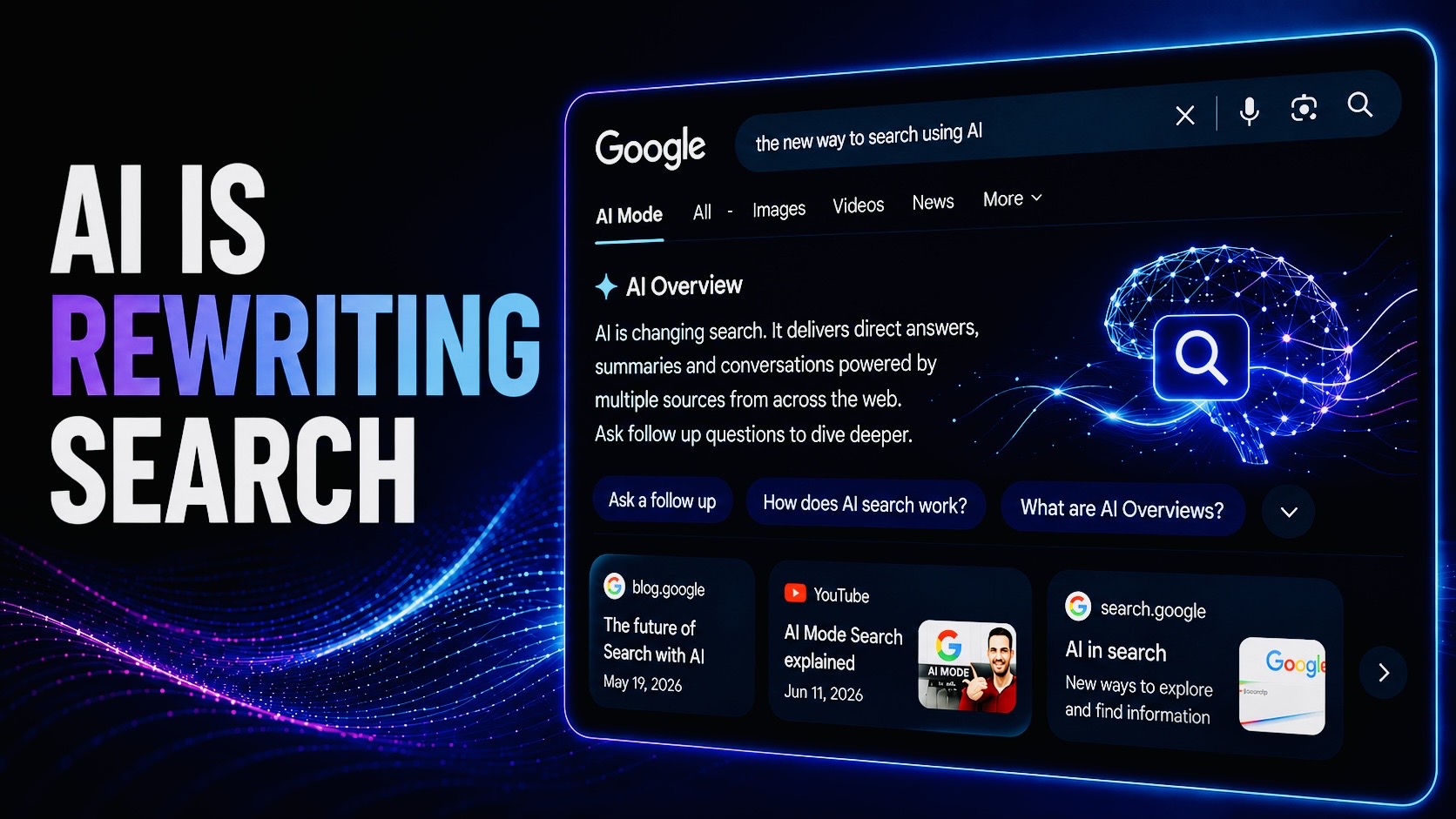
Search engines are shifting from lists of links toward AI-generated answers, changing how people find information, and challenging the web economy built around clicks.
For decades, Search followed a familiar bargain: a person entered a question, a search engine ranked relevant pages, and the user chose where to go next. Artificial intelligence is beginning to change that relationship.
Google now places AI-generated summaries and conversational search experiences directly inside Search, while services such as ChatGPT can search the web and synthesize information into an answer with links to supporting sources. Instead of searching, clicking and reading several pages, users can increasingly ask a detailed question and receive a consolidated response.
That does not mean conventional search engines are disappearing. Google continues to display links and says its AI features are designed to help users discover relevant websites. But the interface between the public and the open web is changing: the search service itself can increasingly provide the information a user came looking for.
For publishers, businesses and anyone dependent on search traffic, that distinction could reshape how online visibility works.
Search Is Becoming an Answer Engine
Google’s AI Overviews generate summaries for searches where its systems determine that an AI response adds value. Its more conversational AI Mode can handle complex questions, comparisons and follow-up queries, using a technique Google calls “query fan-out” to conduct multiple related searches and assemble information from different sources.
ChatGPT Search represents another version of the same shift. Rather than presenting a conventional page of ranked results, it can search for current information and incorporate findings into a conversational response accompanied by source links.
These systems are not necessarily replacing search so much as changing what searching means. The traditional search engine helps users locate information. AI search increasingly attempts to locate, interpret and summarize it.
Evidence suggests users are already encountering the change at scale. A Pew Research Center survey conducted in February 2026 found that 60% of U.S. adults said they read AI summaries appearing at the top of search-engine results.
The implications become more significant when researchers examine what happens after an AI answer appears.
In an analysis of Google browsing behaviour from March 2025, Pew found that users clicked a traditional search result during 8% of visits when an AI summary appeared, compared with 15% when there was no AI summary. Links contained within the AI summaries themselves received clicks in only about 1% of visits containing a summary.
Those findings cover a specific period and group of U.S. users and should not be treated as a universal measure of search behaviour. They nevertheless illustrate the central concern confronting publishers: AI can use information from across the web to answer a question without necessarily sending the reader to the pages that helped produce the answer.
What AI Means for Publishers
The traditional online publishing model has relied heavily on search engines acting as gateways. Publishers produce information, search engines index it, and a portion of searchers visit the originating websites, where publishers can generate advertising, subscription or other revenue.
Generative AI complicates that exchange.
Cloudflare has highlighted a fundamental difference between conventional search crawlers and AI systems: traditional search indexing historically helped return visitors to websites, while AI services may crawl large amounts of content that can contribute to generated answers without producing comparable referral traffic.
Publisher concerns have consequently moved beyond hypothetical discussions. In August 2026, a French press association asked France’s competition authority to intervene over Google’s AI-generated summaries, arguing that the feature was reducing traffic and revenue while relying on publishers’ material. The complaint represents the publishers’ position, not an established finding that Google has violated competition law.
The transition is also changing search-engine optimization.
SEO has traditionally concentrated on elements such as crawlability, indexing, useful content, links, page structure, authority and relevance. Those fundamentals have not disappeared. Google explicitly says there are no special technical requirements for appearing in AI Overviews or AI Mode beyond eligibility for normal Google Search, and that established SEO practices remain applicable.
But publishers now have another objective: creating information sufficiently authoritative, distinctive and useful that AI systems identify it as a source.
That places greater value on original reporting, primary evidence, clear attribution, expert information, unique data and content that adds something unavailable from dozens of similar pages. Simply rewriting widely available information may become less valuable when an AI system can synthesize the same material itself.
Publishers must also decide which AI systems they permit to access their sites. OpenAI, for example, says public websites can appear in ChatGPT Search and advises publishers that want their content discoverable and cited not to block its OAI-SearchBot.
The larger question is economic. The web contains an enormous supply of information because organizations and individuals have had incentives to create it. Search engines became extraordinarily valuable partly because they connected people with that distributed information.
AI search introduces a possible tension: the better an AI system becomes at answering questions directly, the less frequently some users may need to visit the sources behind those answers. But without sustainable incentives to create original reporting, research, analysis and reference material, AI systems could ultimately have less high-quality information to draw upon.
The future of Search is therefore unlikely to be simply AI versus search engines. It is more likely to involve search engines, conversational assistants, publishers and other information providers negotiating a new relationship.
Links will remain important, but increasingly they may sit beside, or behind, an AI-generated answer. The unresolved issue is whether that new model can provide people with faster answers while continuing to reward the websites and institutions responsible for producing reliable information in the first place.
About the Author Brad Socha is the founder of The Universal Record, focused on sourced, factual global reporting. Coverage includes international news, geopolitics, technology, and major developments.