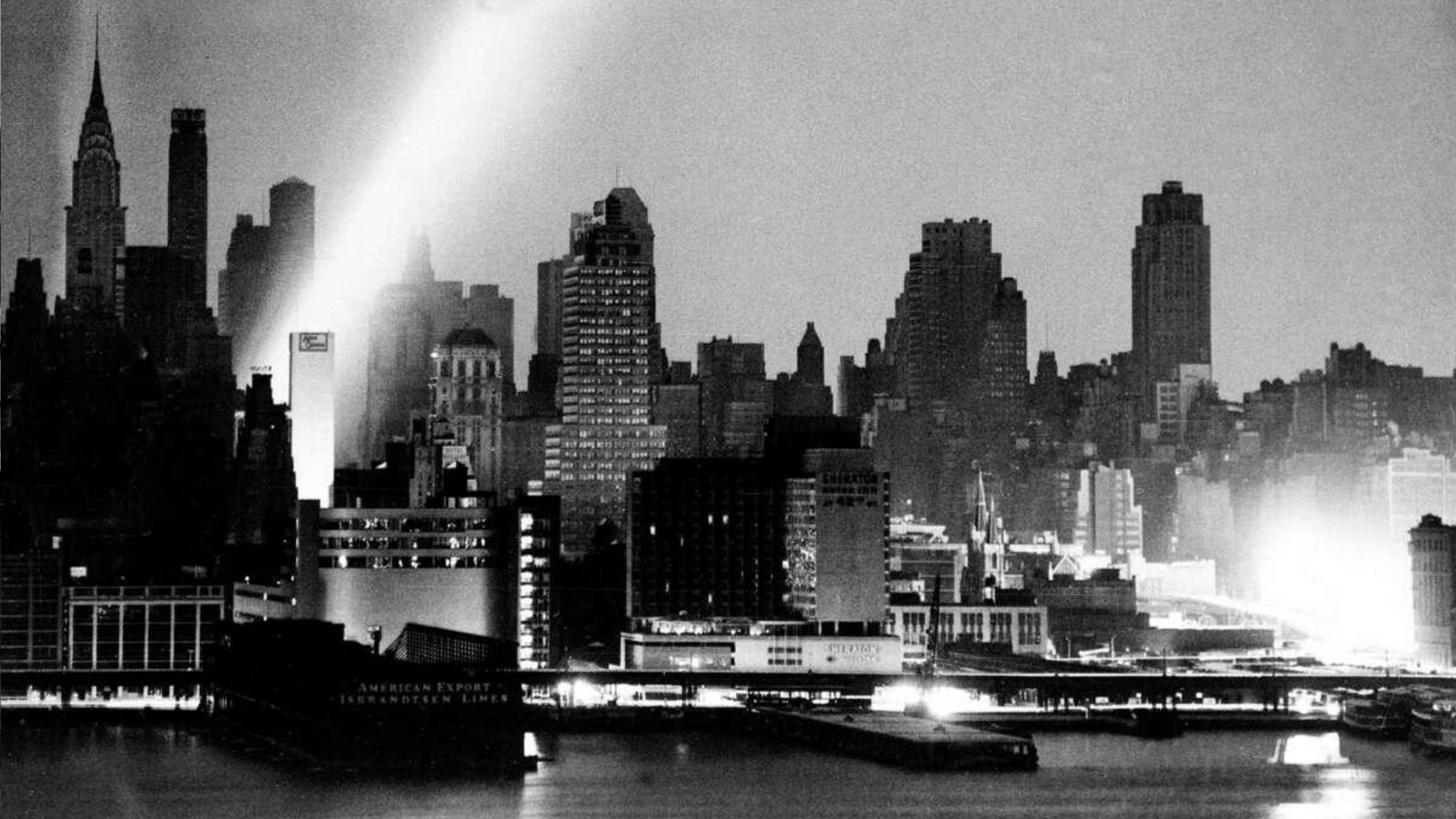
On November 9, a cascading power failure plunged communities across Ontario and the northeastern United States into darkness, exposing weaknesses in the electrical networks connecting millions of people.
Feature Image: Stanley Wolfson / New York World-Telegram & Sun / Library of Congress.
On the evening of November 9, 1965, a massive blackout swept across parts of Canada and the United States, leaving approximately 30 million people without electricity. Within minutes, interconnected power systems failed across a vast region, disrupting transportation, communications, businesses and everyday life.
The outage affected much of Ontario and several northeastern American states, including New York, Massachusetts and Connecticut. New York City, one of the world’s busiest urban centres, was among the hardest-hit communities.
The failure began shortly after 5:15 p.m. Eastern Standard Time, just as commuters were heading home and cities were entering their evening rush.
What started as a disturbance in the electrical transmission network near Niagara Falls developed into one of North America’s most consequential power failures.
The event demonstrated how a problem in one part of an interconnected electrical grid could spread across enormous distances, overwhelming systems that were intended to provide reliable electricity.
How the 1965 Blackout Began
The failure originated at a transmission facility near Niagara Falls, Ontario, where a protective relay operated incorrectly because of an unsuitable setting.
Protective relays are devices designed to detect abnormal electrical conditions and disconnect equipment when necessary. Their purpose is to prevent damage and contain disturbances before they spread.
In this case, the relay disconnected an important transmission line under conditions that did not require it to operate.
The resulting change in electrical flows placed additional pressure on neighbouring transmission lines. As those lines became overloaded, other protective devices disconnected equipment, causing electricity to shift repeatedly through the remaining network.
Within minutes, the disturbance spread through the interconnected power systems serving Ontario and the northeastern United States.
The cascading failures separated sections of the grid and caused generating stations and transmission facilities to disconnect.
The blackout was not caused by a shortage of fuel or the simultaneous failure of numerous power plants. It resulted from a chain reaction within the electrical transmission system.
The event revealed a fundamental weakness: interconnected networks could share electricity efficiently across regions, but disturbances could also spread when protection and operating procedures were unable to contain them.
Cities in Darkness
The consequences became visible almost immediately.
In New York City, subway trains stopped, leaving passengers stranded underground. Elevators halted between floors, traffic signals went dark and buildings lost lighting and electrical services.
Emergency workers, transit employees and utility crews faced the challenge of assisting people while normal communications and transportation systems were disrupted.
Hospitals and other essential facilities relied on emergency power where available, while residents and businesses adapted to an unexpected evening without electricity.
Across Ontario, communities experienced similar interruptions. Industrial operations stopped, businesses closed and households faced uncertainty about when power would return.
The effects varied by location. Some communities experienced relatively short interruptions, while others remained without electricity for much of the night.
In New York City, power was progressively restored, with the recovery extending into the following morning.
Despite the scale of the disruption, the blackout became remembered not only for its infrastructure failures but also for the public response.
Many residents helped neighbours, directed traffic or assisted stranded commuters. Emergency services continued operating under difficult conditions.
Contemporary accounts described a mixture of confusion, inconvenience and cooperation as millions of people experienced the sudden disappearance of a service on which modern life depended.
How the Blackout Changed Electrical Grids
Investigations following the outage focused on the transmission system’s protective equipment, operating practices and ability to withstand disturbances.
The findings demonstrated that reliable electrical service required more than adequate generating capacity. Utilities also needed coordinated protection systems, better communication and operating procedures capable of preventing individual failures from developing into regional emergencies.
The blackout became an important reference point for improving cooperation among interconnected utilities.
In 1968, the North American Electric Reliability Council was established to promote coordinated reliability practices across the continent. Its creation followed growing recognition of the need for common standards and stronger regional cooperation, with the 1965 blackout serving as a major catalyst.
The organization later evolved into the North American Electric Reliability Corporation, commonly known as NERC.
Modern electrical grids continue to rely on interconnected transmission networks, protective relays and automated systems. Interconnection allows utilities to exchange electricity and respond to changing demand, but it also requires careful management of disturbances.
The 1965 event remains relevant because the underlying challenge has not disappeared: a highly connected electrical system must be able to isolate failures before they spread.
Later outages, including the widespread North American blackout of August 2003, demonstrated that cascading failures could still occur despite decades of technological and operational improvements.
The November 9, 1965 blackout showed how quickly a localized electrical disturbance could become an international infrastructure emergency.
Its lasting significance was not simply the darkness experienced by millions of people, but the recognition that the reliability of modern society depended on the resilience of the networks connecting it.
About the Author Brad Socha is the founder of The Universal Record, focused on sourced, factual global reporting. Coverage includes international news, geopolitics, technology, and major developments.