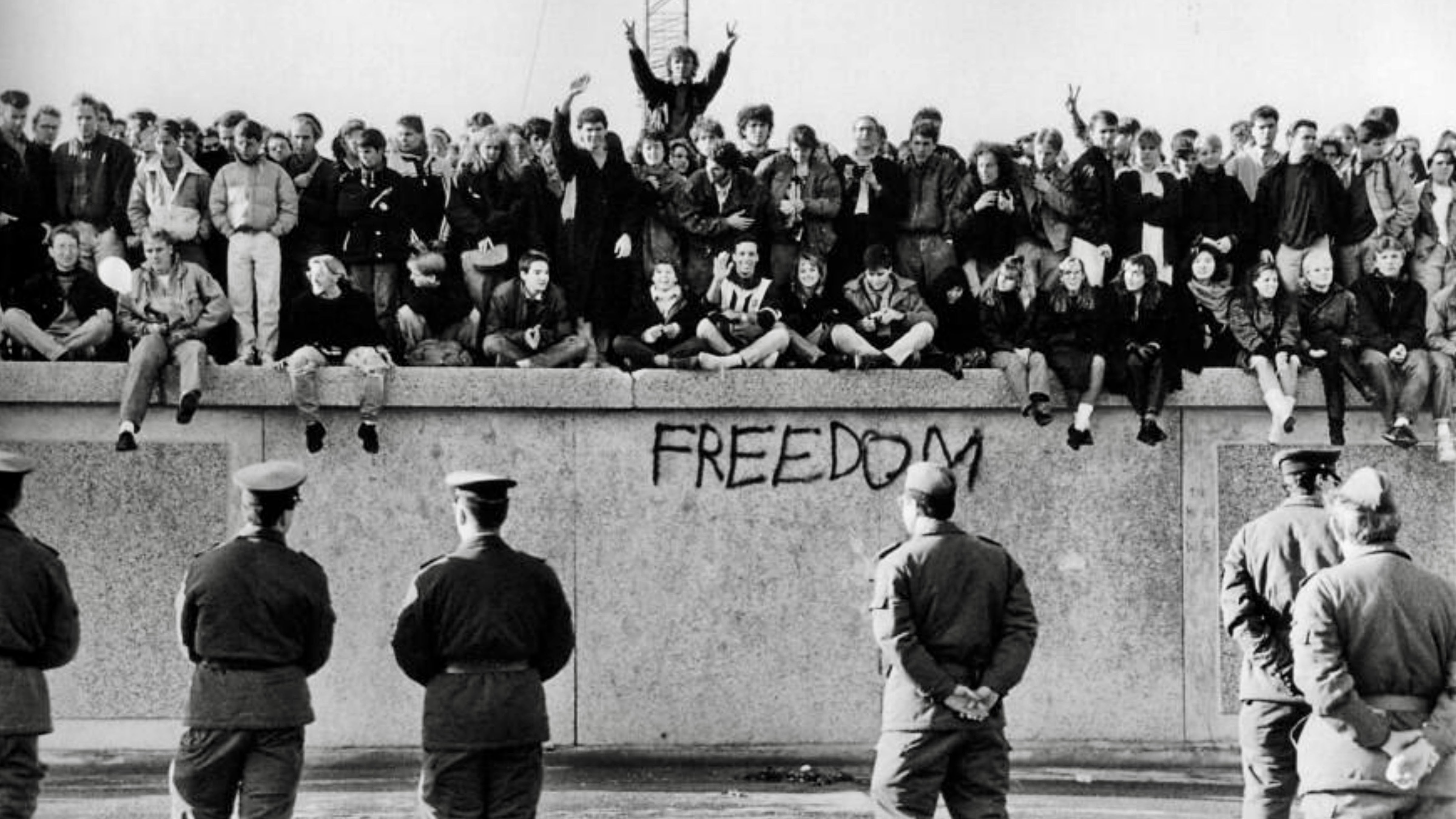
After 28 years of division, an unexpected announcement and growing public pressure opened the border between East and West Berlin, accelerating the transformation of Europe.
On November 9, 1989, the Berlin Wall effectively fell when East German border guards opened checkpoints separating East and West Berlin, allowing thousands of people to cross freely after nearly three decades of restrictions.
The breakthrough followed a confusing government announcement that suggested travel restrictions had been lifted immediately. Within hours, crowds gathered at border crossings, demanding passage into West Berlin.
What began as an attempt by East Germany’s leadership to manage a growing political crisis became a defining moment in the collapse of communist rule across Eastern Europe.
The opening of the border also paved the way for German reunification on October 3, 1990, and became one of the most recognizable symbols of the Cold War’s end.
Why the Berlin Wall Divided a Nation
Germany’s division emerged from the aftermath of the Second World War.
Following Nazi Germany’s defeat in 1945, the country was occupied by the United States, Soviet Union, Britain and France. Berlin, although located within the Soviet occupation zone, was also divided among the four powers.
As relations between the Soviet Union and Western Allies deteriorated, Germany became a central point of Cold War confrontation.
In 1949, two German states emerged: the Federal Republic of Germany in the west and the German Democratic Republic (GDR) in the east.
West Germany developed a parliamentary democracy and market-based economy, while East Germany became a socialist state governed by the Socialist Unity Party under Soviet influence.
Berlin remained divided between the two political systems.
During the 1950s, millions of East Germans left for the West, many travelling through Berlin, where crossing between the sectors remained comparatively accessible.
The departures created serious economic and political difficulties for East Germany, particularly as skilled workers and younger citizens sought opportunities elsewhere.
On August 13, 1961, East German authorities began sealing the border between East and West Berlin.
Barbed-wire barriers were gradually replaced by concrete walls, guard towers, patrol roads and other security installations.
Families, friends and communities were separated, sometimes with little warning.
The border system extended far beyond a single concrete wall. It included restricted zones, armed guards and obstacles intended to prevent unauthorized crossings.
People attempting to escape faced arrest, imprisonment and, in some cases, death.
Over the following decades, the Berlin Wall became an enduring symbol of Europe’s political and ideological division.
By the late 1980s, however, the political environment was changing.
Soviet leader Mikhail Gorbachev introduced reforms known as glasnost and perestroika, encouraging greater openness and economic restructuring.
Meanwhile, reform movements gained momentum across Eastern Europe.
In 1989, Hungary’s relaxation of border restrictions helped create an escape route for East Germans seeking to reach the West.
Inside East Germany, large demonstrations demanded freedom of movement, democratic reforms and greater political accountability.
The Monday demonstrations in Leipzig became particularly important, drawing growing crowds despite the risk of confrontation with security forces.
On October 18, East German leader Erich Honecker was replaced by Egon Krenz, but the change failed to halt public dissatisfaction.
By early November, the government faced mounting pressure to introduce meaningful reforms.
The Night the Border Opened
On November 9, East German officials approved new travel regulations intended to ease restrictions on citizens travelling abroad.
The measures were designed to respond to public demands while preserving some administrative control over departures.
That evening, Günter Schabowski, a senior Socialist Unity Party official, appeared at an internationally televised press conference in East Berlin.
Near the end of the briefing, journalists questioned him about the new travel arrangements.
When asked when the regulations would take effect, Schabowski consulted his notes and replied that, to his knowledge, they applied immediately.
The announcement created confusion.
The new rules had not been intended to produce an instant, unrestricted opening of the border, and the guards responsible for enforcing travel controls had not received clear instructions.
Nevertheless, television and radio reports quickly spread the impression that East Germans could cross into West Berlin.
Thousands of residents began arriving at checkpoints, asking to be allowed through.
At first, border guards attempted to maintain existing procedures. As crowds continued to grow, however, the situation became increasingly difficult to control.
At the Bornholmer Straße crossing, officers initially permitted limited departures before abandoning the restrictions.
At approximately 11:30 p.m., the crossing opened to the assembled crowds.
Other checkpoints followed, and by shortly after midnight, the border crossings within Berlin were open.
East Berliners streamed into the western half of the city, where many were greeted by cheering residents.
People embraced, celebrated in the streets and climbed onto sections of the Wall.
The scenes were broadcast internationally, providing some of the most memorable images of the twentieth century.
Although the Wall did not physically disappear that night, its function as a barrier separating the city’s residents had effectively ended.
In the following days and weeks, additional crossings opened, and sections of the structure began to be dismantled.
The political consequences were immediate.
East Germany’s ruling party rapidly lost its remaining authority. In March 1990, the country held its first free parliamentary election, producing a government committed to reunification.
Negotiations followed between East and West Germany and the four former occupying powers: the United States, Soviet Union, Britain and France.
The resulting Two Plus Four Treaty, signed in September 1990, addressed the international conditions necessary for German unity.
On October 3, 1990, East Germany formally joined the Federal Republic of Germany, ending more than four decades of national division.
The Wall’s opening did not single-handedly end the Cold War, which was already being reshaped by political reforms, popular movements and changing international relations.
Its significance nevertheless extended far beyond Berlin.
The events of November 9 demonstrated the influence of sustained public pressure and exposed the weakening authority of governments that had long restricted political freedoms and movement.
Today, preserved sections of the Berlin Wall serve as memorials to the people affected by Germany’s division.
The anniversary remains a powerful reminder of how quickly political boundaries can change when institutions lose public support and citizens demand a different future.
About the Author Brad Socha is the founder of The Universal Record, focused on sourced, factual global reporting. Coverage includes international news, geopolitics, technology, and major developments.