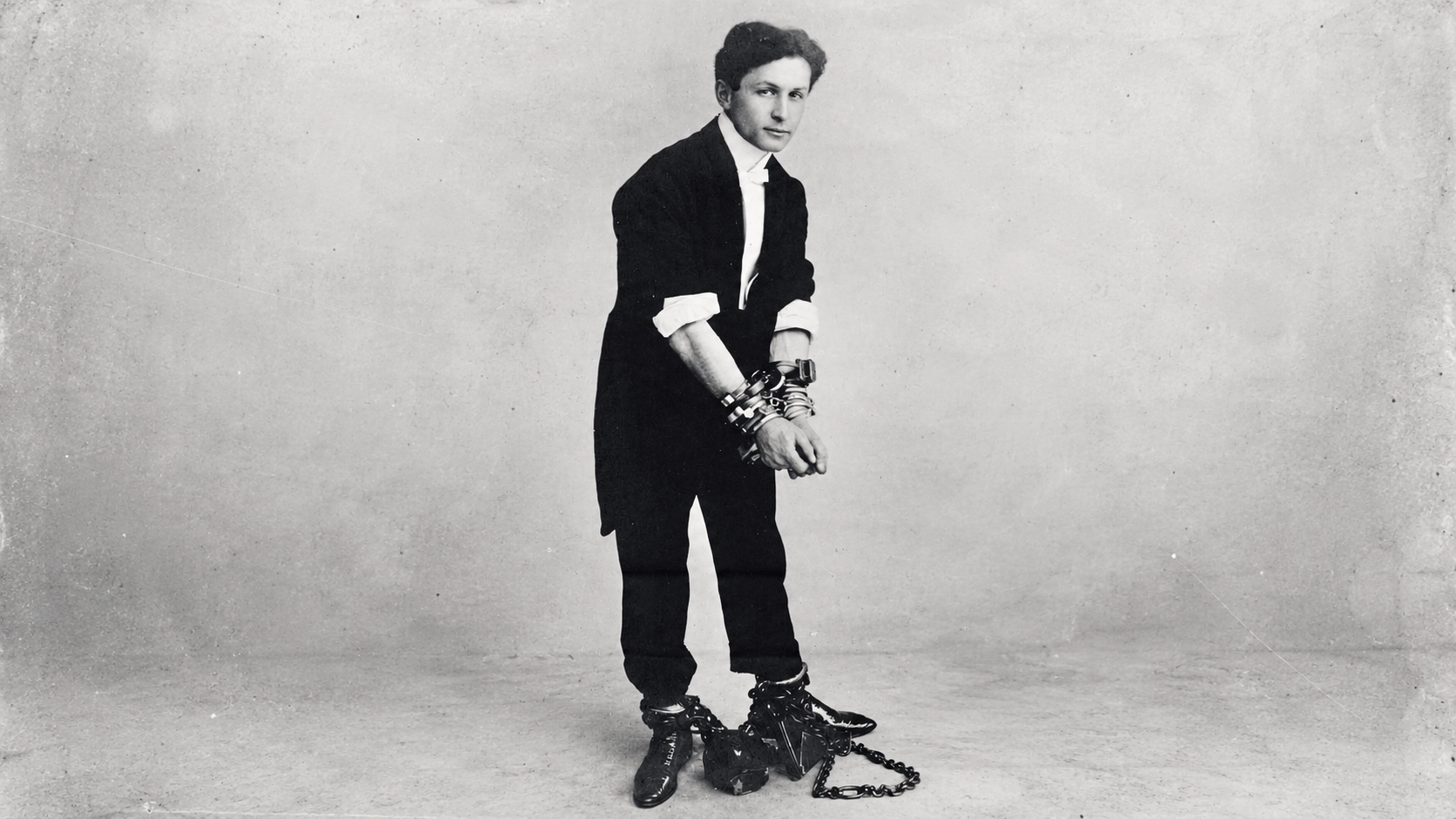
One hundred years after the legendary escape artist’s death in Detroit, the documented circumstances of his final days reveal a story as compelling as the myths that followed.
Harry Houdini, the world-famous magician and escape artist who astonished audiences by freeing himself from handcuffs, chains and locked containers, died in Detroit, Michigan, on October 31, 1926. He was 52 years old.
His death on Halloween became an enduring part of his legend. Yet the medical explanation was far less mysterious than the stories that later surrounded it: Houdini died of peritonitis associated with a ruptured appendix.
A century later, his career remains remarkable not only for the escapes that made him famous but also for his efforts to expose fraudulent claims of communication with the dead.
The contrast between Houdini’s carefully engineered illusions and his insistence on investigating supernatural claims helped define his public identity.
Houdini’s Rise From Magician to International Star
Born Erik Weisz in Budapest on March 24, 1874, Houdini immigrated to the United States with his family as a child. He grew up primarily in Wisconsin and New York, where he developed an interest in magic and performance.
He adopted the stage name Harry Houdini in admiration of French magician Jean-Eugène Robert-Houdin, whose work had helped transform magic into a respected theatrical profession.
His early career brought modest success, but his reputation changed dramatically around the turn of the twentieth century.
Houdini became known for challenging police officers to restrain him with their own handcuffs, then escaping before astonished audiences.
These demonstrations attracted considerable publicity because they appeared to place the performer’s freedom entirely in the hands of others.
In 1899, entertainment entrepreneur Martin Beck recognized Houdini’s potential and helped secure more prominent bookings. International tours followed, establishing him as one of the most recognizable entertainers of his era.
Houdini gradually expanded his performances beyond handcuffs.
He escaped from straitjackets while suspended above city streets, freed himself from locked containers and developed elaborate water-based illusions that appeared to place his life in immediate danger.
Among his best-known performances was the Chinese Water Torture Cell, introduced in 1912, in which he was lowered upside down into a water-filled tank with his ankles restrained.
The act required extensive preparation, physical conditioning and carefully controlled equipment.
Although Houdini cultivated an image of extraordinary personal ability, his escapes depended on practiced techniques, specialized knowledge and theatrical presentation rather than supernatural powers.
His willingness to perform physically demanding stunts helped distinguish him from other magicians and made his name synonymous with escape artistry.
The Final Performances and Houdini’s Death
In October 1926, Houdini was touring North America despite increasing physical strain.
During a visit to Montreal, he met several students at McGill University, including J. Gordon Whitehead.
Accounts of the encounter describe Whitehead striking Houdini repeatedly in the abdomen after a discussion about whether the performer could withstand punches.
Houdini was reportedly unprepared for the blows.
The incident later became central to popular explanations of his death, but the precise medical relationship between the punches and his appendicitis remains uncertain.
Houdini subsequently continued performing while experiencing abdominal pain.
On October 24, 1926, he appeared at Detroit’s Garrick Theatre despite being seriously ill.
The performance proved to be his last.
He was admitted to Grace Hospital, where doctors operated and found that his appendix had ruptured. Infection had spread within his abdominal cavity, causing peritonitis, a potentially fatal inflammation of the abdominal lining.
Despite medical treatment and further efforts to control the infection, his condition deteriorated.
Houdini died on October 31, 1926.
The widely repeated claim that a punch directly killed Houdini simplifies a more complicated medical history.
Appendicitis can develop independently of physical trauma, and the surviving evidence does not establish that Whitehead’s blows caused the disease or the rupture.
Some accounts suggest the encounter may have worsened an existing condition or contributed to delayed recognition of his illness. Neither explanation can be demonstrated conclusively from the available records.
His death was therefore not a failed escape trick, nor is there credible evidence that he died while attempting one of his famous underwater performances.
The recorded cause was peritonitis following a ruptured appendix.
Houdini’s death received extensive attention, reflecting his international fame and the dramatic public image he had cultivated.
His funeral took place in New York, and he was buried at Machpelah Cemetery in Queens.
During the final years of his life, Houdini had also become a determined critic of fraudulent spiritualist practices.
Spiritualism, which attracted widespread interest during the nineteenth and early twentieth centuries, included claims that mediums could communicate with deceased individuals.
Following the death of his mother in 1913, Houdini investigated mediums and séance demonstrations, using his knowledge of illusion techniques to identify methods of deception.
His public disagreements with spiritualist supporters, including author Arthur Conan Doyle, attracted considerable attention.
Houdini did not claim that every question about life after death had been scientifically resolved. Instead, he challenged individuals who presented apparent supernatural demonstrations as proof while relying on methods he believed were fraudulent.
His 1924 book A Magician Among the Spirits documented his investigations and criticism of deceptive mediumship.
The timing of his death on Halloween contributed to a lasting fascination with attempts to contact him after death.
His widow, Bess Houdini, participated in séances intended to determine whether he could communicate from beyond the grave. After years without convincing results, she ended her public efforts.
These events added another chapter to Houdini’s legend, but they did not establish evidence of communication with the deceased.
A century after his death, Houdini’s influence remains visible in modern magic, escape performances and public discussions about deception and extraordinary claims.
His reputation rests on more than spectacular stunts. He combined technical ingenuity, physical endurance and an understanding of public attention with a willingness to question demonstrations that appeared impossible.
The man who built his career escaping restraints ultimately died from a medical emergency that could not be overcome.
His performances continue to inspire wonder, while the documented circumstances of his death offer a reminder of the difference between theatrical mystery and historical evidence.
About the Author Brad Socha is the founder of The Universal Record, focused on sourced, factual global reporting. Coverage includes international news, geopolitics, technology, and major developments.