Beneath Manhattan’s crowded streets, a new electric railway promised faster journeys and helped transform how one of the world’s largest cities would grow.
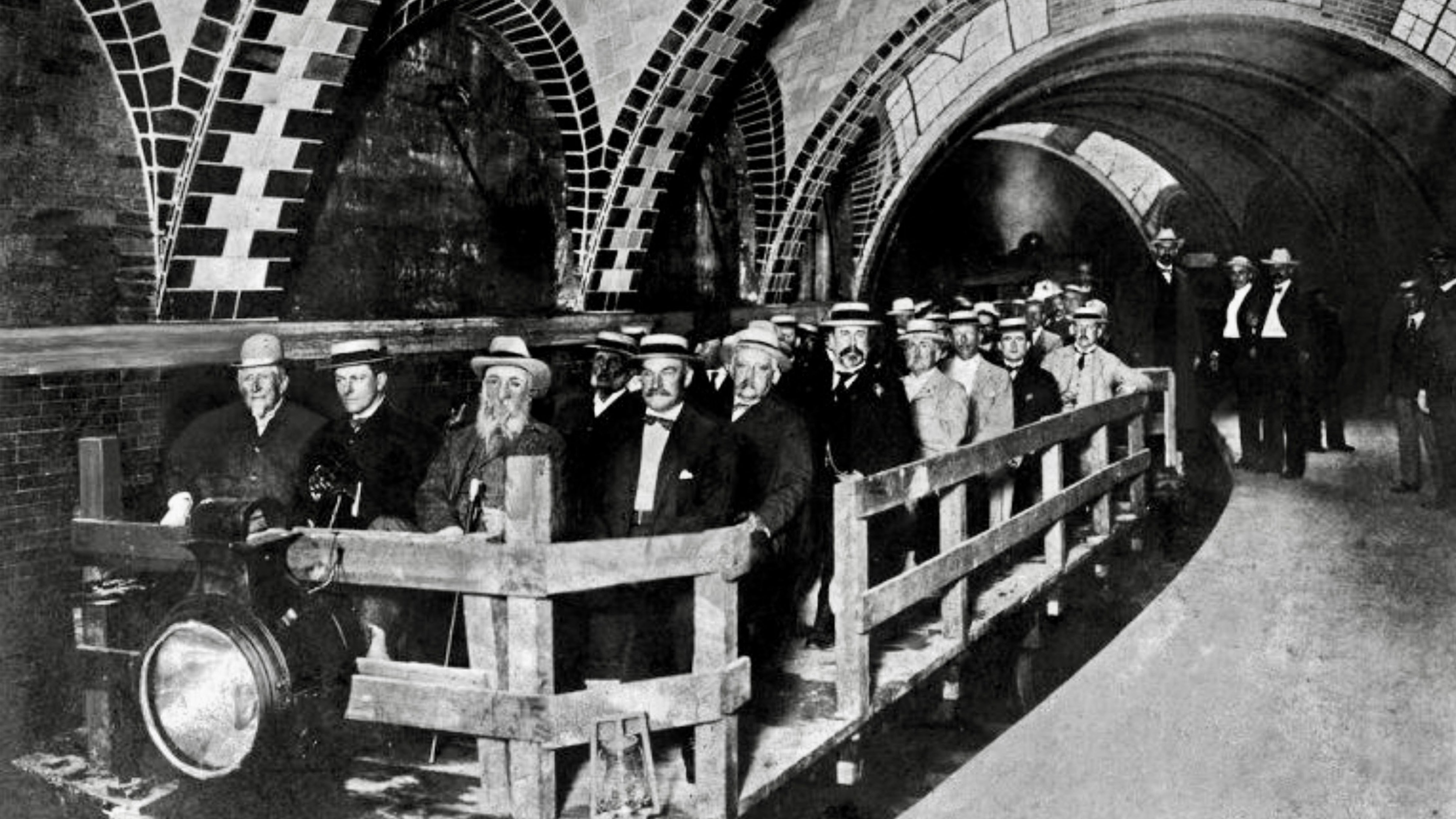
Featured Image: An early subway train at New York City’s City Hall station, circa 1904.
On October 27, 1904, New York City opened its first subway line, introducing an underground rapid-transit system that would fundamentally change transportation across the city. The original route stretched 9.1 miles through Manhattan, serving 28 stations between City Hall and 145th Street.
Mayor George B. McClellan Jr. personally operated the inaugural train, beginning a new chapter in urban transportation. By the end of opening day, more than 110,000 passengers had ridden the subway, paying just five cents for a journey.
The opening marked the beginning of a transportation network that would eventually connect all five boroughs, supporting New York’s growth into a major global centre of commerce, culture and population.
Building a Subway Beneath Manhattan
By the late nineteenth century, New York was struggling with the demands of rapid urban expansion.
Manhattan’s streets were crowded with pedestrians, horse-drawn vehicles, streetcars and commercial traffic. Elevated railways had improved transportation, but their noisy trains and overhead structures created additional problems for neighbourhoods below.
Underground railways offered an alternative. London had opened the world’s first underground railway in 1863, while Boston introduced America’s first subway in 1897.
New York had considered underground transportation for decades, but financial disagreements, engineering difficulties and political opposition repeatedly delayed construction.
A turning point came in 1894, when voters approved using public funds to develop a rapid-transit system.
The city ultimately adopted a financing arrangement under which municipal authorities would fund construction while a private company would build and operate the railway under contract.
Financier August Belmont Jr. became a central figure in the project. His companies helped finance and construct the subway, while the Interborough Rapid Transit Company, commonly known as the IRT, was established to operate the trains.
Construction began on March 24, 1900, near City Hall.
Building beneath an established metropolis presented considerable challenges. Engineers had to work around building foundations, water mains, gas pipes, electrical conduits and sewer systems while maintaining activity on the streets above.
Much of the route was constructed using the cut-and-cover method. Workers excavated trenches beneath city streets, built the railway structures and then restored the road surfaces overhead.
Other sections required tunnelling through rock or using specialized construction methods where conditions made ordinary excavation impractical.
The work was disruptive and dangerous. Construction crews faced unstable ground, underground utilities and the constant pressure of completing a major public project in a densely populated city.
Despite these obstacles, the original line was completed in approximately four and a half years.
Its design incorporated electric trains, express and local tracks, and a sophisticated signalling system intended to accommodate frequent service.
The result was an engineering achievement that offered a new way to move large numbers of passengers through Manhattan without relying entirely on surface transportation.
New York Goes Underground
The opening ceremony began at City Hall, where officials gathered to celebrate the completion of the railway.
Shortly after 2:30 p.m., Mayor McClellan took the controls of the inaugural train at the ornate City Hall station.
The ceremonial journey travelled north through Manhattan, passing Grand Central and Times Square before continuing toward 145th Street.
The trip to the northern terminus took approximately 26 minutes, demonstrating the potential speed of underground electric transportation.
The route followed a path that remains recognizable in today’s subway network. From City Hall, trains travelled north beneath Park Avenue South, turned west along 42nd Street and continued north beneath Broadway.
At 7 p.m., the system opened to paying passengers.
Thousands of New Yorkers entered the stations to experience a form of transportation that had previously existed largely as a long-debated public proposal.
The five-cent fare made the new railway accessible to a broad section of the city’s population, although the cost still represented a meaningful expense for some working families.
The subway’s opening was not the introduction of rapid transit to New York. Elevated trains had operated for decades, and streetcars remained important. Instead, the underground line added capacity and created opportunities for expansion beyond what Manhattan’s crowded streets could accommodate.
The immediate response demonstrated substantial public interest. More than 110,000 passengers rode the system before the first day ended.
The opening was also documented on film by the Edison Manufacturing Company, preserving scenes of officials, crowds and trains during the inaugural celebrations.
The railway quickly became part of everyday city life.
Its influence extended beyond shorter commuting times. Faster transportation made it increasingly practical for residents to live farther from their workplaces, encouraging residential development and changes in the city’s commercial geography.
Extensions followed. Service reached the Bronx in 1905, Brooklyn in 1908 and Queens in 1915, expanding the original Manhattan line into a growing metropolitan network.
Other operators subsequently developed competing subway routes, including the Brooklyn-Manhattan Transit system and the city-owned Independent Subway.
In 1940, New York City unified the three major subway systems under municipal ownership, creating the foundation of the modern network.
The subway also became an enduring element of New York’s identity. Its stations, platforms, maps and trains helped shape daily routines for generations of residents.
The original City Hall station, celebrated for its curved platforms, tiled arches and decorative skylights, eventually closed to regular passenger service in 1945. It remains a notable example of the architectural ambition behind the first subway.
More than a century after the inaugural journey, the network continues to provide essential transportation across New York City.
What began in 1904 as a nine-mile railway beneath Manhattan became a system serving hundreds of stations and connecting neighbourhoods across five boroughs.
Its opening demonstrated how large-scale public infrastructure could change not only the speed of travel but also the physical development and economic possibilities of a growing city.
About the Author Brad Socha is the founder of The Universal Record, focused on sourced, factual global reporting. Coverage includes international news, geopolitics, technology, and major developments.