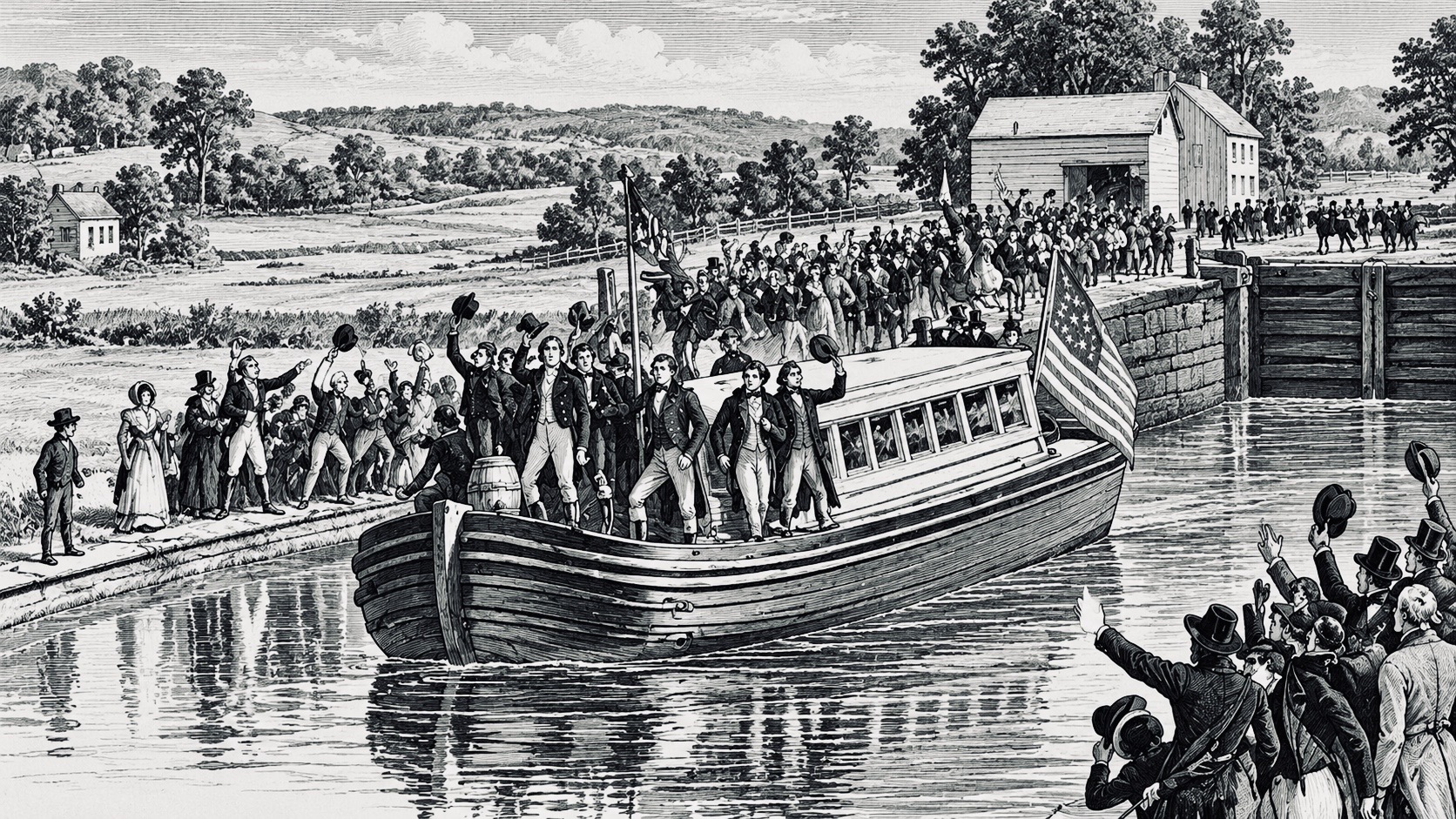
On October 26, 1825, the Erie Canal officially opened in Buffalo, New York, completing an engineering project that would transform transportation and commerce across the northeastern United States. Stretching 363 miles (584 kilometres) between Lake Erie and the Hudson River, the waterway created a practical shipping connection between the Great Lakes region and the Atlantic Ocean.
Its opening 201 years ago marked a turning point in American economic development. Goods that had once moved slowly over difficult roads could now travel by boat at a fraction of the previous cost. Towns along the route expanded, western markets became more accessible, and New York City strengthened its position as a leading commercial port.
The achievement had taken eight years of construction, substantial public investment and thousands of workers using tools that were basic by modern engineering standards.
Building a Waterway Across New York
In the early nineteenth century, moving goods between the Atlantic coast and the American interior was expensive and time-consuming.
The Appalachian Mountains presented a major obstacle to overland transportation. Roads were often poorly maintained, and moving heavy cargo by wagon could cost more than the goods themselves were worth.
New York offered a geographical advantage. The Mohawk River valley provided a relatively accessible passage through the Appalachian barrier, creating an opportunity to connect the Hudson River with Lake Erie.
DeWitt Clinton, a prominent New York politician who became governor in 1817, emerged as the project’s leading advocate. He believed a canal could strengthen the state’s economy by linking agricultural regions, expanding markets and encouraging trade.
The proposal faced considerable opposition. Critics questioned whether such an extensive artificial waterway could be built successfully or generate enough revenue to justify its expense. The undertaking became widely associated with the dismissive nickname Clinton’s Ditch.
Nevertheless, New York’s legislature authorized construction in April 1817, and work began near Rome, New York, on July 4 of that year.
The project presented extraordinary engineering challenges.
Workers excavated long stretches of canal by hand, using shovels, picks, wheelbarrows and animal-drawn equipment. The workforce included immigrants and American-born labourers who endured demanding conditions, accidents and disease.
Engineers had to carry water across streams, construct embankments and overcome substantial changes in elevation.
The completed canal measured approximately 40 feet wide and four feet deep. Its original system included 83 locks, allowing boats to travel between waterways separated by hundreds of feet in elevation.
Construction cost approximately $7.1 million, an enormous public investment for the period.
Yet the project was completed in 1825, establishing one of the most consequential transportation routes in early American history.
The Erie Canal Opens a New Trade Route
The official opening began on October 26, 1825, when Governor Clinton boarded the canal boat Seneca Chief in Buffalo.
Accompanied by other vessels, the boat departed along the newly completed waterway as communities celebrated the achievement.
The journey continued eastward through New York State, eventually reaching the Hudson River and New York Harbor.
On November 4, Clinton participated in a ceremony known as the Wedding of the Waters. Water carried from Lake Erie was poured into the Atlantic Ocean, symbolizing the new transportation connection between the Great Lakes and the eastern seaboard.
The canal’s economic impact soon became evident.
Before its construction, merchants depended heavily on wagons and difficult overland routes. Canal boats, pulled by horses or mules walking along towpaths, could transport substantially heavier loads at lower expense.
New York State historical records indicate that shipping wheat from Buffalo to New York City cost roughly $100 per ton in 1815. By 1825, the cost had fallen to approximately $10 per ton.
The savings made it more profitable for farmers to send grain and other agricultural products to distant markets.
Timber, flour and raw materials travelled east, while manufactured goods and supplies moved west.
Transportation also became more accessible to passengers. A canal journey between Albany and Buffalo took approximately five days, compared with roughly two weeks by stagecoach.
These improvements helped connect communities that had previously been separated by difficult and expensive travel.
Cities including Buffalo, Rochester, Syracuse and Utica benefited from increased commercial activity. Warehouses, mills, shops and transportation businesses developed along the canal corridor.
New York City gained an especially important advantage. With its harbour connected to the Hudson River and the canal system, it became a major gateway for agricultural products and other goods moving between the American interior and international markets.
The waterway also accelerated westward migration, helping settlers reach areas around the Great Lakes and beyond.
That expansion carried consequences for Indigenous peoples. Increased migration and land development added to the pressures already affecting Native American communities, including the Haudenosaunee nations whose territories and established routes had long shaped the region.
The canal’s history therefore includes both substantial economic development and the wider consequences of nineteenth-century territorial expansion.
As trade increased, toll revenue helped repay construction costs. The canal was later enlarged to accommodate growing traffic and larger vessels.
Railroads eventually offered faster transportation, reducing the canal’s importance for long-distance passenger travel and some commercial shipping. Nevertheless, the waterway continued operating and underwent further modernization.
Today, the New York State Canal System preserves the Erie Canal’s transportation legacy, serving recreational boaters, tourism and some commercial navigation.
Two centuries after its opening, the Erie Canal remains a landmark of public infrastructure development. Its completion demonstrated how a transportation investment could alter shipping costs, settlement patterns and the economic relationships between regions.
What began as a disputed construction proposal became a waterway that helped reshape American commerce and New York’s place within it.
About the Author Brad Socha is the founder of The Universal Record, focused on sourced, factual global reporting. Coverage includes international news, geopolitics, technology, and major developments.