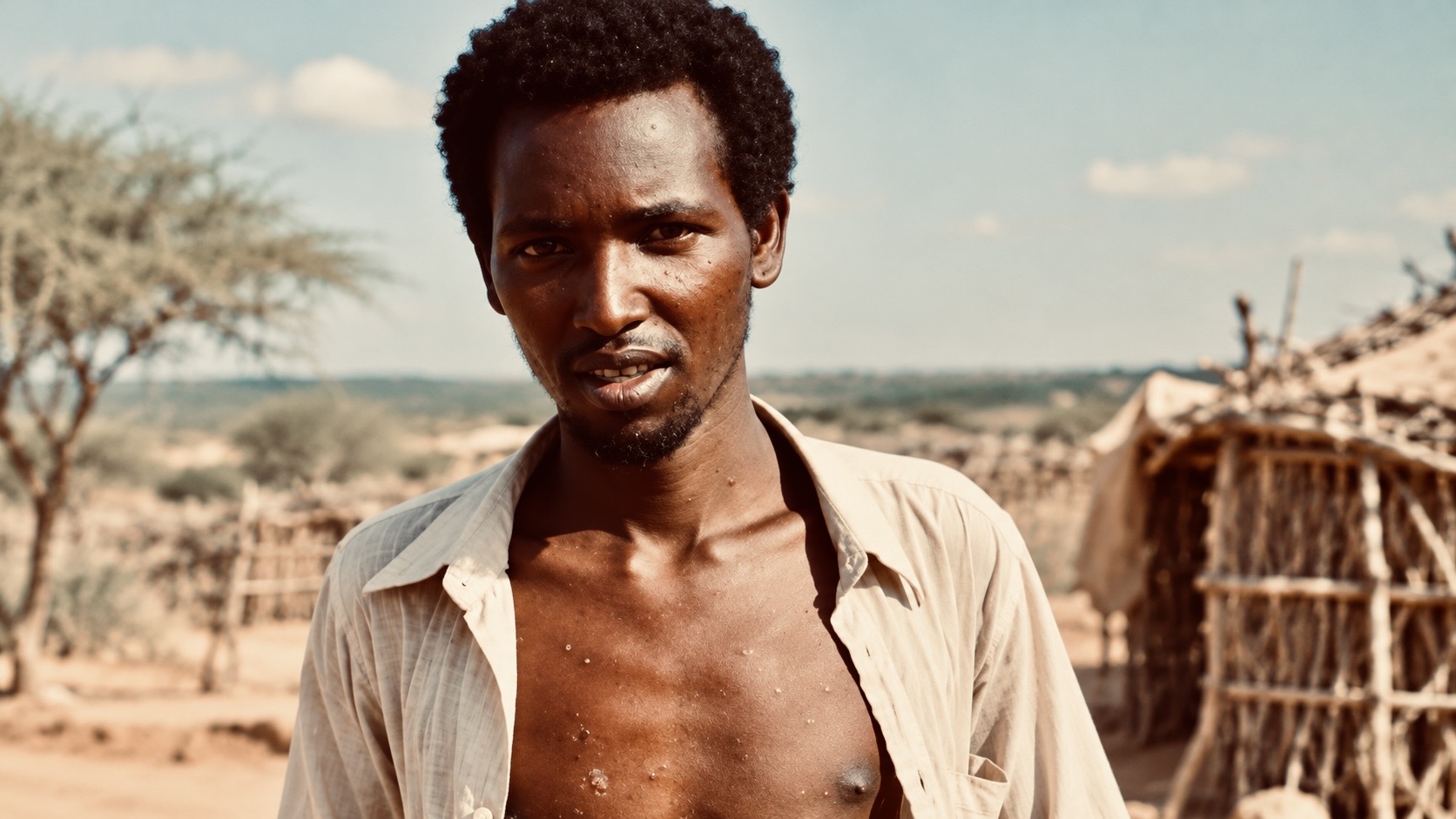
An infection in Somalia became the final known case of a disease that had killed millions, bringing the world closer to an unprecedented achievement in public health.
On October 26, 1977, a young hospital worker in Somalia developed the characteristic rash of smallpox. His illness would become the world’s last known naturally acquired case of a disease that had threatened humanity for thousands of years.
The patient, 23-year-old Ali Maow Maalin, lived in Merca, a coastal town south of Mogadishu. His recovery, followed by intensive disease surveillance, marked a decisive turning point in an international effort to eliminate smallpox through vaccination and public health coordination.
The date is now recognized as a milestone in medical history. In 1980, the World Health Organization (WHO) formally declared smallpox eradicated, making it the first human infectious disease eliminated worldwide.
The Final Smallpox Patient
Smallpox was caused by the variola virus, which spread primarily through close contact with infected people. Symptoms typically began with fever, fatigue and body aches, followed by a distinctive rash that developed into fluid-filled lesions.
The more severe form, variola major, killed approximately 30% of those infected in many historical outbreaks. Survivors could experience permanent scarring or blindness.
By the twentieth century, vaccination had eliminated smallpox from several regions, but the disease continued circulating in parts of Africa and Asia.
Somalia was among the final countries where naturally transmitted smallpox remained.
Maalin worked as a cook at Merca Hospital and occasionally assisted local health personnel. On October 12, 1977, he travelled in a vehicle with two children who had smallpox, exposing him to the virus.
Although he had previously received a vaccination attempt, it had not produced effective protection.
Ten days after his exposure, on October 22, Maalin developed a fever. The characteristic rash appeared on October 26.
His illness was initially mistaken for other diseases, including malaria and chickenpox. Health workers subsequently recognized the symptoms as smallpox, and the case was identified by the eradication programme at the end of October.
Maalin had contracted variola minor, a less deadly form of smallpox than variola major.
His diagnosis triggered an urgent public health response.
Somali health authorities and international teams isolated Maalin, investigated his movements and identified people who might have been exposed.
Vaccination teams worked to protect contacts and surrounding communities, while surveillance personnel searched for additional infections.
Investigators traced the infection to an existing chain of transmission among communities moving through southern Somalia.
The response was particularly important because even a single undetected infection could have allowed the disease to continue circulating.
Maalin recovered, and no subsequent naturally acquired smallpox case was identified anywhere in the world.
His survival also became part of a wider public health story. Years later, he participated in efforts to eliminate polio in Somalia, continuing to support vaccination campaigns until his death from malaria in 2013.
How the World Eradicated Smallpox
The elimination of smallpox was the result of centuries of medical progress and an intensive international campaign.
In 1796, English physician Edward Jenner demonstrated that inoculation using material from cowpox could protect against smallpox. His work helped establish vaccination as a preventive medical practice.
During the nineteenth and twentieth centuries, vaccination programmes expanded, although access and coverage varied considerably between countries.
In 1958, the Soviet Union proposed a coordinated global effort to eliminate smallpox through the World Health Assembly.
The WHO began its global eradication programme in 1959, but progress was initially limited by shortages of resources, vaccine supplies and reliable surveillance.
A major expansion followed in 1967, when the WHO launched its Intensified Smallpox Eradication Programme.
The campaign combined vaccination with a strategy known as surveillance and containment.
Rather than relying exclusively on mass vaccination, health workers actively searched for cases, isolated infected patients and vaccinated people who had been exposed or were at risk.
This approach, often called ring vaccination, helped interrupt transmission around identified infections.
Technological improvements also contributed to the campaign’s success.
Freeze-dried vaccines could remain effective under difficult transportation conditions, while the bifurcated needle allowed health workers to administer vaccinations efficiently using relatively small quantities of vaccine.
Local medical teams, community workers and international specialists coordinated efforts across countries with different healthcare systems, languages and geographical challenges.
The final stages required particularly intensive surveillance in remote and mobile populations, where infections could remain undetected.
By 1975, the last known naturally acquired case of variola major had occurred in Bangladesh. The patient was three-year-old Rahima Banu, who survived.
Two years later, Maalin’s illness in Somalia marked the final known natural transmission of either major form of smallpox.
However, the disappearance of naturally occurring cases did not immediately establish that the virus had been eradicated.
Health authorities needed to confirm that transmission had stopped everywhere.
International verification teams continued searching for cases and evaluating surveillance systems.
A laboratory-associated outbreak in Birmingham, England, in 1978 caused additional smallpox infections and one death. These cases did not represent renewed natural transmission, but they demonstrated that laboratory containment remained an important concern.
In December 1979, a global commission certified that smallpox had been eradicated.
On May 8, 1980, the World Health Assembly formally endorsed the achievement.
The declaration represented an extraordinary result: a disease that had caused widespread death, disfigurement and social disruption for centuries no longer circulated naturally among humans.
Smallpox eradication also transformed international public health.
The campaign demonstrated that vaccination, disease surveillance, rapid containment and cooperation between governments could eliminate a major infectious disease across national borders.
It influenced subsequent efforts against polio, measles and other preventable diseases, although their biological characteristics and transmission patterns present different challenges.
Today, routine smallpox vaccination is no longer required for the general population in most countries. Authorized laboratory stocks of the variola virus remain under strict international oversight.
The legacy of October 26, 1977, extends beyond one patient’s recovery. It represents the final known natural transmission of a disease once considered an unavoidable part of human life.
Smallpox eradication remains a rare achievement in medicine: the permanent interruption of a human infectious disease through coordinated scientific and public health action.
About the Author Brad Socha is the founder of The Universal Record, focused on sourced, factual global reporting. Coverage includes international news, geopolitics, technology, and major developments.