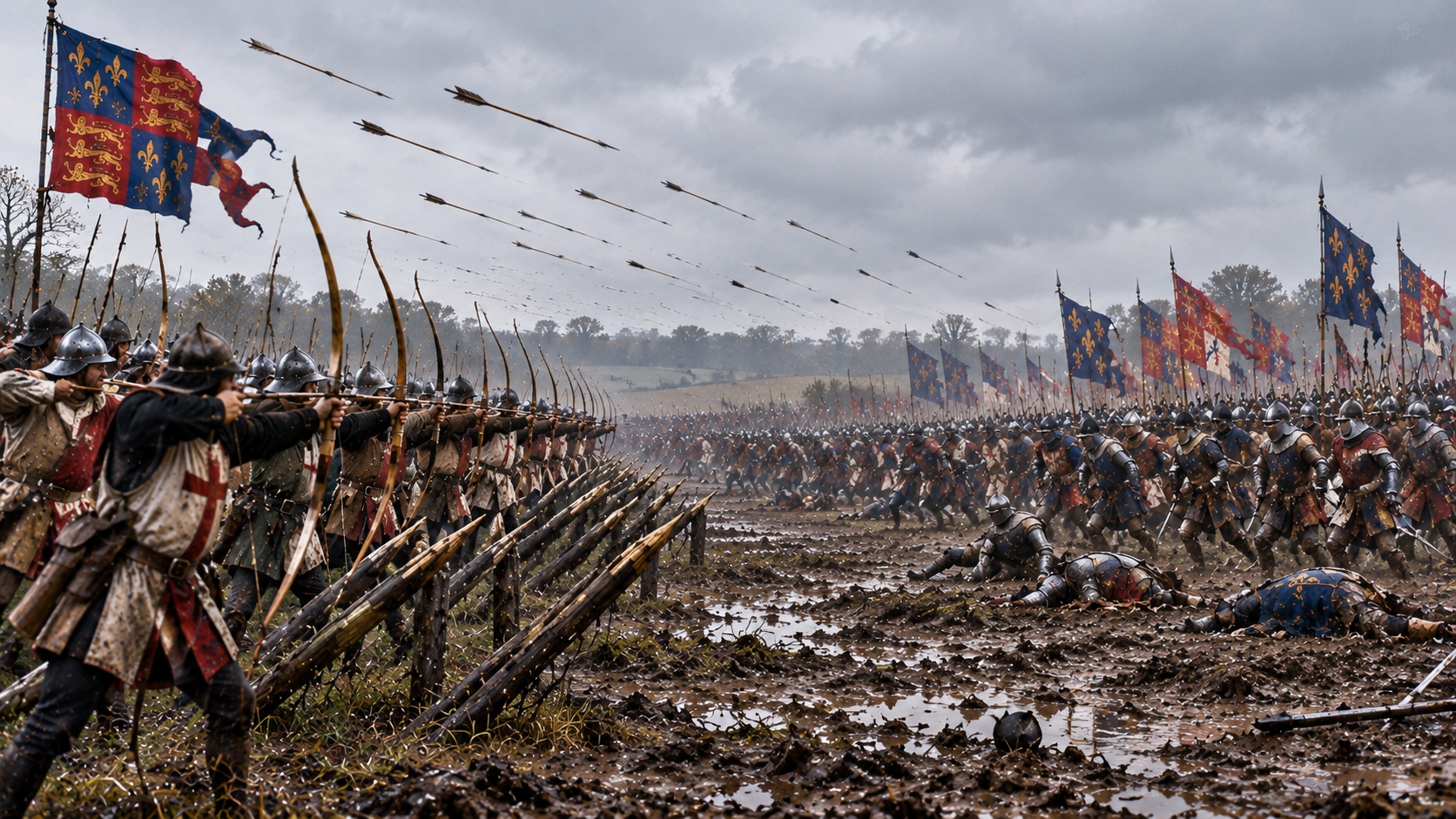
An exhausted English army defeated a larger French force in a battle where longbows, difficult terrain and military decisions helped determine the outcome of the Hundred Years’ War.
On October 25, 1415, King Henry V of England defeated a larger French army near the village of Azincourt in northern France. The Battle of Agincourt became one of the most celebrated English victories of the Hundred Years’ War, demonstrating how terrain, battlefield organization and the effective use of archers could overcome numerical disadvantage.
Fought on St. Crispin’s Day, the battle lasted only a few hours but had consequences extending far beyond the battlefield. Thousands of French soldiers were killed or captured, including prominent nobles, while Henry’s victory strengthened his position in a conflict over territory and the French crown.
More than six centuries later, Agincourt remains an important example of medieval warfare and the relationship between military success, political ambition and national memory.
Henry V’s Campaign in France
The Hundred Years’ War began in 1337 and developed into a prolonged struggle involving English claims to the French throne, territorial disputes and competing political interests.
Henry V became king of England in 1413. Determined to strengthen his kingdom’s position in France, he revived English territorial claims and prepared a military expedition.
In August 1415, Henry crossed the English Channel with an army that included men-at-arms and thousands of longbowmen.
His first major objective was Harfleur, a fortified port in Normandy. The English captured the town in September after a difficult siege, but the campaign had already taken a considerable toll.
Disease, casualties and the need to leave a garrison behind reduced Henry’s available forces.
Rather than continue an extensive offensive, Henry marched toward Calais, an English-held port from which his army could return home.
French forces attempted to prevent his escape. Their commanders assembled an army and moved to intercept the English as they travelled through northern France.
By late October, Henry’s troops were exhausted, short of supplies and facing an enemy generally believed to outnumber them.
Estimates of the armies’ sizes vary considerably among medieval accounts and modern historians. Many modern reconstructions suggest approximately 6,000 to 9,000 English soldiers faced a substantially larger French force, although the precise numbers remain disputed.
The opposing armies finally confronted one another near Azincourt, in what is now the Pas-de-Calais department of France.
The battlefield was bordered by woodland, restricting the space available for manoeuvre. Recent rainfall had also softened the agricultural ground, creating difficult conditions for heavily equipped troops.
These circumstances would prove important when fighting began.
How Agincourt Was Won
On the morning of October 25, the English army formed a defensive position with men-at-arms supported by large numbers of longbowmen.
The archers carried powerful bows capable of launching arrows over considerable distances. Sharpened wooden stakes placed in front of their positions helped protect them against cavalry attacks.
Henry eventually ordered his forces to advance within effective bow range, encouraging the French to attack.
French mounted troops attempted to disrupt the English archers, but their charges failed to break the defensive formation.
As the battle developed, French men-at-arms advanced across the muddy ground toward the English centre.
Many were wearing substantial plate armour, which provided effective protection against numerous weapons. However, the wet terrain, crowded formations and physical demands of advancing under attack made movement increasingly difficult.
The narrow battlefield limited the ability of French soldiers to deploy their numerical advantage.
English arrows disrupted the advancing formations and threatened horses and less-protected areas. The effectiveness of arrows against high-quality plate armour remains a subject of historical debate, and the victory cannot be explained simply by archers shooting through armour.
Once the armies met, the fighting became a violent struggle at close quarters.
French troops became compressed into crowded formations. Some fell and struggled to rise, while others found themselves unable to use their weapons effectively.
English men-at-arms fought alongside archers who joined the close combat with swords, axes and other weapons.
The French army suffered a devastating defeat.
Among the dead were several senior French nobles, including Charles d’Albret, the constable of France, who had commanded the French forces. Numerous other nobles were taken prisoner, including Charles, Duke of Orléans.
Casualty estimates differ significantly between sources, but French losses numbered in the thousands, while English casualties were much lower.
One of the battle’s most troubling episodes occurred when Henry ordered the killing of many French prisoners during the fighting.
The order is generally associated with fears that renewed French attacks could endanger the English army while substantial numbers of prisoners remained under guard. Historians continue to examine the circumstances and extent of the killings.
Although Henry emerged victorious, Agincourt did not immediately end the Hundred Years’ War or establish permanent English control over France.
The battle nevertheless strengthened his political standing and gave England an important military and diplomatic advantage.
Henry returned to France in 1417 and undertook further campaigns, capturing significant territory in Normandy.
In 1420, the Treaty of Troyes recognized Henry as heir to the French throne and provided for his marriage to Catherine of Valois, daughter of King Charles VI of France.
However, Henry died in 1422 before Charles VI, leaving his infant son, Henry VI, to inherit the English crown and the contested French succession.
French resistance continued, and England eventually lost most of its remaining French territories. The Hundred Years’ War conventionally ended in 1453.
Agincourt’s reputation endured through historical chronicles, military studies and literature. William Shakespeare’s Henry V, written near the end of the sixteenth century, transformed the battle into one of the most recognizable episodes in English historical drama.
The play’s famous portrayal of courage and unity helped shape popular memory, although its dramatic interpretation should not be confused with a complete historical account.
The battle also contributed to the enduring reputation of the English longbow. Yet longbows were already established weapons before 1415, and Agincourt was not the moment when medieval warfare suddenly changed.
Its outcome reflected the combined effects of terrain, preparation, troop deployment, leadership and failures within the French attack.
The Battle of Agincourt remains significant because it demonstrated how a smaller army could defeat a larger opponent under favourable tactical conditions, while also illustrating the brutality and political consequences of medieval conflict.
Its legacy belongs not only to England’s military history but also to the broader history of France, the Hundred Years’ War and the centuries-long process through which battlefield events become national legends.
About the Author Brad Socha is the founder of The Universal Record, focused on sourced, factual global reporting. Coverage includes international news, geopolitics, technology, and major developments.