1867: Alaska Passes From Russia to the United States
The transfer of a vast northern territory reshaped North America, expanded American influence in the Pacific and brought lasting consequences for Alaska’s Indigenous peoples.
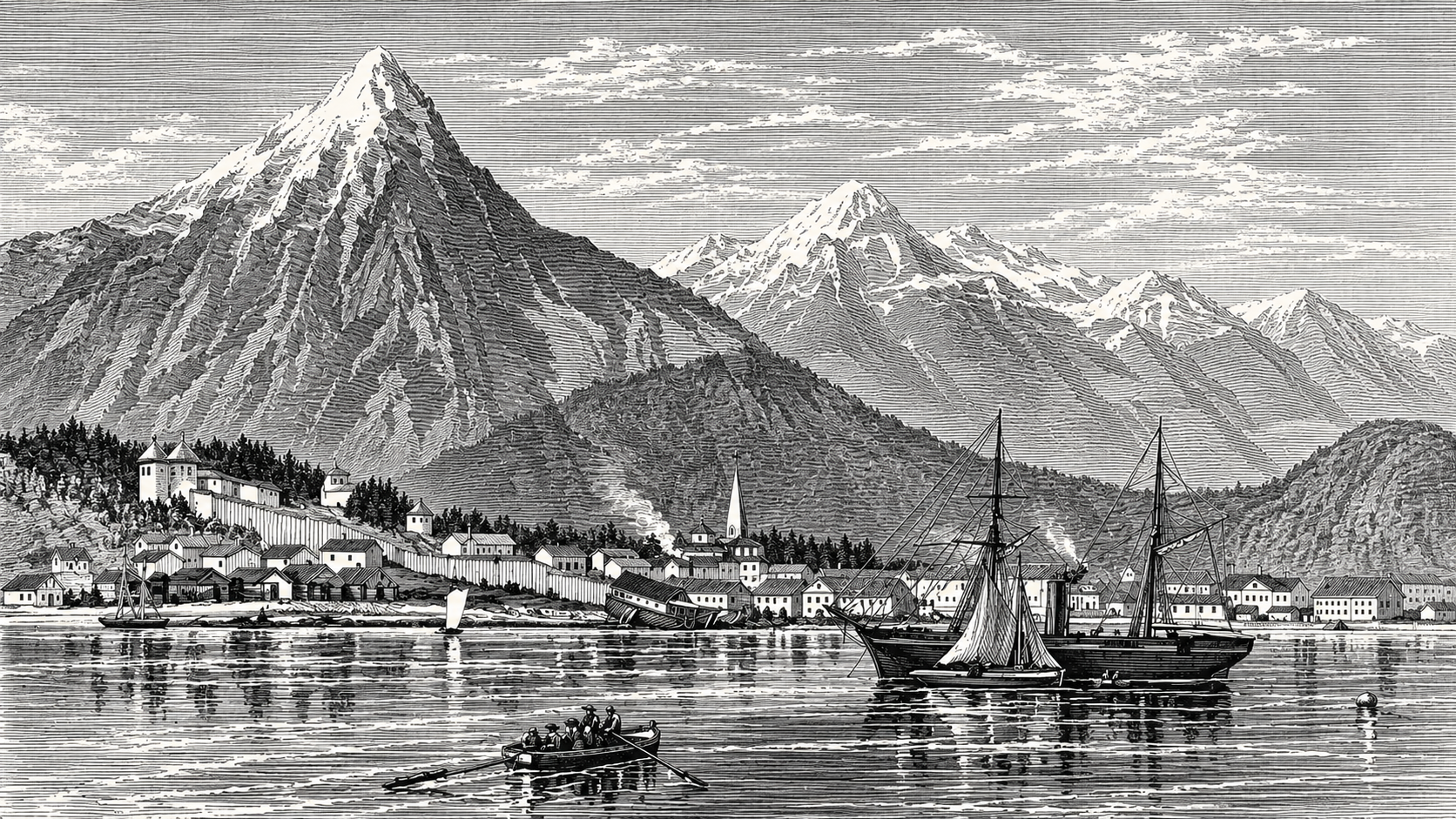
On October 18, 1867, the United States formally took possession of Alaska from the Russian Empire during a ceremony in Sitka, ending more than a century of Russian colonial expansion in the region. The transfer followed a $7.2 million purchase agreement and permanently altered the political geography of North America.
The ceremony marked the beginning of American administration over a territory larger than many European countries. Yet the land was already home to Indigenous nations whose histories, cultures and relationships with the region extended back thousands of years.
For Russia, the sale represented a retreat from a distant and increasingly expensive colony. For the United States, it opened a new chapter of territorial expansion, economic opportunity and strategic influence across the North Pacific.
Why Russia Sold Alaska
Russian involvement in Alaska developed during the 18th century, when explorers and traders crossed the North Pacific in search of valuable animal furs.
The maritime fur trade, particularly the pursuit of sea otters, encouraged the establishment of Russian trading settlements and commercial operations. In 1799, the Russian-American Company received an imperial charter granting it extensive privileges to administer and exploit Russia’s North American possessions.
Russian colonial expansion was not peaceful. Indigenous communities experienced commercial pressure, coercion, disease and armed conflict as foreign traders sought control over resources and territory.
In southeastern Alaska, the Tlingit resisted Russian encroachment. Fighting around Sitka in 1802 and 1804 demonstrated that Russian authority was contested and depended heavily on military and commercial power.
By the middle of the 19th century, the colony had become less attractive to the Russian government.
Sea otter populations had declined following intensive hunting, reducing the profitability of the fur trade. Maintaining settlements across the Pacific was expensive, and Russia faced serious difficulties defending such a distant possession.
Russia’s defeat in the Crimean War, which ended in 1856, reinforced concerns about its military vulnerability.
British possessions lay immediately to the east, and Russian officials feared that Britain might seize Alaska during a future conflict. Selling the territory to the United States offered a way to recover some value while strengthening relations with a potential counterweight to British influence.
Negotiations accelerated after the American Civil War.
U.S. Secretary of State William H. Seward supported the acquisition, viewing Alaska as an opportunity to expand American commercial and strategic interests in the Pacific.
On March 30, 1867, Seward and Russian minister Eduard de Stoeckl signed a treaty establishing the purchase price at $7.2 million in gold.
The U.S. Senate approved the agreement on April 9, and President Andrew Johnson completed American ratification in May. The two governments exchanged ratifications on June 20.
The agreement established the legal framework for the transfer, but the formal handover would take place thousands of kilometres away.
Alaska Changes Hands in Sitka
On October 18, 1867, Russian and American officials assembled at Castle Hill in Sitka, then known to the Russians as New Archangel.
The Russian commissioner, Captain Aleksei Peshchurov, represented the departing empire. Brigadier General Lovell H. Rousseau accepted the territory on behalf of the United States.
Soldiers from both countries participated in the ceremony as the Russian flag was lowered and the American flag raised.
Contemporary accounts describe an unexpected difficulty when the Russian flag became caught during its removal, briefly interrupting the proceedings.
The exchange of flags symbolized the transfer of sovereignty, while official documents established the handover of government property and administrative authority.
The territory covered approximately 1.5 million square kilometres, making the purchase one of the largest territorial acquisitions in American history.
The treaty also addressed the status of people living in the territory. Russian subjects were offered certain choices concerning citizenship and departure, but the agreement treated Indigenous inhabitants differently.
Under its provisions, Alaska Native peoples were excluded from the treaty’s general citizenship protections and made subject to laws and regulations adopted by the United States.
The sale had been negotiated between two imperial governments without the consent of the Indigenous nations whose homelands were involved.
For the Tlingit, Unangax̂ (Aleut), Sugpiaq, Yup’ik, Iñupiat and other Indigenous peoples, the transfer did not erase existing relationships with their lands. It introduced another government claiming authority over them.
American administration brought further changes to land use, commerce, education and political power. Questions involving Indigenous sovereignty and land rights continued long after the transfer ceremony.
The purchase was controversial in the United States. Some critics questioned the value of acquiring a remote northern territory, and the transaction became associated with the expression “Seward’s Folly.”
However, public reaction was not uniformly hostile. Supporters recognized Alaska’s potential natural resources, commercial advantages and strategic position.
During the following decades, discoveries of gold and other resources increased economic interest in the region. Alaska also became an important gateway to the Klondike Gold Rush of the late 1890s.
Its strategic significance grew during the Second World War and the Cold War, when its location near Asia and the Arctic became increasingly important to American defence.
On January 3, 1959, Alaska became the 49th U.S. state.
The events of October 18, 1867, are commemorated annually as Alaska Day. The anniversary recalls a defining moment in American expansion, but the history extends beyond the transfer between Russia and the United States.
It is also the history of Indigenous peoples who inhabited the territory long before either country claimed it, and whose communities continue to shape Alaska’s identity.
What began as a diplomatic agreement between two governments ultimately transformed the future of a vast region and its place in North America.
About the Author Brad Socha is the founder of The Universal Record, focused on sourced, factual global reporting. Coverage includes international news, geopolitics, technology, and major developments.