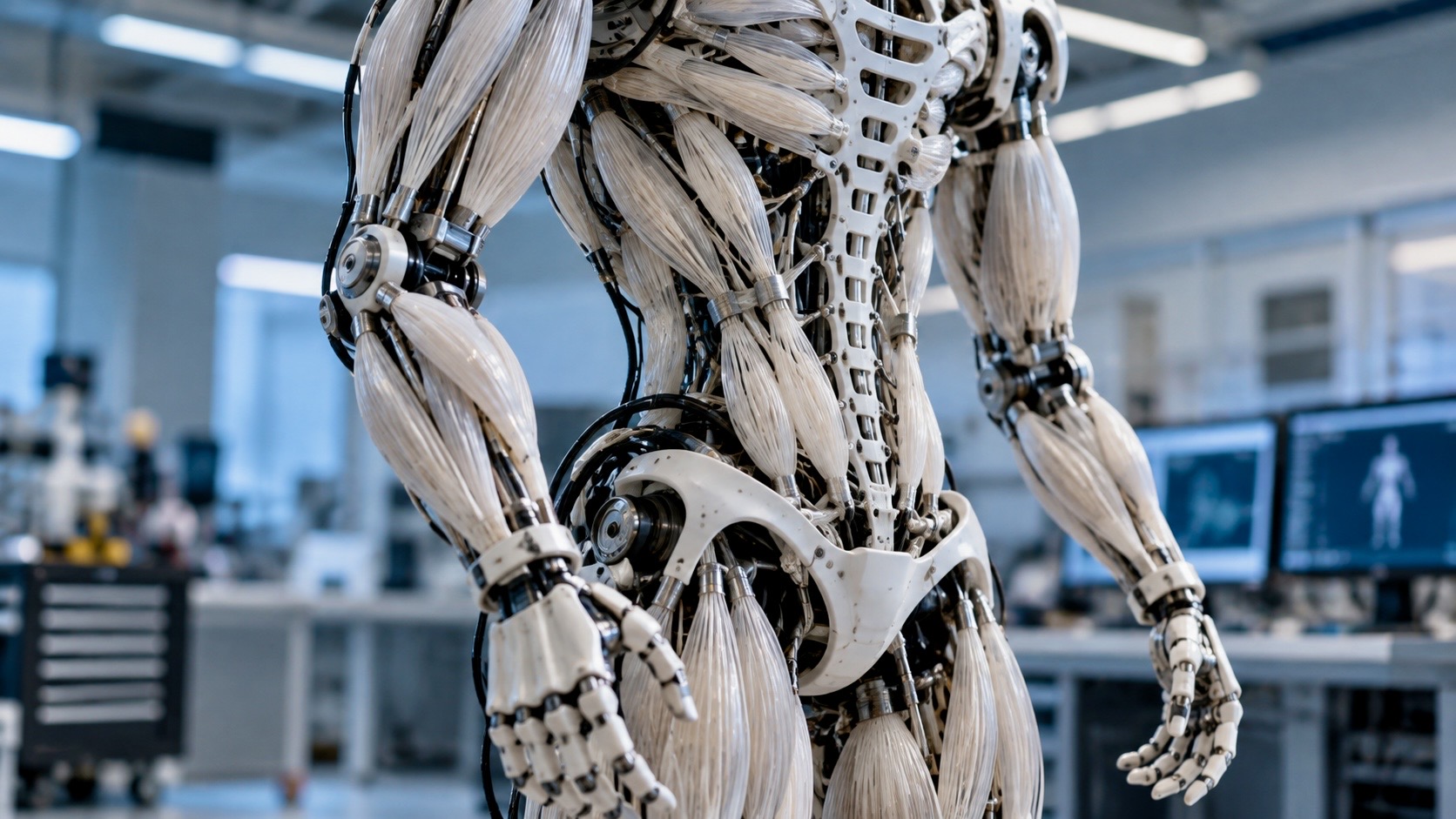
Researchers are developing flexible actuators that contract, stretch and respond more like biological muscle, opening a different path toward robots that can move through the physical world.
Featured image: Conceptual illustration of a humanoid robot built with artificial muscle-like actuators.
Robots usually move because electric motors turn gears, shafts or joints. The human body works differently. Muscles contract and pull through tendons, joints move in response, and sensory feedback constantly adjusts force and position.
Researchers are increasingly trying to reproduce some of those characteristics with artificial muscles: actuators designed to generate movement while remaining flexible or compliant rather than completely rigid.
The idea is not simply to make robots appear more human. Artificial muscles are being investigated for humanoid and soft robots, prosthetic and rehabilitation devices, wearable systems, robotic grippers and medical technologies. A major scientific review published in September 2026 described artificial muscles as a developing bridge between rigid electromechanical machines and biological tissue, while also identifying significant barriers to practical deployment.
The technology is already capable of moving robotic limbs and producing muscle-like contractions in laboratories. The larger challenge is turning individual actuators into reliable machines containing many coordinated muscles, sensors and control systems.
How Artificial Muscles Work
“Artificial muscle” does not describe a single material or mechanism. It covers several technologies designed to reproduce useful characteristics of biological muscle, particularly contraction, flexibility, force generation and mechanical compliance.
Some use compressed air. Pneumatic artificial muscles typically contain a flexible chamber that changes shape when pressurized. McKibben-type actuators, which have roots stretching back decades, contract when their internal bladder expands against a surrounding braided structure.
Others use hydraulic pressure, electricity, heat, magnetic fields or materials that change shape when stimulated. A 2026 scientific review identified pneumatic, hydraulic, thermal, ionic, electrochemical and electrostatic systems among the approaches under development. Each involves different trade-offs in force, movement, speed, efficiency, manufacturing and control.
Electrohydraulic actuators combine electrical and fluidic principles. Researchers at ETH Zurich and the Max Planck Institute for Intelligent Systems demonstrated a musculoskeletal robotic leg using paired electrohydraulic actuators that functioned as flexor and extensor muscles. The experimental leg could jump and adapt to different surfaces, although it was attached to a supporting structure rather than operating as an independent walking robot.
The significance lies partly in compliance, the ability of a mechanism to yield when it encounters an external force. A rigid machine can require sophisticated sensing and control to avoid applying excessive force. Soft and muscle-like actuators can provide some flexibility mechanically.
Researchers are exploring whether that characteristic could eventually make robots better suited to handling delicate objects and interacting physically with people.
There are also attempts to reproduce not just muscle contraction but aspects of the body’s own feedback mechanisms. Research published in Frontiers in Robotics and AI in February 2026 used pneumatic artificial muscles in a musculoskeletal robotic system designed to simulate elements of human stretch and force reflexes. The work illustrates how bio-inspired robotics is expanding from reproducing anatomy toward reproducing some of the control principles behind it.
One particularly visible experiment is Protoclone, a humanoid prototype developed by Clone Robotics. Its human-inspired skeletal structure is surrounded by artificial muscle actuators that pull on the body rather than relying primarily on the conventional arrangement of geared motors at individual joints. Protoclone is an experimental example of the wider musculoskeletal approach; demonstrations of the full-body prototype should not be confused with evidence of a commercially mature autonomous android.
Why Build Robots With Muscles?
Human anatomy offers engineers something that remains extraordinarily difficult to reproduce mechanically: a body that can be powerful, precise and adaptable without being completely rigid.
Consider a hand picking up an egg.
The brain must determine where the egg is, but intelligence alone cannot accomplish the task. Fingers must make contact, detect resistance, regulate grip and continuously make tiny adjustments. Too little force and the egg falls. Too much and it breaks.
This is one reason artificial muscles intersect with the broader field of soft robotics.
A September 2026 study from Delft University of Technology examined ways of improving McKibben artificial muscles by borrowing more complex fibre arrangements from biological muscle. The researchers noted that conventional artificial-muscle systems can provide compliance and high force, but multiple actuators can require bulky pneumatic or hydraulic hardware and introduce problems including leaks and difficult assembly.
Other materials present different compromises. Hydrogel fibres, for example, can be soft and responsive to stimuli including heat, electrical fields and chemical changes. A 2026 review identified potential uses in humanoid robots, exoskeletons and wearable technologies, while highlighting limitations such as mechanical strength, speed and work capacity.
Artificial-muscle research therefore extends far beyond humanoid robots.
Soft actuators could contribute to prosthetic devices that more closely reproduce aspects of biological movement. Wearable systems and exoskeletons could assist human motion. Rehabilitation robots could apply controlled forces while accommodating a patient’s movement. Flexible robotic grippers could handle irregular or fragile objects that are difficult for rigid mechanisms.
Biomedical devices are another promising area of research. Because soft materials can bend and respond to movement, researchers are exploring their use in prosthetics, rehabilitation systems and other technologies that interact directly with the human body. Many of these applications remain experimental, but they show how artificial-muscle technology could extend well beyond humanoid robots.
Humanoid robots face an even greater challenge: creating an artificial muscle is only one part of creating an entire functioning body.
A practical robot must know where its limbs are, determine how much force they are producing, maintain balance and coordinate many actuators simultaneously. It must also carry whatever pumps, compressors, batteries, valves, electronics and computers its particular architecture requires.
Durability presents another challenge. A useful robot may need to repeat movements thousands or millions of times. Flexible materials can stretch, fatigue or fail, while fluid-powered systems introduce seals, tubing, pressure regulation and potential leakage.
Control can be equally difficult. Artificial muscles frequently behave less predictably than conventional motors. Their response may depend on pressure, temperature, deformation or previous movement, requiring sophisticated mathematical models and feedback systems.
Artificial intelligence may eventually help robots learn how to coordinate complicated bodies, but AI cannot eliminate those physical constraints. Understanding an instruction and safely executing it in an unpredictable environment remain different problems.
That is why artificial muscles should not yet be viewed as a replacement for conventional robotic motors. They represent another engineering approach, with advantages and limitations that researchers are still working to understand.
The larger possibility is more interesting than any single humanoid prototype.
Biological evolution produced bodies in which muscles, tendons, bones, sensory systems and the nervous system operate together. Robotics has traditionally approached movement from a different direction, building precise mechanical systems and then controlling them computationally.
Artificial-muscle research is beginning to explore what happens when engineers borrow more of the body’s mechanics as well.
Whether that eventually produces robots that move as naturally as people remains unresolved. But researchers are already demonstrating individual pieces of that idea, and discovering that building a machine more like a body requires much more than giving a robot a human shape.
PubMed — Progress on Artificial Muscles: Material Designs, Structural Engineering, and Actuation Strategies for Advanced Applications https://pubmed.ncbi.nlm.nih.gov/42683600/
About the Author Brad Socha is the founder of The Universal Record, focused on sourced, factual global reporting. Coverage includes international news, geopolitics, technology, and major developments.