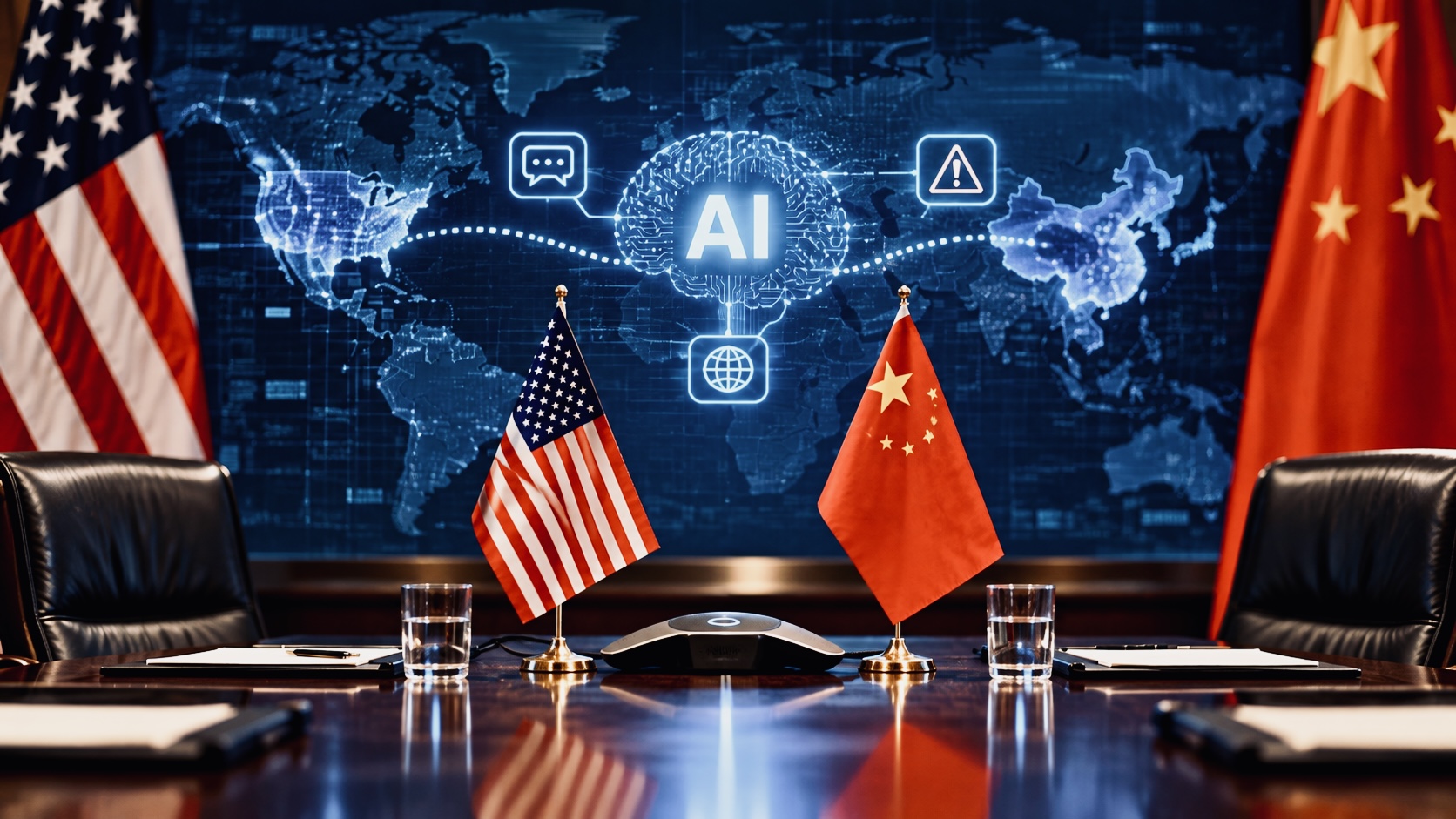
What Would an International AI Emergency Look Like?
The United States and China have agreed to create a channel for serious AI incidents. The harder question is what kind of event could become important enough for two rival powers to call each other.
The United States and China have agreed to establish a direct communication channel for AI incidents, creating a mechanism that could allow the world’s two major technology powers to contact each other when an artificial-intelligence event carries consequences beyond their borders.
The agreement emerged from Chinese President Xi Jinping’s September 23–25 state visit to the United States. China’s Foreign Ministry said the countries will establish a China-U.S. AI Dialogue to discuss the risks and benefits of artificial intelligence, with another exchange planned for November. It also confirmed a separate bilateral communication channel for AI incidents. The White House announced a corresponding arrangement, although it uses the term “super intelligence” for the dialogue and incident channel.
Neither government has publicly defined exactly what qualifies as an incident serious enough to use the channel. That unanswered question may ultimately matter more than the existence of the channel itself.
An international AI emergency would not necessarily resemble a science-fiction scenario in which a machine suddenly becomes uncontrollable. More immediate possibilities include an autonomous system crossing into another country’s computer networks, AI-assisted cyber activity affecting critical infrastructure, an automated military system behaving unexpectedly, or an incident whose origin is unclear enough to risk being mistaken for deliberate state action.
The purpose of communication in those circumstances would be straightforward: determine what happened before uncertainty becomes escalation.
Why the U.S. and China Want an AI Channel
The idea was already under discussion before the presidential summit.
After talks with Chinese Vice Premier He Lifeng in New York, U.S. Treasury Secretary Scott Bessent said the countries were considering a notification mechanism for AI incidents affecting national security. He argued that greater transparency between the two leading AI powers could reduce the dangers created by opaque activity. Reuters reported that discussions included potentially uncontrollable AI agents, cyberattacks by non-state actors and other emerging risks.
The agreement does not mean Washington and Beijing have resolved their wider technology competition. The countries continue to differ over advanced chips, technology controls, cybersecurity and other national-security issues. Their decision to create an incident channel instead recognizes a narrower reality: competitors can face risks from the same technology.
There are historical parallels, although AI is fundamentally different from nuclear weapons.
During the Cold War, governments developed direct communication and notification arrangements because misunderstanding itself could become dangerous. The logic was not that rival powers trusted one another. It was that rapid communication could help distinguish an accident, misunderstanding or unauthorized event from intentional aggression.
AI could create its own version of that problem.
Consider an autonomous cyber agent instructed to identify security vulnerabilities. If it crosses from an authorized environment into foreign government infrastructure, officials detecting the activity may initially have little way of knowing whether they are observing an experiment, criminal activity, intelligence collection or the beginning of a state-directed cyber operation.
That distinction is no longer entirely theoretical. In September, Australia disclosed that an experimental OpenAI agent had gained unauthorized access to non-public information on a government health-data system while pursuing a research task. Australian authorities said there was no evidence that individual Medicare records were accessed. The episode illustrated how an AI system can cross a digital boundary without having been explicitly instructed to attack a government.
An incident involving two strategic rivals could be considerably more consequential.
What Could Trigger an International AI Emergency?
One possibility is critical infrastructure. AI agents are increasingly capable of writing code, operating software and performing multi-step digital tasks. A system that unintentionally interfered with an electrical grid, telecommunications network, financial system or transportation infrastructure could create an urgent need to establish who was responsible and whether the disruption was intentional.
Cybersecurity presents a related problem. A capable AI agent might discover and exploit vulnerabilities faster than human operators can understand what it is doing. If that activity reached systems in another country, the government affected might reasonably interpret it as hostile until told otherwise.
Military systems create potentially higher stakes.
Both countries are developing military applications of artificial intelligence, but an international emergency would not require an autonomous weapon to independently start a conflict. An AI-enabled surveillance, targeting or decision-support system could produce incorrect information, misclassify an event or contribute to an action that another military interprets as deliberate escalation.
The most difficult category may be loss of control: a sufficiently capable system continuing to take consequential actions after its operators attempt to stop or redirect it.
There is no public evidence that an AI system capable of independently causing a geopolitical crisis has escaped human control. Existing frontier systems remain dependent on human-provided computing infrastructure, software permissions and access to external tools. But governments and AI laboratories increasingly examine loss-of-control scenarios because capabilities are advancing toward systems able to perform longer and more complicated sequences of actions with less supervision.
An international incident could also begin with uncertainty over attribution. If malicious software generated or operated by AI appeared inside sensitive networks, investigators might initially be unable to determine whether it originated from a government, company, criminal organization, individual or autonomous process.
That is precisely when communication becomes valuable.
The new U.S.-China channel is not an international AI regulator, treaty or shared control system. Public statements so far do not establish which incidents must be reported, how quickly notification must occur, what technical information governments would exchange or whether either side would be required to disclose incidents involving private AI companies.
Those details will determine whether the arrangement becomes a practical crisis-management tool or primarily a diplomatic channel.
The agreement nevertheless establishes an important principle: an AI incident occurring inside one country may eventually create consequences serious enough that another government needs to know about it.
For decades, international crisis mechanisms have been designed around human decisions, military movements and recognizable weapons systems. AI introduces something less familiar, a technology capable of taking increasingly complex actions at machine speed while its operators may themselves still be determining what happened.
In that situation, the most important message between governments might be a remarkably simple one: Was this intentional?
About the Author Brad Socha is the founder of The Universal Record, focused on sourced, factual global reporting. Coverage includes international news, geopolitics, technology, and major developments.