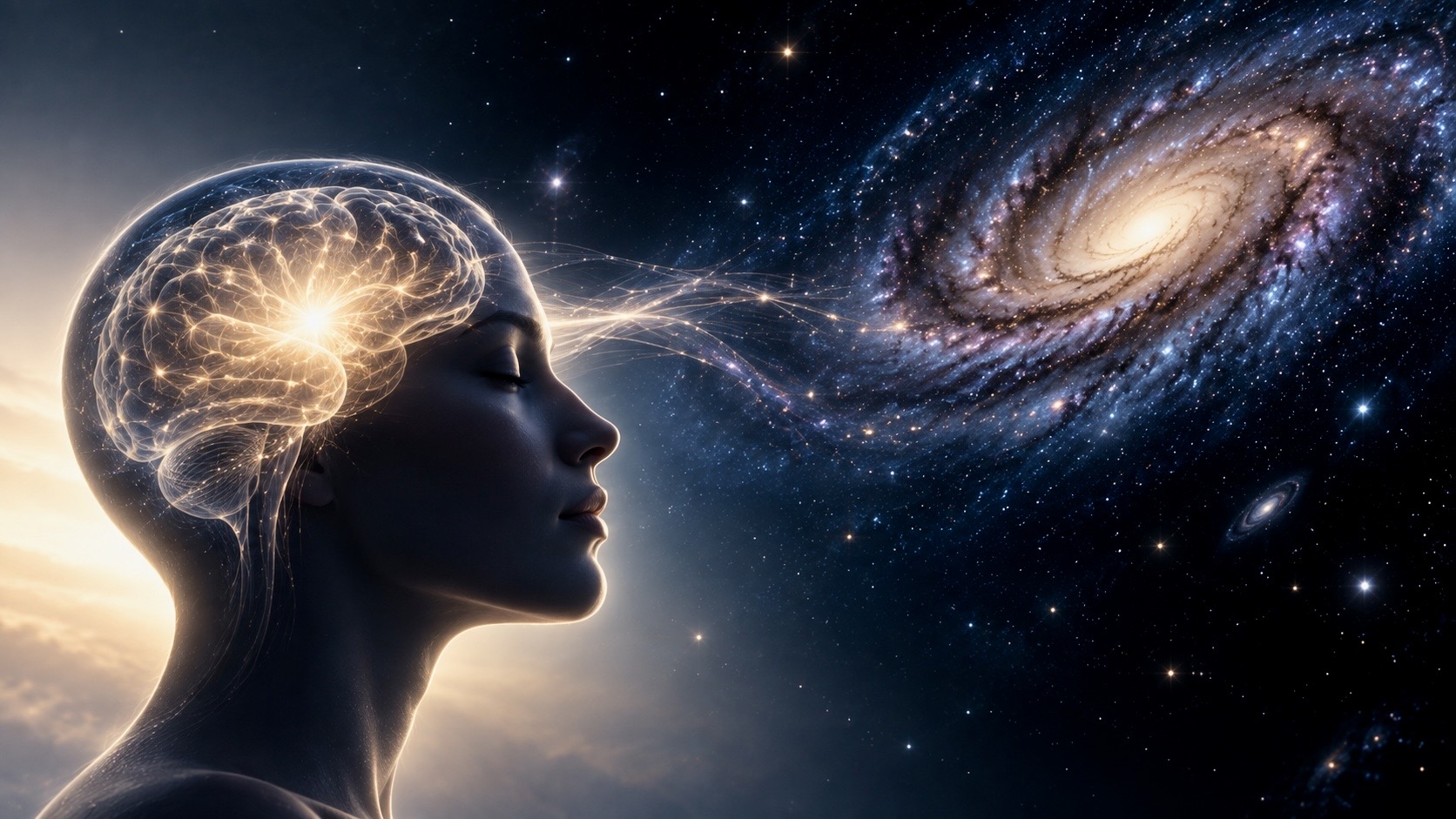
What Is Consciousness? Why Science Still Can’t Fully Explain It
Brain imaging, anesthesia and studies of severely injured patients are revealing when consciousness appears and disappears, but no experiment has yet explained why brain activity produces subjective experience at all.
Every waking moment contains something science can observe only indirectly: the experience of being you. Colours look a certain way, pain hurts, music sounds like something, and thoughts appear within an inner point of view. Consciousness is so familiar that it can seem ordinary, yet explaining how it arises remains one of neuroscience’s most difficult problems.
Scientists have made substantial progress identifying brain activity associated with conscious perception and distinguishing conscious from unconscious states. They can study what changes during sleep, anesthesia and severe brain injury. But finding the neural machinery associated with experience is not the same as explaining why that machinery should produce experience in the first place.
That gap is why consciousness remains both a scientific problem and a philosophical one.
Searching the Brain for Consciousness
A major goal of neuroscience has been to identify the neural correlates of consciousness: the minimum neural mechanisms associated with a particular conscious experience or conscious state.
Researchers can present a stimulus that a person sometimes consciously perceives and sometimes does not, then compare brain activity between the two conditions. Techniques including functional magnetic resonance imaging, electroencephalography and direct recordings of neural activity can reveal differences associated with awareness.
The difficulty is separating consciousness itself from processes that accompany it. Attention, memory, decision-making and reporting what someone experienced can all generate brain activity. A signal appearing when a person reports seeing an image might therefore reflect the conscious experience, the act of remembering it or the preparation of a response.
Anesthesia provides another window into the problem. General anesthetics can cause a reversible loss of responsiveness and, typically, conscious experience without simply shutting the brain down. Neural activity continues, but communication and coordination among brain networks change. Research into anesthesia has consequently helped scientists investigate which forms of brain interaction may be necessary for consciousness.
Severe brain injury provides an even more consequential test.
In a 2024 multinational study published in The New England Journal of Medicine, researchers examined 353 people with disorders of consciousness using behavioral assessments and either functional MRI, EEG or both. Among 241 participants who showed no observable response to commands, 60, about 25%, displayed brain responses indicating they could perform cognitive tasks when instructed. Researchers call this phenomenon cognitive motor dissociation.
The finding does not mean every unresponsive patient is consciously aware. It demonstrates something more specific and clinically important: outward behaviour alone can sometimes fail to reveal cognitive processing occurring inside an injured brain.
It also exposes a fundamental problem in consciousness research. Consciousness is private. Scientists can measure behaviour and neural activity, but another person’s subjective experience cannot be directly observed.
Competing Theories of Consciousness
There is no universally accepted scientific theory explaining how the brain produces consciousness.
Global Neuronal Workspace Theory proposes, broadly, that information becomes consciously accessible when it is amplified and distributed across a large-scale network, making it available to systems involved in memory, evaluation and action.
Integrated Information Theory takes a different approach. It attempts to relate consciousness to the amount and structure of integrated information within a system. Other frameworks emphasize recurrent neural processing, higher-order representations, predictive processing or combinations of mechanisms.
Scientists have increasingly tried to move beyond debating these theories toward testing competing predictions directly.
A major adversarial collaboration published in Nature in 2025 tested predictions from Global Neuronal Workspace Theory and Integrated Information Theory using multiple experimental methods. Some findings were consistent with predictions from each theory, while other results challenged important elements of both. The experiment did not produce a decisive winner.
That result illustrates the state of the field: researchers are accumulating increasingly sophisticated evidence without converging on a single explanation. A recent review of major theories likewise found substantial areas of disagreement and unresolved questions about what mechanisms are sufficient for conscious experience.
Language adds another complication. Humans often reveal consciousness by describing what they experience, but the ability to speak should not automatically be equated with the capacity for experience. Infants process and learn about their surroundings before acquiring language, and the possibility of consciousness in non-human animals is actively studied despite their lack of human language. Language is enormously useful for reporting experience; it is not established as a prerequisite for consciousness itself.
This distinction has become increasingly relevant as artificial intelligence grows more sophisticated. A machine can generate remarkably human-like descriptions of emotions, perceptions and self-reflection. Such behaviour alone does not establish that the system has subjective experiences. Without an accepted theory or reliable test for consciousness, science currently has no straightforward method for determining whether sufficiently advanced artificial systems could ever become conscious.
Brain-computer interfaces present the question from the opposite direction. Rather than asking whether a machine possesses an inner experience, researchers can sometimes use neural signals to reveal intentions or cognitive activity in people who cannot communicate normally. The discoveries in patients with severe brain injuries show how much may remain hidden when behaviour is the only available measurement.
Science can increasingly identify conditions under which consciousness changes, fades or appears to return. It can map networks associated with perception and test theories about how information travels through the brain.
What remains unexplained is how physical activity in the brain gives rise to subjective experience, why neural signals are accompanied by the sensation of seeing a colour, feeling pain, hearing music or simply being aware.
Neuroscience may eventually reveal more of the mechanisms behind that experience. For now, consciousness remains an extraordinary scientific frontier: something we experience every waking moment, but still cannot fully explain.
Philosophical Transactions of the Royal Society B — Becoming Human: Human Infants Link Language and Cognition, but What About the Other Great Apes? https://doi.org/10.1098/rstb.2018.0408
About the Author Brad Socha is the founder of The Universal Record, focused on sourced, factual global reporting. Coverage includes international news, geopolitics, technology, and major developments.