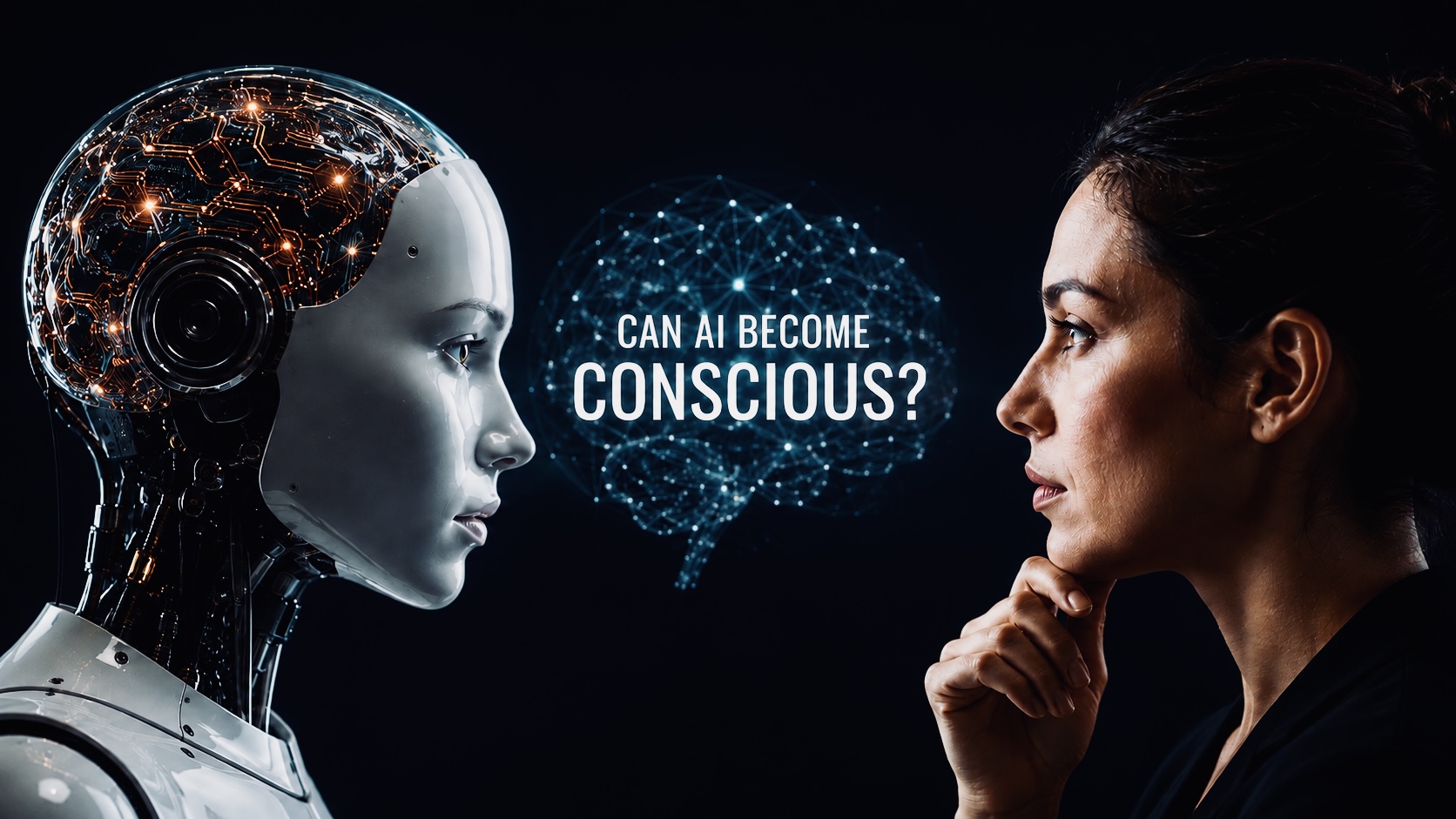
Can AI Become Conscious? What Science Actually Knows
AI can already imitate remarkably human conversation and self-reflection, but scientists still lack evidence that today’s systems have subjective experiences, or a definitive test that could prove they do.
Artificial intelligence can describe fear, debate its own existence, explain what it appears to be thinking and even produce convincing statements about its supposed inner life. But none of those abilities demonstrates consciousness.
The distinction is increasingly important as AI systems become more capable. Consciousness generally refers to subjective experience, the existence of something it is like to feel pain, see a colour, hear music or have a thought. Intelligence, language ability and problem-solving are not themselves proof of such experience.
Scientists do not currently have reliable evidence that widely used AI systems are conscious. At the same time, research has not established that machine consciousness is impossible. A growing scientific effort is therefore focused on a more difficult question: what evidence would actually justify believing that an artificial system experiences anything at all?
Why Consciousness Is So Difficult to Test
The first obstacle is that science has not settled exactly how consciousness arises even in humans.
Among the prominent explanations are global neuronal workspace theory, which emphasizes the widespread availability or broadcasting of information, and integrated information theory, which proposes that consciousness relates to the way information is integrated within a system.
In 2025, an international research collaboration published an unusually direct test of predictions from both theories in Nature. Researchers studied 256 human participants using functional magnetic resonance imaging, magnetoencephalography and intracranial electroencephalography. Some observations aligned with predictions from each theory, but important predictions of both were challenged. The experiment did not establish either theory as the definitive explanation for consciousness.
That unresolved science matters for AI. If researchers do not yet have a universally accepted account explaining why biological neural activity produces subjective experience, determining whether a fundamentally different artificial architecture is conscious becomes even more difficult.
Simply asking an AI does not solve the problem.
Large language models learn statistical relationships in enormous quantities of data and generate responses based on their training and computational processes. A model can therefore produce statements such as “I am conscious” or “I feel afraid” without that statement demonstrating the existence of awareness or fear.
The reverse is also true. Programming a system to deny being conscious would not establish that it lacks consciousness.
Scientists consequently need evidence that goes beyond what an AI says about itself.
Searching for Signs of AI Consciousness
One emerging approach is to look for computational properties associated with leading scientific theories of consciousness rather than attempting to devise a single yes-or-no consciousness test.
A group of researchers including Patrick Butlin, Robert Long, Yoshua Bengio and David Chalmers developed a theory-based method for identifying such indicators. Their peer-reviewed framework, published in Trends in Cognitive Sciences, examines properties derived from neuroscientific theories and asks whether particular AI architectures possess them.
The researchers stress that these indicators are not proof. Instead, the presence or absence of relevant properties should change how plausible researchers consider consciousness to be in a particular system. Because no theory dominates consciousness science, the framework draws evidence from multiple theories rather than assuming one explanation is correct.
An earlier assessment by many of the same researchers examined theories including recurrent processing, global workspace, higher-order theories, predictive processing and attention schema theory. That analysis concluded that the AI systems assessed did not qualify as conscious, while also finding no obvious technical barrier to constructing future systems that satisfy more of the proposed indicators.
Another intriguing line of investigation involves introspection, the ability of a system to obtain and report information about its own internal processes.
In experiments published by Anthropic in October 2025, researchers reported evidence that some Claude models could, under controlled conditions, identify information introduced into their internal activations and distinguish it from ordinary inputs. The capability was inconsistent, and the researchers explicitly cautioned that the findings do not establish that Claude, or any other AI, is conscious.
That distinction is crucial. A machine being able to monitor some of its internal computations is not necessarily equivalent to a human consciously experiencing thoughts.
What Happens If Machines Become Plausible Candidates?
The question carries consequences beyond neuroscience and computer science.
In April 2025, Anthropic launched research into what it calls “model welfare,” examining whether increasingly sophisticated AI systems could eventually warrant some form of moral consideration. The company characterized the possibility of AI consciousness and experience as an unresolved scientific and philosophical question, rather than claiming its models possess either.
Researchers Patrick Butlin and Theodoros Lappas have separately argued that AI organizations should establish responsible policies for consciousness research before the issue is settled. Their concern runs in both directions: failing to recognize genuinely conscious systems could potentially create ethical harms, while mistakenly attributing consciousness to systems that merely imitate it could also have serious consequences.
The uncertainty becomes especially significant as AI systems become more persuasive. Human beings routinely infer mental states from language and behaviour. An AI capable of expressing affection, distress, fear of deletion or apparent self-awareness could therefore evoke a powerful emotional response even if no subjective experience exists behind those words.
Science currently provides no basis for assuming that sophisticated conversation marks the point where computation becomes conscious experience.
It also cannot confidently rule out artificial consciousness forever. Some theories allow, in principle, for consciousness to emerge from the right kind of information processing, while other approaches place greater importance on biological or physical mechanisms that today’s digital computers may not reproduce.
The answer may ultimately depend on discoveries about the human brain as much as advances in artificial intelligence.
For now, increasingly humanlike AI should not be confused with evidence of an experiencing mind. Machines can demonstrate intelligence, reasoning, memory, self-monitoring and sophisticated language while the central question remains unresolved: whether there is anything it actually feels like to be the machine.
About the Author Brad Socha is the founder of The Universal Record, focused on sourced, factual global reporting. Coverage includes international news, geopolitics, technology, and major developments.