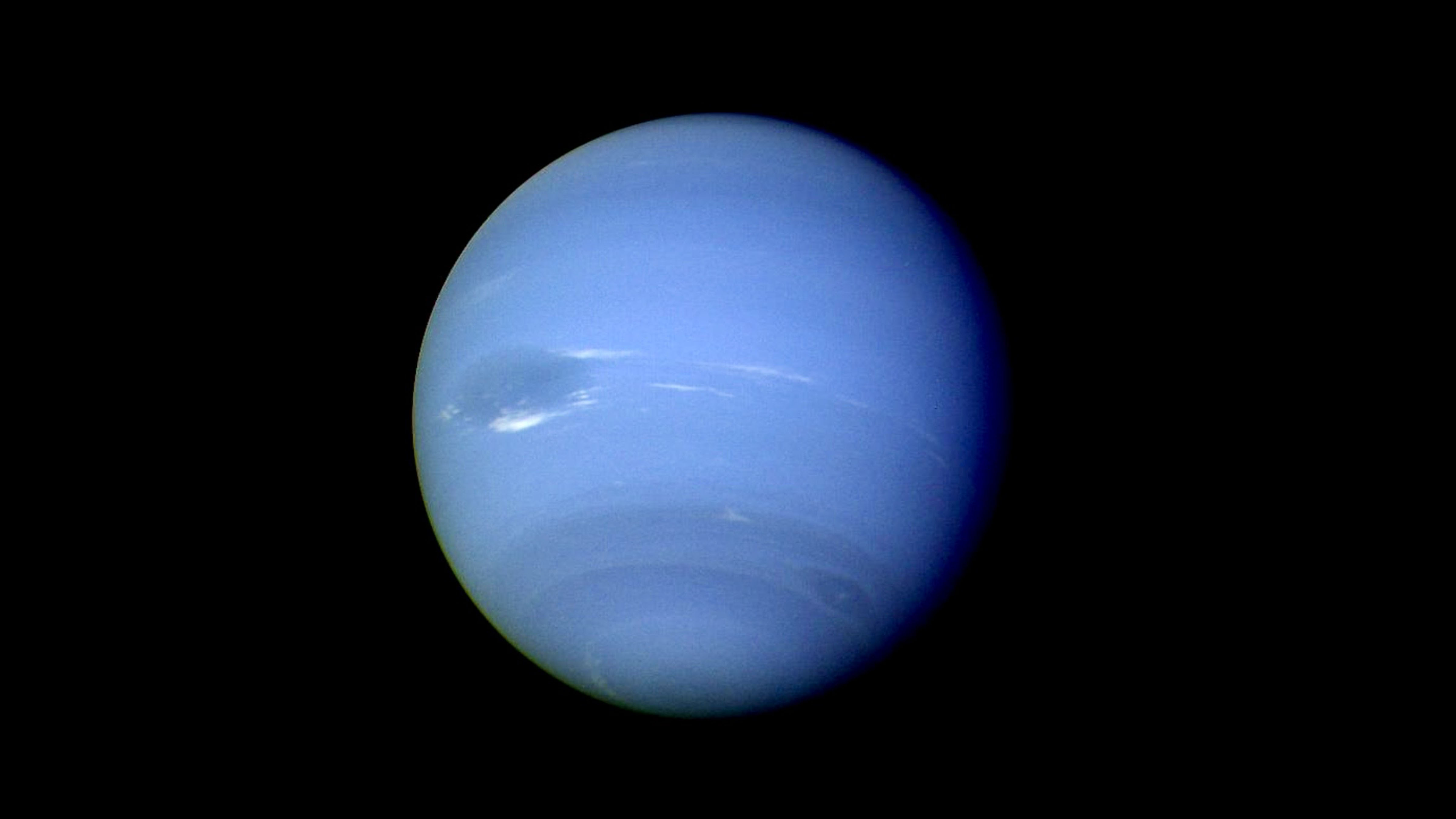
NASA’s only visit to Neptune revealed a dynamic world of immense winds, faint rings and unexpected moons, completing an unprecedented tour of the giant planets.
On August 25, 1989, NASA’s Voyager 2 swept past Neptune after a journey of more than 12 years, giving humanity its first close look at the solar system’s most distant planet. At 03:56 UTC, the spacecraft passed roughly 4,800 kilometres above Neptune’s cloud tops, closer than it had approached any of the other planets on its extraordinary journey.
No spacecraft had reached Neptune before it. None has returned since.
The encounter was the culmination of a planetary expedition that began when Voyager 2 launched on August 20, 1977. It had already explored Jupiter in 1979, Saturn in 1981 and Uranus in 1986. Neptune would be its fourth and final planetary encounter, making Voyager 2 the only spacecraft ever to visit all four giant planets.
The opportunity was remarkable. Neptune lies about 30 times farther from the Sun than Earth, and the spacecraft was billions of kilometres from home. Around the time of the encounter, a radio signal travelling at the speed of light took nearly four hours to reach Earth.
Voyager Reveals an Active World
Before the encounter, Neptune remained largely mysterious. Its enormous distance made detailed observation from Earth difficult. Voyager 2 transformed that picture.
Its cameras revealed an unexpectedly active atmosphere, including bright high-altitude clouds and a vast storm system known as the Great Dark Spot. Winds were measured at extraordinary speeds, demonstrating that Neptune possessed vigorous weather despite receiving only a fraction of the sunlight reaching the inner solar system.
The Great Dark Spot was large enough to rival Earth in scale. Later observations by the Hubble Space Telescope found that the storm had disappeared, reinforcing the understanding of Neptune as a changing, dynamic world rather than a static blue sphere.
Voyager 2 also transformed scientists’ understanding of Neptune’s surroundings. During the encounter it discovered six moons, Naiad, Thalassa, Despina, Galatea, Larissa and Proteus, and provided detailed observations of the planet’s faint ring system. NASA records the encounter as having revealed four new rings, while Voyager imagery provided the first detailed views of Neptune’s rings and their unusual concentrations of material.
The mission also detected radio emissions associated with Neptune’s magnetic field before closest approach. Together, measurements of the atmosphere, magnetic environment, rings and satellites turned a distant telescopic object into a complex planetary system.
Then Voyager 2 turned its attention toward one of the encounter’s most important targets: Triton.
A Final Close Look at Triton
About five hours after passing Neptune, Voyager 2 flew roughly 40,000 kilometres from Triton, Neptune’s largest moon. It was the last substantial solid world the spacecraft would encounter during its planetary tour.
Triton proved to be far stranger than a simple frozen satellite.
Voyager discovered an extraordinarily cold, reflective surface and evidence of active plumes. Images showed material rising about eight kilometres above the surface and being carried downwind for roughly 140 kilometres. The observations provided evidence of geological activity on a world receiving very little solar energy.
Triton is also unusual because it travels around Neptune in a retrograde orbit, the opposite direction to the planet’s rotation. That characteristic is an important clue to its history and supports the idea that Triton was likely captured by Neptune rather than forming alongside the planet.
After Triton, there were no more planets ahead.
Voyager 2 departed Neptune heading southward out of the plane in which most planets orbit the Sun. Its grand planetary tour was finished, but the spacecraft’s mission was not. Its instruments continued studying the environment far beyond the major planets, eventually carrying the mission into interstellar space.
The Neptune encounter also left planetary scientists with something unusually valuable: a detailed scientific record of a world that remains otherwise unexplored at close range. Modern telescopes have continued observing Neptune and have revealed changes in its atmosphere, but every close-up image ever taken there still comes from that single 1989 encounter.
Voyager 2 therefore occupies a unique place in the history of planetary exploration. One spacecraft visited Jupiter, Saturn, Uranus and Neptune, returning observations from worlds separated by billions of kilometres and completing a journey that has never been duplicated.
More than three decades after the flyby, Neptune remains the only planet in the solar system visited just once.
And the spacecraft that made that visit was already 12 years into its journey when it arrived.
About the Author Brad Socha is the founder of The Universal Record, focused on sourced, factual global reporting. Coverage includes international news, geopolitics, technology, and major developments.