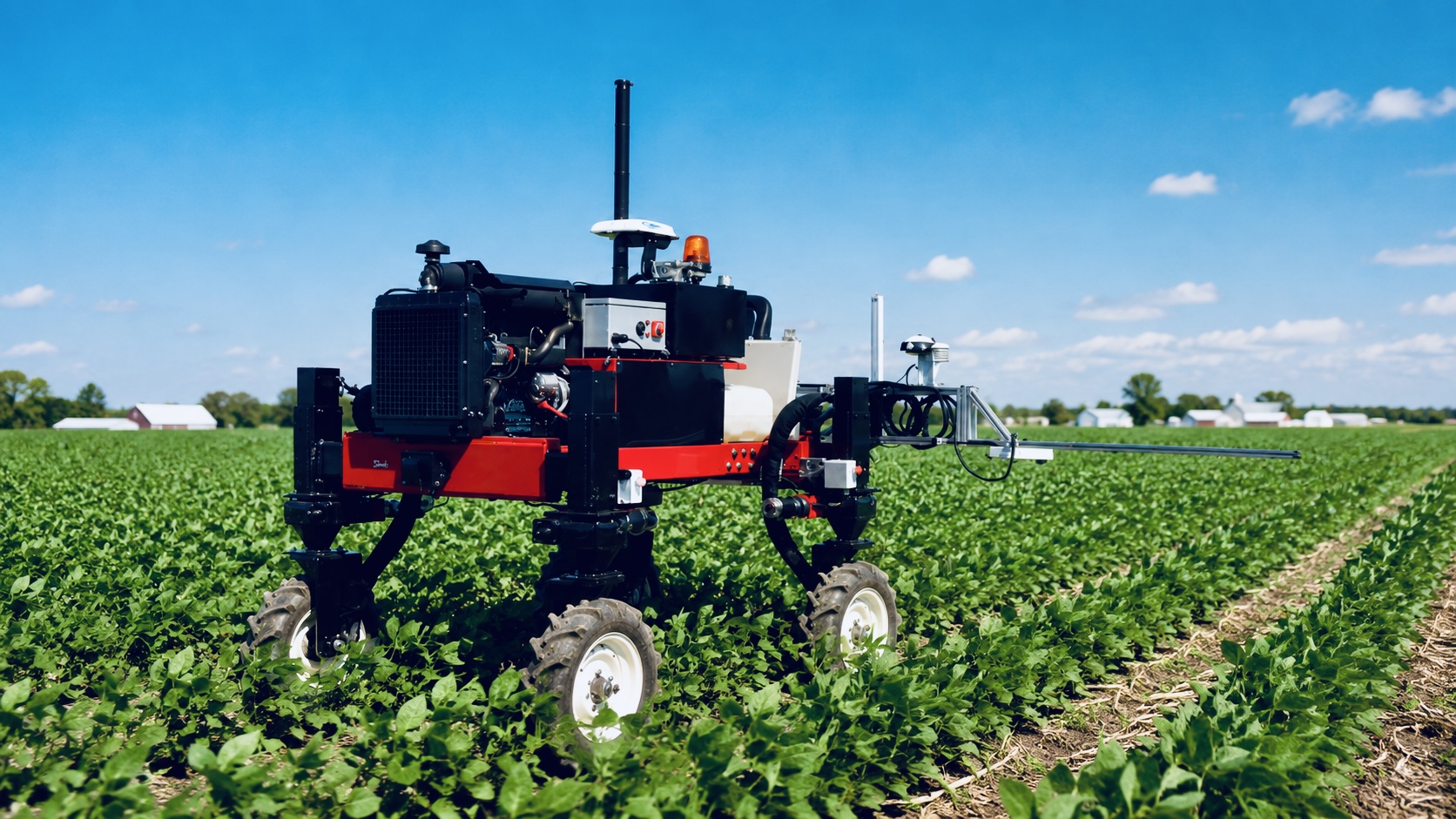
From autonomous tractors and satellite crop monitoring to precision irrigation, fertilizer management and pest detection, artificial intelligence is moving from agricultural research into real farm operations.
Artificial intelligence is beginning to change Agriculture at field level, where decisions that were once based primarily on visual inspection, experience and fixed schedules can increasingly be informed by cameras, satellites, sensors and machine-learning models. Some systems are already commercially deployed, while others remain experimental. Together, they point toward farming in which machinery and inputs can respond more precisely to conditions that vary across a single field.
The goal is not simply to automate farmers out of the process. Much of agricultural AI is being developed as decision-support technology: identifying patterns in enormous quantities of crop, soil and weather data, alerting operators to problems and helping equipment act on those observations.
That distinction matters. Agriculture takes place in environments that can change rapidly because of rainfall, temperature, soil conditions, insects, disease and crop development. An AI system useful on one crop or farm may require different training, sensors or human oversight somewhere else.
Autonomous Agriculture Moves Into the Field
Perhaps the most visible change is occurring in farm machinery.
John Deere now offers autonomous capability for several of its large tractors and tillage implements. Its system can be configured in a field and monitored remotely through a smartphone or tablet. Deere says the tractor scans its surroundings for obstacles and can alert the operator if it encounters an obstacle or mechanical problem. The company also offers an autonomy upgrade for some existing equipment rather than restricting the technology entirely to new tractors.
That is significant for an industry where certain jobs must be completed within narrow weather windows and labour availability can affect how quickly fields are planted, cultivated or harvested.
Autonomy is also extending beyond large tractors. USDA-backed research programs are developing AI-controlled robots for tasks including harvesting, crop monitoring and other labour-intensive operations. Not every prototype will become commercially practical, but the direction is clear: agricultural machinery is increasingly combining robotics, computer vision, GPS, sensors and machine learning.
AI is also changing what machines do as they move through a field.
Computer vision can identify plants in real time. John Deere’s See & Spray system, for example, uses cameras and machine learning to distinguish weeds from crops and activate spraying where weeds are detected rather than continuously applying herbicide across the entire area. Deere has reported substantial herbicide reductions in its own field data, although those figures are company-reported and results can depend on crop, weed pressure and operating conditions.
The same principle can be extended to insects and disease. Cameras mounted on drones, vehicles or other platforms can collect images that algorithms analyze for visual patterns associated with plant stress, weeds, pests or disease symptoms.
USDA-funded work in the western United States has used remotely sensed imagery and AI to improve pest detection and has tested multispectral drones for disease and weed detection in specialty crops.
Water, Fertilizer and Crops Become Data Problems
Crop monitoring is one of AI’s broadest agricultural applications.
Satellite imagery, drones and ground-based sensors can repeatedly observe fields at scales that would be difficult to inspect manually. Machine-learning systems can then analyze changes in vegetation, soil moisture, temperature and other measurements to identify areas that may require attention.
USDA’s National Institute of Food and Agriculture says crop and soil monitoring systems are increasingly combining machine learning with remote sensing, satellites, drones and precision-agriculture technologies. USDA researchers have also demonstrated how time-series satellite imagery can help AI identify crops across agricultural landscapes.
Water management is a particularly important use.
Instead of irrigating an entire field according to one schedule, precision systems can combine soil-moisture measurements, weather conditions, remotely sensed imagery and crop information to estimate where and when plants require water. USDA research has explored AI-supported systems capable of predicting crop water stress so irrigation can be directed toward areas where it is needed.
The potential benefit is both economic and environmental: water can be targeted more precisely while reducing unnecessary irrigation, runoff and deep percolation.
Fertilizer can be managed in a similar way.
Nutrient requirements are rarely uniform across an entire field. Soil composition, previous yields and crop conditions can vary considerably over relatively short distances. Precision systems can combine soil and yield maps with sensors, satellite observations and predictive models to help determine how much fertilizer should be applied in different locations.
A joint U.S.-Brazil agricultural research initiative is investigating precision management, big data and AI as tools for distributing nutrients more efficiently, with the aim of reducing fertilizer requirements and nutrient losses to the environment.
The long-term vision is therefore more sophisticated than simply replacing a human driver with a computer. A machine could eventually detect the condition of individual plants or sections of a field and adjust water, fertilizer or crop-protection treatments as it travels.
There are important limits. AI models depend on the quality and relevance of the information used to train them. Agricultural conditions vary between regions, crops and growing seasons, and rural connectivity can be limited. USDA-supported research has specifically identified weak internet access, computing constraints and highly variable production environments as obstacles to deploying advanced systems widely.
Cost also matters. Large farms may be better positioned to invest in autonomous equipment, sensor networks and sophisticated software than smaller operations unless less expensive systems become widely available.
For that reason, AI in agriculture is best understood as an expanding set of tools rather than a single technological revolution occurring everywhere at once. Autonomous tractors are already working commercially, computer vision is targeting weeds, and AI-supported monitoring is helping researchers and farmers make increasingly precise decisions about crops, water and nutrients.
The larger shift is toward agriculture in which decisions can be made at the scale of individual sections of a field, and eventually, in some applications, individual plants. Farmers will still determine what objectives those systems serve. AI is increasingly giving them a more detailed picture of what is happening between planting and harvest.
About the Author Brad Socha is the founder of The Universal Record, focused on sourced, factual global reporting. Coverage includes international news, geopolitics, technology, and major developments.