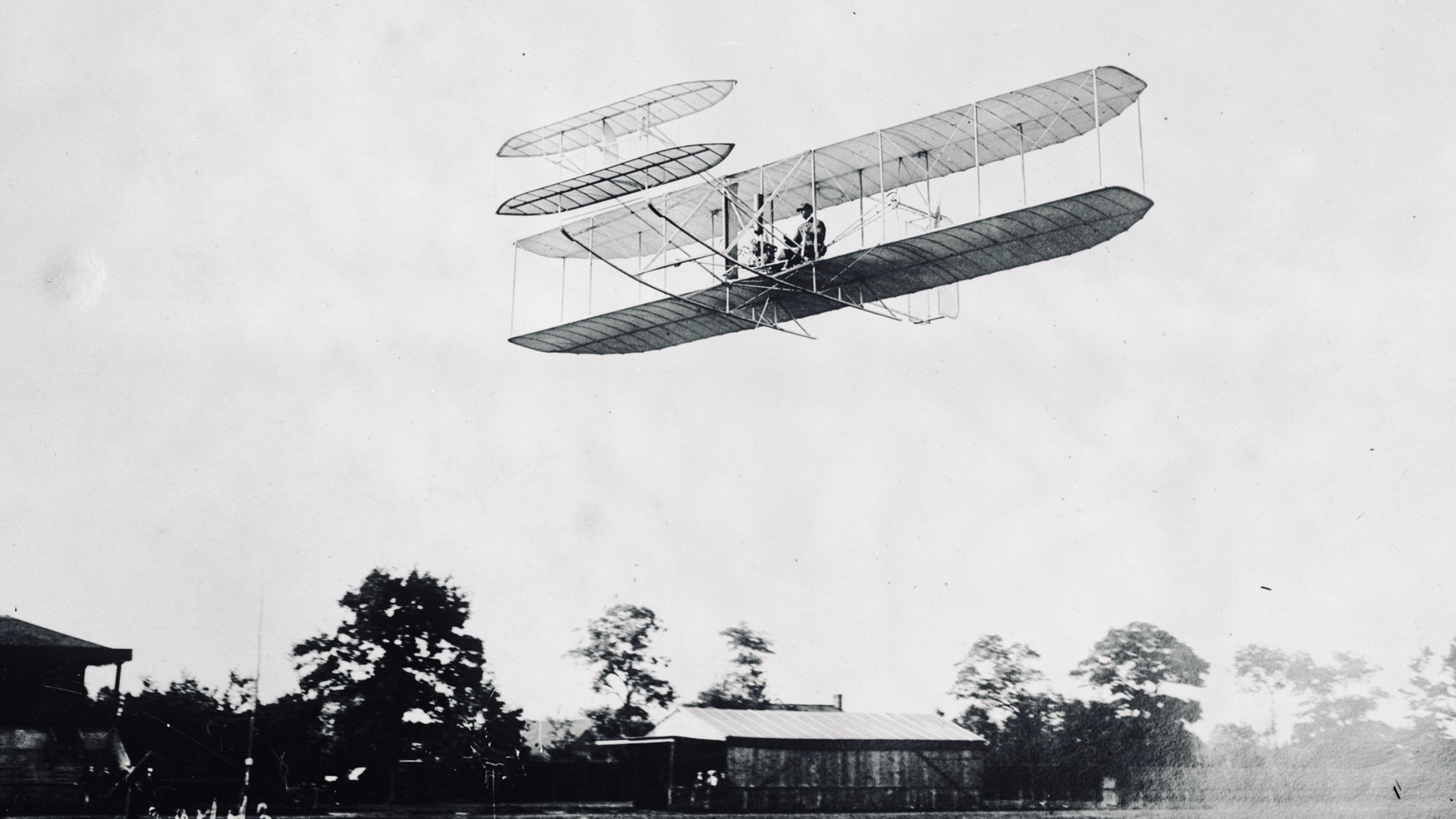
Five years after the Wright brothers’ breakthrough at Kitty Hawk, a brief public demonstration near Le Mans showed Europe how far controlled powered flight had advanced.
On August 8, 1908, Wilbur Wright took off from the Hunaudières racecourse near Le Mans, France, and publicly demonstrated a Wright airplane in Europe for the first time. The flight lasted less than two minutes, but its controlled turns made an immediate impression on experienced European aviators and observers. Five years after the brothers’ first powered flights in North Carolina, Wilbur had provided visible proof of the control and maneuverability that distinguished the Wright aircraft.
The importance of the demonstration went beyond its short duration. European experimenters had made significant progress in aviation, but skepticism remained about the Wright brothers’ earlier claims. Their reluctance to reveal their aircraft publicly while protecting patents and pursuing commercial agreements had contributed to those doubts. At Le Mans, Wilbur could finally demonstrate what the brothers had developed.
Wright Takes His Aircraft to Europe
The Wright brothers had made their historic powered flights at Kitty Hawk, North Carolina, on December 17, 1903. Orville piloted the first, remaining airborne for 12 seconds and traveling 120 feet. Wilbur made the fourth and longest flight of the day, covering 852 feet in 59 seconds.
Those flights were only the beginning. At Huffman Prairie near Dayton, Ohio, the brothers continued refining their aircraft. By 1905, they had developed a machine capable of sustained, controlled flight and repeated turns. They then largely stopped flying while seeking patent protection and customers for their invention.
Their relative secrecy had consequences. Aviation was developing rapidly in Europe, particularly in France, where Alberto Santos-Dumont, Henri Farman, Léon Delagrange and others were conducting public flights. Because Europeans had not seen the Wrights reproduce their more advanced claims publicly, some questioned whether the Americans had accomplished what they said they had.
By 1908, the brothers were ready to demonstrate their technology. They divided the task: Orville prepared to conduct trials for the U.S. Army at Fort Myer, Virginia, while Wilbur travelled to France.
Wilbur arrived in France in May. His aircraft had been damaged during transportation and handling, forcing him to spend weeks repairing and preparing it. Eventually, the Hunaudières racecourse south of Le Mans was selected for the demonstration.
On August 8, the wait ended.
Wilbur’s first flight lasted approximately one minute and 45 seconds. Duration alone was not what impressed the spectators. His ability to bank, turn and maintain deliberate control of the aircraft demonstrated capabilities that European observers immediately recognized as significant.
It was the Wright brothers’ first flight in Europe, and it began changing perceptions almost immediately.
Wright Changes European Perceptions
The demonstration helped confirm the Wright brothers’ claims and transformed Wilbur’s reception in France. Instead of relying on reports of flights conducted years earlier in the United States, European aviators could now watch the Wright machine perform for themselves.
It was also only the beginning.
Wilbur continued flying at Hunaudières during the following days before moving operations to the larger Camp d’Auvours military field east of Le Mans. His increasingly ambitious flights attracted substantial crowds as public interest grew.
The demonstrations showed that the Wright aircraft was not simply capable of getting off the ground. Wilbur could maneuver it through circles and increasingly complex flight paths with a level of control that distinguished the brothers’ approach to aviation.
Over the following months, Wilbur made extensive flights in Europe. He later moved his demonstrations to Pau in southern France, where he continued flying and trained pilots. His performances brought international recognition to the brothers and strengthened their position at the forefront of early aviation.
The achievements continued through the final months of 1908. On December 31, Wilbur won the Michelin Cup after remaining airborne for more than two hours and covering approximately 124 kilometres near Le Mans. Compared with his brief demonstration in August, the flight demonstrated how dramatically the scale of his public performances had expanded in less than five months.
Meanwhile, Orville was demonstrating another Wright aircraft for the U.S. Army at Fort Myer. Those trials were interrupted on September 17 when his airplane crashed following a propeller failure. Orville was seriously injured, and his passenger, U.S. Army Lieutenant Thomas Selfridge, was killed. The brothers returned to the military trials in 1909, and the Army ultimately purchased a Wright airplane, designated Signal Corps No. 1.
The August 8 demonstration at Le Mans occupies a different place in aviation history from the Wright brothers’ breakthrough at Kitty Hawk. It was not the first powered flight, nor was it Wilbur’s most impressive flight by distance or duration.
Its significance was public proof.
For years, the brothers had developed their aircraft largely away from international audiences while aviation advanced rapidly on both sides of the Atlantic. At Hunaudières, European observers could finally see a Wright machine in controlled flight for themselves.
The demonstration lasted less than two minutes. Its consequences lasted far longer. The Wright brothers moved from disputed claims and private experimentation into international public recognition, while aviation itself was entering an era in which the airplane would rapidly develop from an experimental machine into a transformative technology.
About the Author Brad Socha is the founder of The Universal Record, focused on sourced, factual global reporting. Coverage includes international news, geopolitics, technology, and major developments.