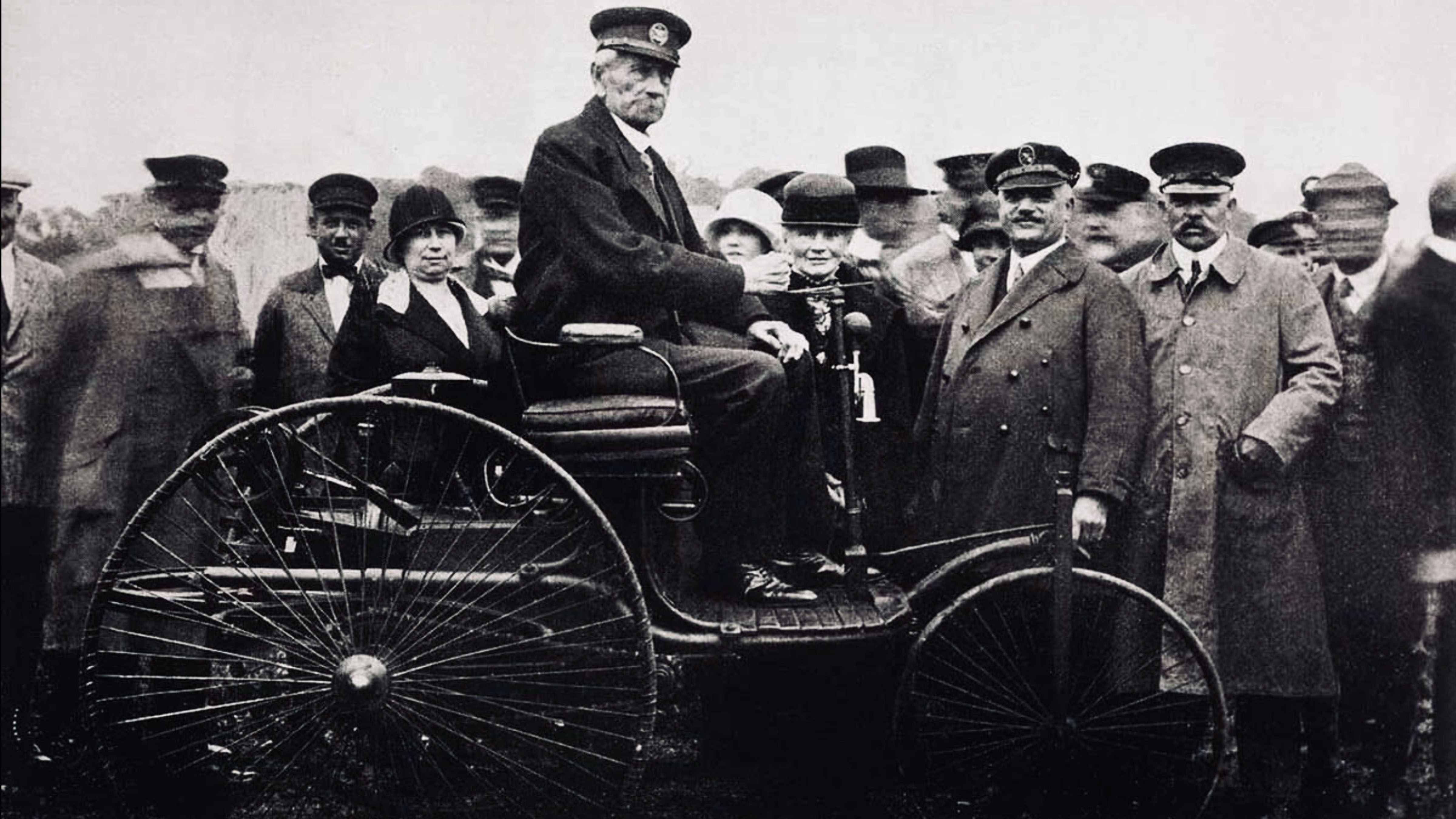
On July 3, 1886, a strange three-wheeled machine rolled onto the streets of Mannheim, Germany. It moved without horses, relying instead on a compact gasoline-powered engine. Curious onlookers watched as German engineer Karl Benz publicly demonstrated his Patent-Motorwagen, an invention that would forever change how people traveled, worked, and connected with the world.
Although earlier steam-powered road vehicles had existed, Benz’s machine is widely recognized as the first practical automobile designed from the ground up around an internal combustion engine. More than a mechanical curiosity, it introduced a new form of transportation that would eventually reshape cities, economies, global trade, and daily life for billions of people.
The road to the Motorwagen had taken years of experimentation. Benz believed simply attaching an engine to an existing carriage would never create an efficient vehicle. Instead, he engineered an entirely new machine in which the engine, chassis, steering, drivetrain, and suspension were designed as a single integrated system. That concept remains the foundation of automobile engineering today.
Powered by a single-cylinder four-stroke gasoline engine producing roughly two-thirds of a horsepower, the original Patent-Motorwagen reached a top speed of about 16 kilometers per hour (10 mph). While modest by modern standards, its engineering was remarkably advanced for the late nineteenth century.
The vehicle featured a lightweight steel tube frame, wire-spoke wheels, chain-driven rear wheels, differential gearing, evaporative cooling, and electric ignition, innovations that distinguished it from earlier experimental vehicles. Rather than adapting existing horse-drawn technology, Benz created a purpose-built automobile.
On July 3, local newspapers reported the successful public demonstration along Mannheim’s Ring Road. It was the first widely documented public appearance of the gasoline-powered automobile, giving people their first glimpse of what transportation might become.
Public reaction, however, was mixed.
Some observers were fascinated by the noisy machine, while others questioned whether it had any practical future. Roads were designed for horses and wagons, fuel stations did not exist, and few imagined a world where millions of motor vehicles would one day dominate transportation.
Even Benz himself faced skepticism from investors and customers.
The breakthrough in public acceptance came two years later through an unexpected demonstration.
In August 1888, Karl Benz’s wife, Bertha Benz, secretly took one of the improved Patent-Motorwagens on the world’s first long-distance automobile journey. Traveling approximately 106 kilometers (66 miles) from Mannheim to Pforzheim with her two sons, she proved the vehicle could operate beyond short demonstrations.
During the trip she improvised repairs, purchased fuel from a pharmacy, and identified practical improvements including better brakes and lower gearing for climbing hills. Her journey became one of history’s earliest examples of product testing and public marketing, helping convince both investors and the public that the automobile had real-world potential.
The Patent-Motorwagen itself was never produced in large numbers. Approximately 25 examples were built between 1886 and 1894, making it one of history’s rarest automobiles.
Its true importance lay not in sales but in influence.
Engineers across Europe soon expanded upon Benz’s ideas. Companies refined engines, transmissions, suspension systems, and manufacturing methods, while road networks gradually improved to accommodate motor vehicles. Within a few decades, automobiles evolved from handcrafted machines for wealthy buyers into mass-produced products accessible to ordinary families.
The rise of the automobile transformed far more than transportation.
It accelerated industrialization, created entirely new manufacturing sectors, expanded oil production, reshaped urban planning, encouraged suburban growth, and fueled innovations in highways, traffic safety, insurance, logistics, tourism, and emergency services. Entire industries, including automotive design, motorsports, roadside businesses, and modern supply chains, trace their origins to the first practical automobiles developed during this period.
Today, more than 1.4 billion motor vehicles operate worldwide, making the automobile one of humanity’s most influential technologies. Yet many engineering principles found in modern cars, including integrated vehicle design and purpose-built automotive architecture, can be traced directly to Benz’s pioneering work in the 1880s.
The invention also established Germany as one of the world’s leading centers of automotive engineering. Companies that evolved from Benz’s early enterprise eventually became part of Mercedes-Benz, while German manufacturers continue to shape automotive innovation in areas ranging from performance engineering to electric mobility.
Ironically, the same spirit of innovation that launched the gasoline automobile now drives its transformation. Electric vehicles, autonomous driving systems, artificial intelligence, connected transportation networks, and alternative fuels represent the latest chapters in a story that began with a modest three-wheeled machine on a summer day in Mannheim.
Nearly 140 years after its first public outing, the Patent-Motorwagen remains more than a museum artifact. It symbolizes the moment engineering imagination became everyday reality.
What began as one inventor’s vision of a horseless carriage ultimately revolutionized human mobility, altered the global economy, and helped shape the modern world.
About the Author Brad Socha is the founder of The Universal Record, focused on sourced, factual global reporting. Coverage includes international news, geopolitics, technology, and major developments.