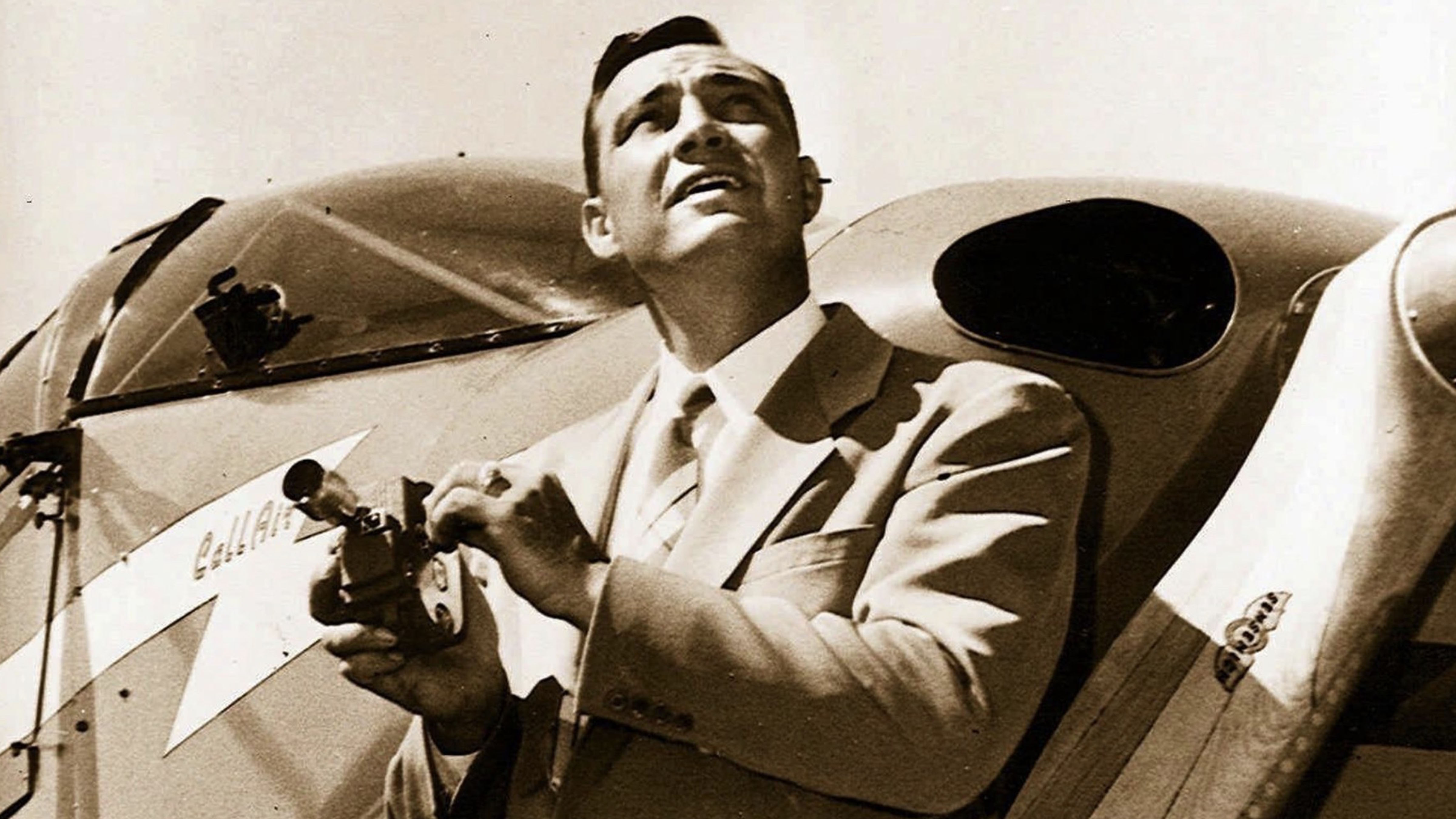
On June 24, 1947, pilot Kenneth Arnold reported seeing nine unusual objects near Mount Rainier, a sighting that introduced the term “flying saucer” and sparked decades of public fascination with unidentified aerial phenomena.
On a clear summer day in 1947, a private pilot flying over the mountains of Washington State reported seeing something he could not explain. The observation lasted only a few minutes, but its impact would extend across generations, influencing aviation investigations, military research, popular culture, and ongoing debates about unidentified aerial phenomena.
The event occurred on June 24, 1947, when businessman and experienced pilot Kenneth Arnold was flying his CallAir A-2 near Mount Rainier while searching for a missing military transport aircraft. During the flight, Arnold noticed a series of bright objects moving rapidly through the sky. What he described that day would become one of the most famous sightings in aviation history and is widely regarded as the beginning of the modern UFO era.
Arnold estimated that the objects were traveling at extraordinary speed. He reported seeing nine crescent-shaped or boomerang-like objects flying in formation near Mount Rainier and Mount Adams in Washington State. The objects appeared to move in an unusual fashion, unlike any aircraft he had previously encountered during his years of flying.
After landing in Yakima, Arnold discussed the sighting with others before speaking to reporters. During interviews, he attempted to describe how the objects moved, comparing their motion to a saucer skipping across water. Although Arnold was referring to their movement rather than their shape, newspapers quickly adopted the phrase “flying saucer.” Within days, the term had spread across the United States and soon around the world.
The timing of the sighting contributed significantly to public interest. The Second World War had ended only two years earlier. Advances in aviation technology, jet aircraft development, and military research had transformed public perceptions of what was possible in the sky. At the same time, the emerging Cold War fueled concerns about secret weapons and unidentified aircraft.
News of Arnold’s report generated a wave of similar sightings. Hundreds of people across North America began reporting unusual objects in the sky during the summer of 1947. Some observers believed they were seeing experimental military aircraft. Others suggested atmospheric phenomena, optical illusions, or unknown natural events. Still others speculated about visitors from beyond Earth.
Only weeks after Arnold’s report, another incident would further intensify public fascination. In July 1947, reports emerged from New Mexico concerning what became known as the Roswell incident. Although the two events were unrelated, the combination of Arnold’s sighting and Roswell helped establish UFOs as a major topic of public discussion.
The U.S. military soon became involved. The growing number of reports prompted the U.S. Air Force to launch formal investigations into unidentified aerial sightings. Early studies evolved into projects such as Project Sign, Project Grudge, and eventually Project Blue Book, which operated from 1952 until 1969.
Over the course of these investigations, thousands of reports were collected and analyzed. Most were ultimately attributed to known aircraft, weather balloons, astronomical objects, atmospheric effects, or misidentifications. However, a small percentage remained unexplained, ensuring continued public interest in the phenomenon.
Debate over Arnold’s sighting has continued for nearly eight decades. Skeptics have proposed a variety of explanations, including unusual cloud formations, mirages, birds, and optical distortions caused by mountain terrain and lighting conditions. Others argue that Arnold’s experience remains difficult to explain fully based on available evidence.
Unlike many later UFO reports, Arnold was considered a credible witness. He was an experienced pilot familiar with aircraft performance and weather conditions. Investigators and historians have often pointed to his aviation background as one reason the sighting received significant attention.
The cultural impact proved even more enduring than the mystery itself. The phrase “flying saucer” became one of the most recognizable terms of the twentieth century. Books, films, television programs, magazines, and newspaper stories helped transform UFOs into a global cultural phenomenon.
The sighting also influenced scientific and governmental approaches to unidentified aerial reports. Modern investigations increasingly focus on collecting data rather than making assumptions about origins. Advances in radar systems, satellite tracking, infrared sensors, and digital imaging have changed how unusual aerial observations are evaluated.
In recent years, unidentified aerial phenomena have returned to mainstream discussion. The U.S. Department of Defense established dedicated programs to examine reports from military personnel. Congressional hearings have addressed the topic, and government agencies have released reports acknowledging that some cases remain unresolved due to insufficient data.
These modern developments differ significantly from the atmosphere of 1947. Today’s investigations rely on sophisticated technology and structured reporting systems. Yet many discussions still trace their origins back to Kenneth Arnold’s flight over the Cascade Mountains nearly eighty years ago.
Whether Arnold witnessed an unusual natural phenomenon, a misidentified object, or something still unexplained, the historical significance of the event is clear. His report transformed a single observation into a lasting subject of scientific inquiry, public curiosity, and cultural fascination.
The skies over Mount Rainier remain unchanged. The questions first raised there on June 24, 1947, continue to inspire debate among researchers, historians, pilots, and the public. Few aviation sightings have had such a profound and lasting influence on how humanity thinks about the unknown.
About the Author Brad Socha is the founder of The Universal Record, focused on sourced, factual global reporting. Coverage includes international news, geopolitics, technology, and major developments.