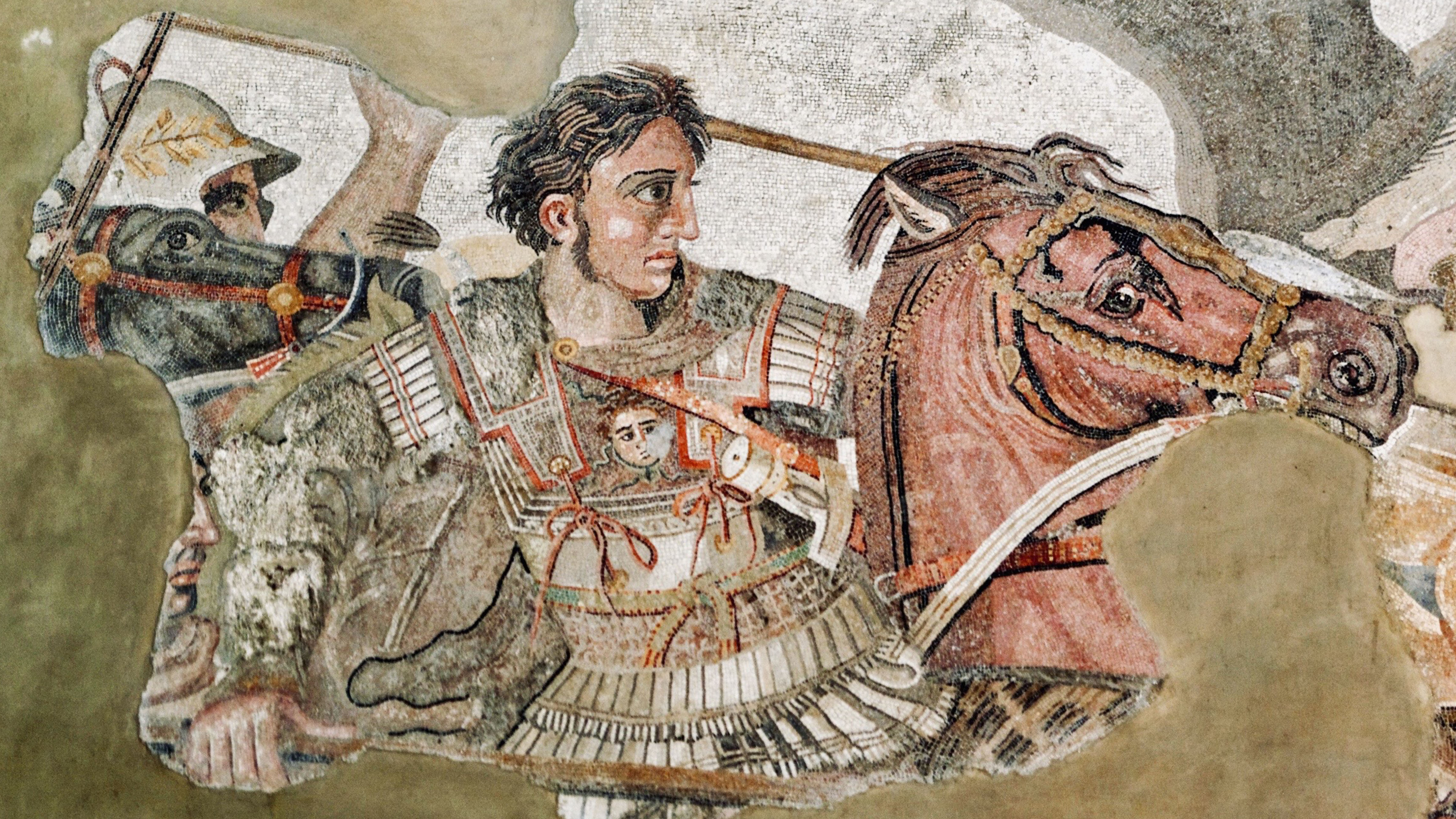
The death of Alexander in Babylon ended one of history’s most remarkable military careers and triggered a power struggle that reshaped the ancient world for centuries.
Nearly 2,350 years after his death, Alexander the Great remains one of the most influential figures in human history. His military campaigns redrew the map of the ancient world, spread Greek culture across three continents, and laid the foundations for a new era that connected Europe, Africa, and Asia. When Alexander died in Babylon on June 13, 323 BC, at just 32 years old, he left behind an empire stretching from Greece to India, but no clear successor. The consequences of that moment would alter the course of civilization.
Alexander III of Macedon was born in 356 BC in Pella, the capital of the Kingdom of Macedon. He was the son of King Philip II, who transformed Macedon into a dominant military power, and Queen Olympias. From an early age, Alexander received an education that few rulers could match. Among his tutors was the philosopher Aristotle, whose teachings exposed the young prince to science, politics, literature, and philosophy.
When Philip II was assassinated in 336 BC, Alexander inherited the throne at the age of twenty. Many rivals expected the young king to struggle, but he quickly secured his position. Rebellions were crushed, rival claimants were eliminated, and Greek city-states that questioned Macedonian authority were brought back under control.
With his kingdom stabilized, Alexander turned his attention eastward. His father had planned an invasion of the Persian Empire, the largest empire of its time. Alexander embraced that ambition and launched one of history’s most extraordinary military campaigns.
In 334 BC, he crossed the Hellespont into Asia Minor with an army estimated at around 40,000 men. Over the next decade, he defeated Persian forces in a series of decisive battles, including the Battle of Granicus, the Battle of Issus in 333 BC, and the Battle of Gaugamela in 331 BC. These victories shattered the power of Persian King Darius III and opened the way for Alexander’s conquest of vast territories.
His campaigns carried him through modern-day Turkey, Syria, Lebanon, Israel, Egypt, Iraq, Iran, Afghanistan, and Pakistan. In Egypt, he was welcomed as a liberator and founded the city of Alexandria, which would become one of the greatest centers of learning in the ancient world.
Unlike many conquerors, Alexander sought not only to defeat rival kingdoms but also to integrate them into his expanding empire. He adopted certain Persian customs, encouraged intermarriage between Greeks and local populations, and established dozens of cities that served as centers of administration, trade, and cultural exchange.
These actions helped create what historians call the Hellenistic Age, a period during which Greek language, art, architecture, philosophy, and science spread across a vast geographic region. The influence of this cultural blending would endure long after Alexander’s empire disappeared.
By 326 BC, Alexander’s forces had reached the Indian subcontinent. There he defeated King Porus at the Battle of the Hydaspes River. Although victorious, his exhausted troops refused to march farther east. After years of campaigning thousands of miles from home, they demanded a return journey.
Alexander reluctantly agreed and began the long trek back west.
In 323 BC, he arrived in Babylon, one of the most important cities in his empire. Babylon was expected to serve as a major administrative center for future campaigns and imperial projects. Alexander appeared to be planning new military expeditions, including possible operations in Arabia.
Those plans would never be realized.
In early June 323 BC, Alexander fell seriously ill after attending a banquet. Ancient accounts describe a gradual decline over several days. He reportedly developed a high fever and eventually lost the ability to speak. On June 13, 323 BC, he died in Babylon.
The exact cause of death remains one of history’s enduring mysteries.
Ancient writers offered various explanations, including disease, fever, malaria, typhoid, or poisoning. Modern historians and medical researchers have examined the evidence for centuries, but no definitive conclusion has been reached. Most scholars consider natural illness more likely than assassination, though debate continues.
Alexander’s death immediately created a political crisis. Despite controlling one of the largest empires the world had ever seen, he left no clearly designated adult heir. When asked who should inherit the empire, later accounts claim he replied, “To the strongest,” though historians remain uncertain whether those words were actually spoken.
Without a recognized successor, Alexander’s generals, known as the Diadochi, or Successors, began competing for power.
The resulting struggles lasted for decades and ultimately fragmented the empire into several major kingdoms. The Ptolemaic Kingdom emerged in Egypt, the Seleucid Empire controlled much of Asia, and Macedon remained under separate rule. Although Alexander’s unified empire disappeared, the Hellenistic civilization he helped create continued to flourish.
The long-term consequences of Alexander’s life and death were profound.
Greek became a common language across much of the eastern Mediterranean and Near East. Trade routes expanded. Scientific knowledge circulated more widely. Cities founded during his campaigns became centers of commerce and scholarship. The famous Library of Alexandria, established under his successors, grew into one of the ancient world’s greatest repositories of knowledge.
His influence also extended into later eras. Roman leaders studied his campaigns. Medieval rulers admired his achievements. Military academies continue to analyze his tactics today. Few individuals have shaped so much territory and influenced so many cultures in such a short lifetime.
Alexander’s death marked the end of an empire but not the end of his impact. The political map changed, kingdoms rose and fell, and centuries passed, yet the world that emerged after June 323 BC carried unmistakable traces of his conquests.
More than two millennia later, Alexander remains a symbol of ambition, military genius, and historical transformation. His death in Babylon closed one chapter of history, but it opened another, one that would shape the ancient world and leave a legacy still studied today.
About the Author Brad Socha is the founder of The Universal Record, focused on sourced, factual global reporting. Coverage includes international news, geopolitics, technology, and major developments.