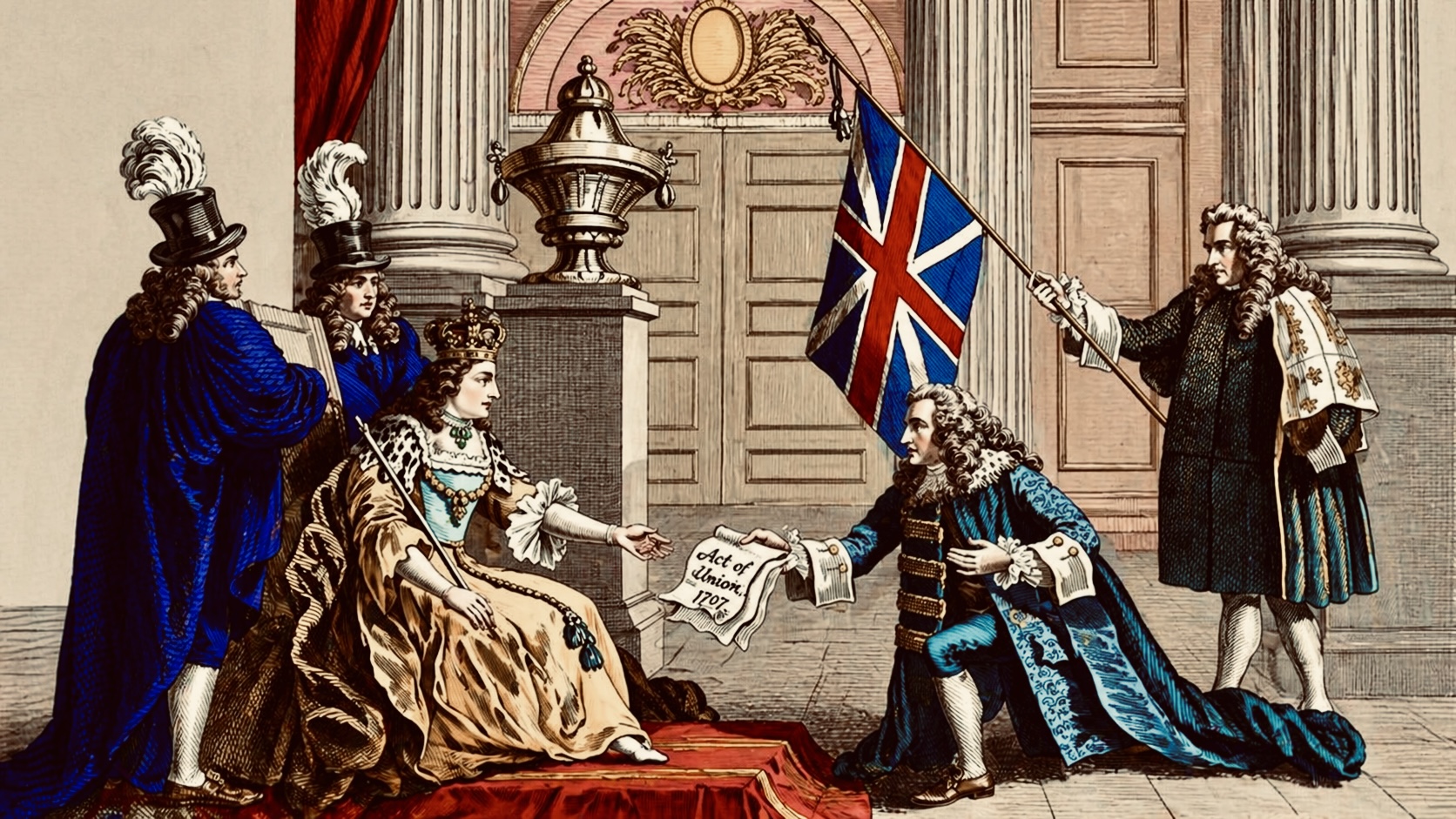
The Kingdom of Great Britain formed on May 1, 1707, stands as a defining turning point in European history, with consequences that still shape modern politics, economics, and national identity. This moment marked the formal political union of England and Scotland into a single sovereign state, fundamentally altering the balance of power within Europe and laying the groundwork for what would become one of the most influential global empires.
The creation of Great Britain was driven by a combination of political necessity, economic pressure, and strategic calculation. Prior to 1707, England and Scotland had shared a monarch since 1603, when James VI of Scotland became James I of England. Despite this shared crown, both nations maintained separate parliaments, legal systems, and economic structures. Over time, however, the limitations of this arrangement became increasingly clear, particularly as both kingdoms faced internal challenges and external threats.
Economic hardship played a major role in pushing Scotland toward union. The failure of the Darien Scheme, an ambitious but disastrous attempt by Scotland to establish a colony in Central America, left the Scottish economy severely weakened. Many investors suffered significant losses, and the country faced mounting financial instability. Union with England offered access to broader trade networks, financial support, and economic recovery.
For England, the motivation was equally strategic. The country sought to secure its northern border and prevent Scotland from aligning with rival European powers, particularly France. At a time when Britain was engaged in broader continental conflicts, including the War of the Spanish Succession, ensuring political stability at home was essential. A unified parliament would eliminate the risk of conflicting foreign policies and strengthen the kingdom’s overall position.
The Acts of Union, passed separately by the English and Scottish parliaments in 1706 and 1707, formalised the agreement. These acts dissolved both parliaments and created a new Parliament of Great Britain based in London. Scotland retained certain key institutions, including its legal and educational systems, but political authority shifted to the new unified government.
The union was not without controversy. In Scotland, opposition was widespread, with critics arguing that the agreement compromised national sovereignty and disproportionately favoured English interests. Protests and unrest were reported in several areas, reflecting public concern over the loss of independent governance. Supporters, however, emphasised the long-term economic benefits and the opportunity for greater stability and prosperity.
In England, the union was generally viewed as a strategic success. It secured the kingdom’s borders, expanded its economic reach, and reinforced its position as a major European power. The newly formed Great Britain quickly emerged as a significant force in global trade, military affairs, and colonial expansion.
The long-term impact of the 1707 union cannot be overstated. It laid the foundation for the British Empire, which would grow to become one of the largest and most influential empires in history. The unified state played a central role in shaping global trade routes, industrial development, and international politics over the following centuries.
At the same time, the union created a complex national identity that continues to evolve. While Great Britain functioned as a single political entity, cultural and national distinctions between England and Scotland remained strong. These differences have influenced political debates for centuries, including modern discussions surrounding Scottish independence and devolution.
The formation of Great Britain also had broader implications for governance and state-building. It demonstrated how political unions could be used to consolidate power, manage economic challenges, and respond to external threats. This model would later influence other unions and federations around the world.
Today, the legacy of the 1707 union remains highly relevant. The United Kingdom, which later expanded to include Ireland (and now Northern Ireland), continues to navigate questions of identity, governance, and regional autonomy. The historical roots of these discussions can be traced directly to the decisions made in 1707.
From a global perspective, the creation of Great Britain marked the beginning of a new era in international relations. The unified kingdom would go on to play a leading role in shaping the modern world, from industrialisation to diplomacy and global trade. Its influence extended far beyond Europe, affecting societies and economies across multiple continents.
As of today, the Kingdom of Great Britain formed in 1707 is recognised not only as a milestone in British history but as a pivotal moment in the broader narrative of European and global development. The union of England and Scotland reshaped the trajectory of both nations and set the stage for centuries of political, economic, and cultural transformation.
About the Author Brad Socha is the founder of The Universal Record, focused on sourced, factual global reporting. Coverage includes international news, geopolitics, technology, and major developments.