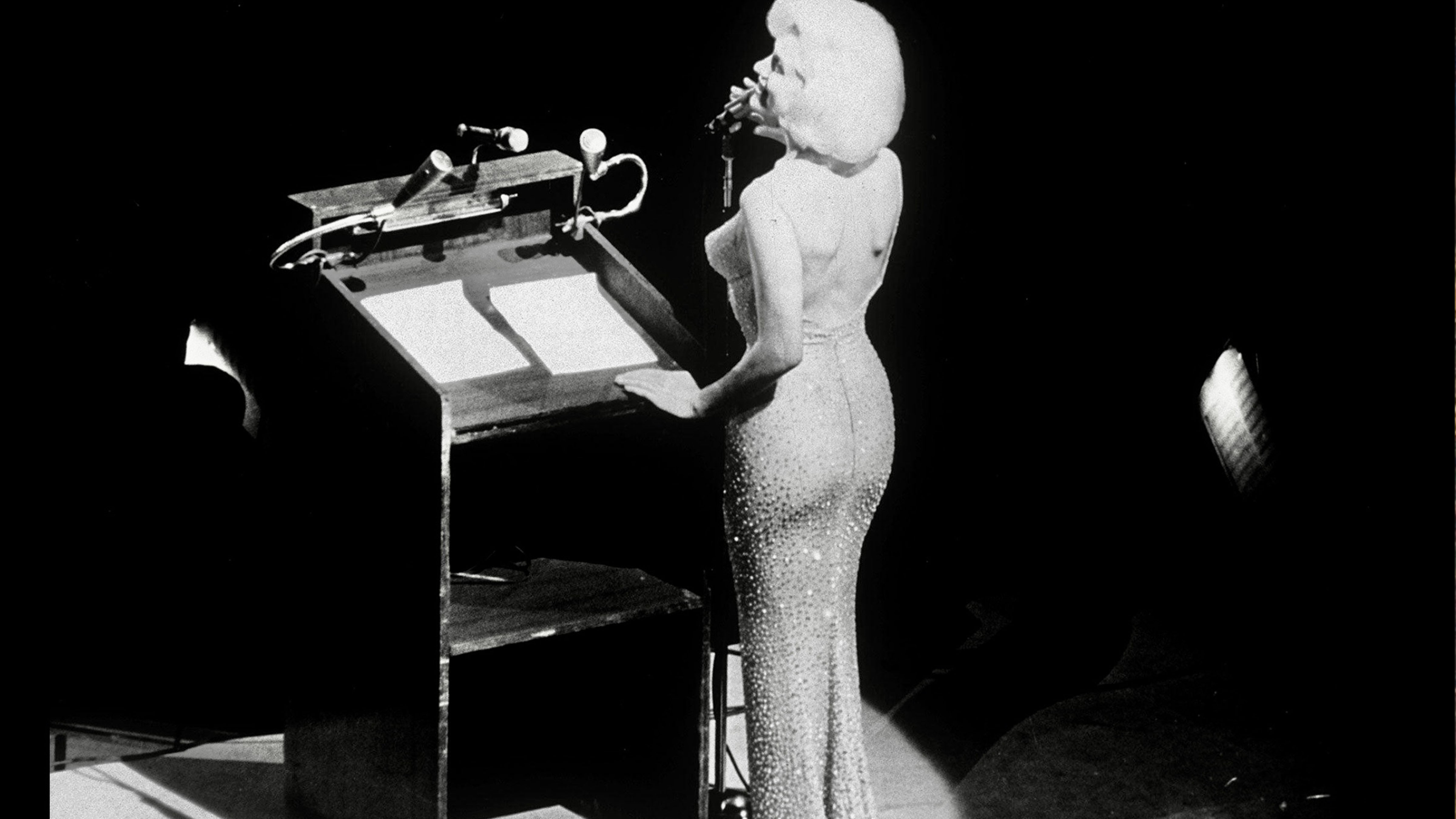
More than six decades later, Marilyn Monroe’s “Happy Birthday, Mr. President” performance for John F. Kennedy remains one of the most discussed intersections of celebrity culture and American politics. The brief appearance at a Democratic Party fundraising gala in New York City on May 19, 1962, continues to attract attention because it symbolized a changing era in media, fame, television culture, and presidential image-making in the United States.
The event took place at Madison Square Garden during a celebration for Kennedy’s upcoming 45th birthday. Thousands attended the fundraiser, which featured major entertainers, politicians, donors, and public figures. While the evening included multiple performances, Monroe’s appearance ultimately overshadowed nearly everything else associated with the event.
Wearing a skin-tight, crystal-covered gown designed by Jean Louis, Monroe delivered a slow and highly stylized rendition of “Happy Birthday” before transitioning into a tribute song praising Kennedy. Television cameras and photographers captured the moment, helping cement it into American pop culture history. The performance quickly became one of the defining visual and cultural images of the early 1960s.
The moment still matters today because historians, political analysts, and media researchers frequently point to the performance as an example of how entertainment and politics became increasingly intertwined during the television age. Kennedy was among the first modern presidents to fully operate within the realities of mass media, celebrity influence, and visual public relations. Monroe, meanwhile, represented one of the most globally recognized entertainment figures of her era.
The gala itself was organized as a Democratic Party fundraiser, with proceeds supporting political efforts ahead of the 1962 midterm elections. The event demonstrated how political fundraising was evolving into large-scale media spectacles involving celebrities and cultural figures. Similar approaches remain common in modern political campaigns worldwide.
Monroe’s appearance generated immediate headlines across newspapers, magazines, and television broadcasts. The performance became especially memorable due to her breathy delivery style, the audience reaction, and Kennedy’s own joking response afterward. Speaking to the crowd, Kennedy humorously remarked that he could now retire from politics after receiving such a rendition of “Happy Birthday.”
The event occurred during a period of intense public fascination with both Monroe and the Kennedy administration. The early 1960s saw the rapid growth of television influence across American society, helping transform politicians into nationally recognized personalities beyond traditional policy discussions. Kennedy’s administration became closely associated with glamour, youth, and media sophistication, later contributing to the enduring “Camelot” narrative surrounding his presidency.
At the same time, Monroe’s career was undergoing significant personal and professional strain. Despite remaining one of Hollywood’s biggest stars, she faced increasing health issues, studio disputes, and public scrutiny. Her Madison Square Garden performance would become one of her final major public appearances before her death less than three months later in August 1962.
The dress worn by Monroe later became nearly as famous as the performance itself. The gown, covered with thousands of rhinestones and designed to appear almost invisible under stage lighting, became one of the most recognizable pieces of clothing in entertainment history. Decades later, the dress sold at auction for millions of dollars and continues to be referenced in fashion, film, and celebrity culture discussions.
Historians continue debating the broader significance of the moment. Some view it primarily as a milestone in entertainment history, while others see it as symbolic of deeper cultural changes taking place in postwar America. The blending of celebrity influence, political image management, televised spectacle, and mass public fascination reflected a media environment that would continue expanding throughout the decades that followed.
The performance has also remained the subject of ongoing public interest because of longstanding speculation regarding Monroe’s relationship with Kennedy and members of the Kennedy family. While rumors and allegations have circulated for decades, historians note that many claims remain disputed, unverified, or heavily shaped by popular culture mythology rather than confirmed historical documentation.
Modern discussions surrounding the event often focus less on scandal and more on its role in shaping celebrity politics. Researchers examining media history frequently cite the performance as an early example of how public figures, entertainment personalities, and political branding increasingly merged into a shared cultural space driven by television and mass media attention.
The moment’s legacy has remained remarkably durable in American culture. Clips, photographs, documentaries, biographies, and archival footage continue to be referenced more than 60 years later. The phrase “Happy Birthday, Mr. President” itself has become instantly recognizable worldwide, often detached entirely from the original political fundraiser where it was first performed.
The event also highlights how single televised cultural moments can outlive the broader political context surrounding them. Although the fundraiser itself was tied to routine political operations of the early 1960s, Monroe’s performance became the enduring historical memory associated with the evening.
Today, the Madison Square Garden appearance remains one of the defining visual records of both Marilyn Monroe’s public image and the Kennedy era. It continues to serve as a reference point for historians studying celebrity influence, media evolution, American politics, and the growing power of televised culture during the 20th century.
About the Author Brad Socha is the founder of The Universal Record, focused on sourced, factual global reporting. Coverage includes international news, geopolitics, technology, and major developments.