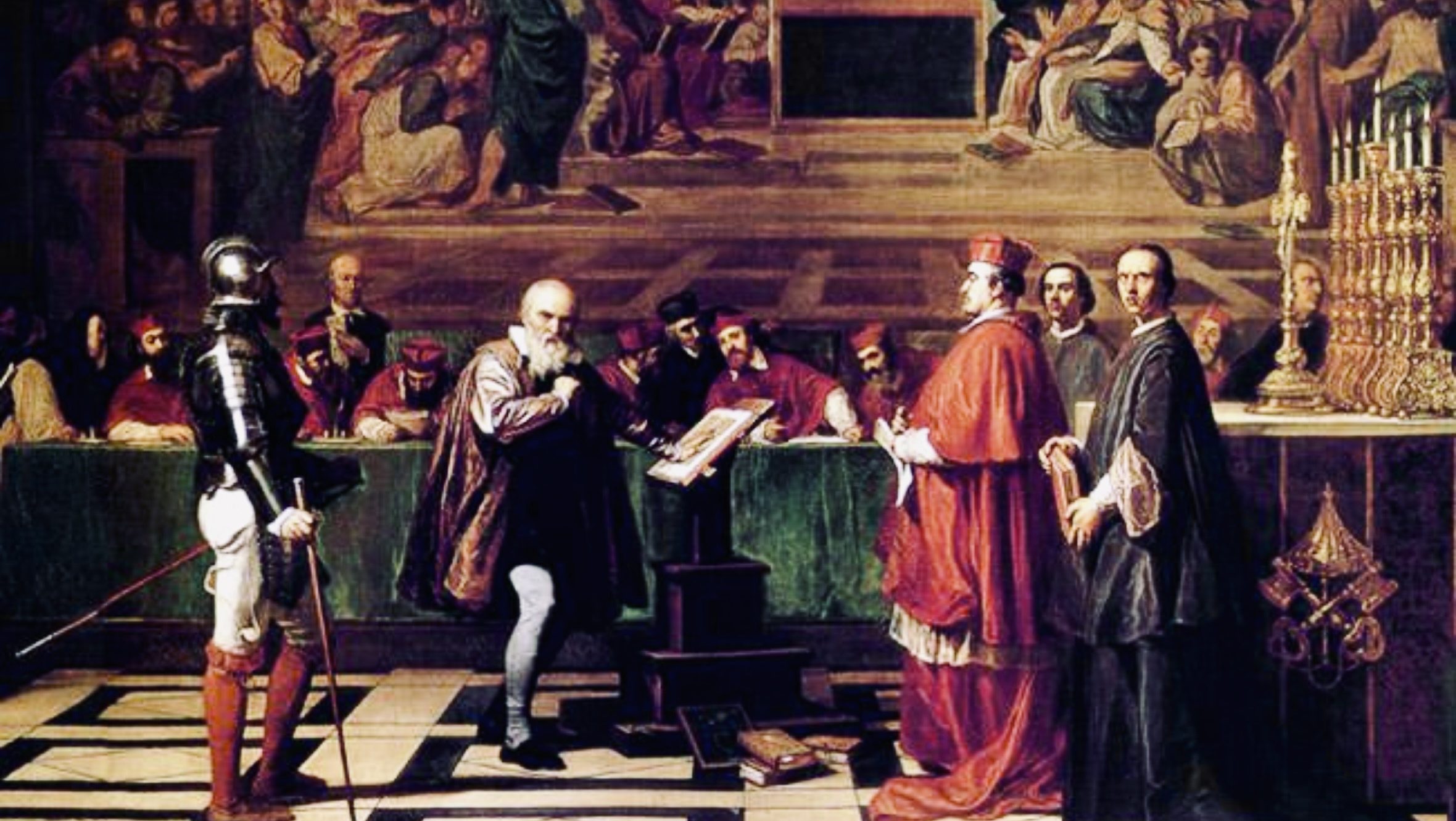
On April 12, 1633, Italian astronomer Galileo Galilei appeared before the Roman Inquisition to answer charges related to his support of heliocentrism, the theory that the Earth orbits the Sun.
The case centered on Galileo’s advocacy of the ideas originally proposed by Nicolaus Copernicus, whose heliocentric model challenged the long-standing geocentric view that placed Earth at the centre of the universe. Galileo’s telescopic observations, including evidence of moons orbiting Jupiter and phases of Venus, supported the heliocentric model.
The controversy intensified after Galileo published his work Dialogue Concerning the Two Chief World Systems in 1632. Although presented as a discussion between opposing viewpoints, the book was interpreted by Church authorities as defending heliocentrism as fact rather than hypothesis.
During the proceedings, Galileo was questioned on whether he had violated previous instructions not to promote heliocentrism. In June 1633, the Inquisition found him guilty of “vehement suspicion of heresy.” He was required to recant and was sentenced to house arrest, where he remained for the rest of his life.
The trial became one of the most significant conflicts between emerging scientific inquiry and established religious authority. It remains a key reference point in discussions on academic freedom, the scientific method, and the relationship between science and institutions of power.
About the Author Brad Socha is the founder of The Universal Record, an independent platform dedicated to sourced, factual reporting on global events. The publication focuses on delivering verified information without opinion or editorial bias. Based in Canada, the publication covers international news, geopolitics, technology, and global developments.



Leave a Reply