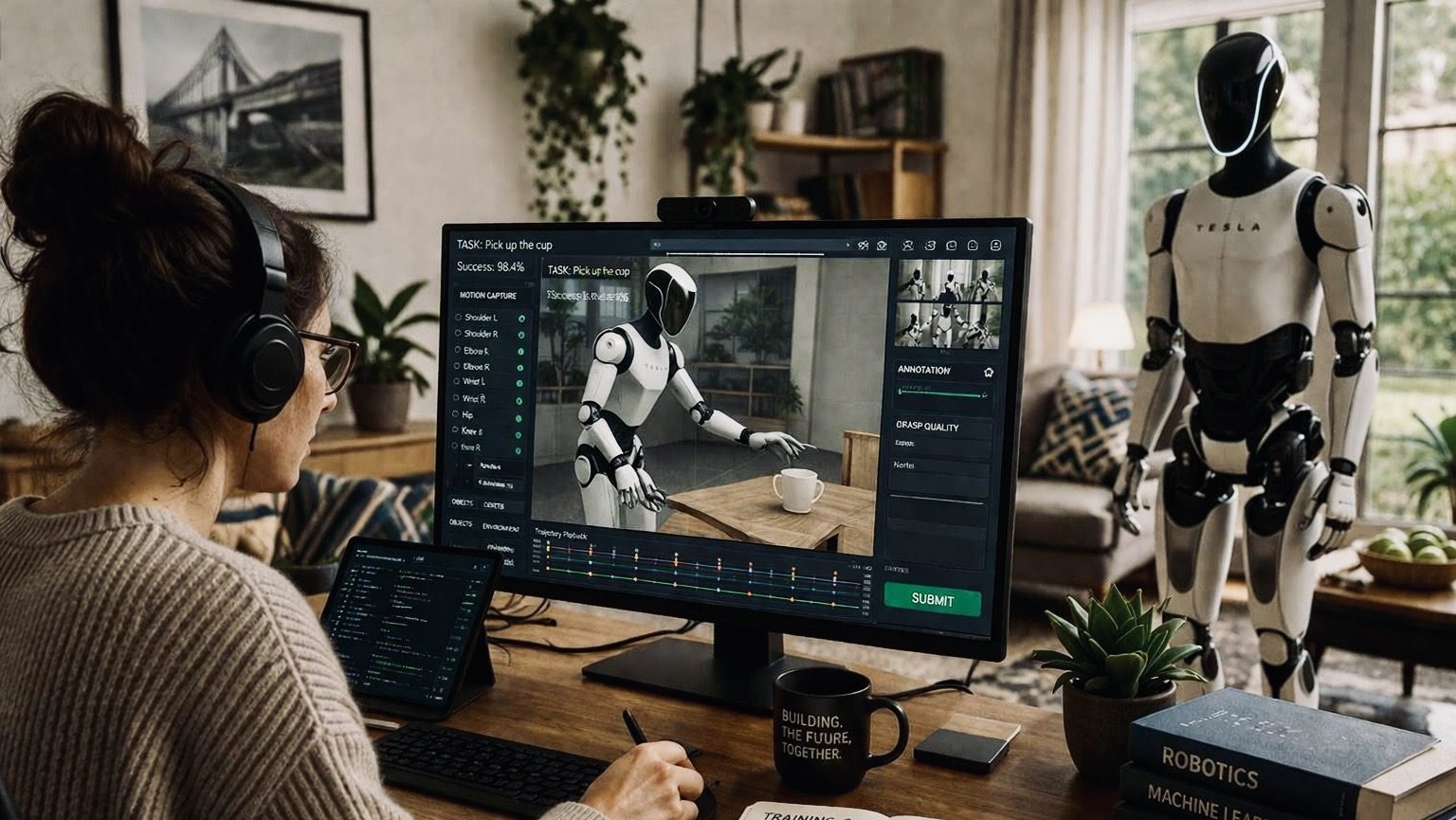
Technology companies are increasingly turning to gig workers to help train humanoid robots, with some tasks now being performed remotely from workers’ homes. This emerging model reflects a broader shift in artificial intelligence development, where human input is used to refine how machines interpret and respond to real-world environments.
Workers participating in these programs are typically tasked with guiding robot behaviours through simulations, reviewing recorded interactions, or performing structured tasks that help train AI systems. In some cases, individuals use motion capture tools, virtual interfaces, or annotated video data to teach robots how to complete everyday actions such as grasping objects, navigating spaces, or responding to human cues.
Companies including Tesla, Figure AI, and Agility Robotics are among those developing humanoid robots designed for real-world deployment. These systems rely heavily on large datasets and human-guided training to improve reliability, safety, and adaptability.
The use of distributed gig workers allows companies to scale training efforts quickly while capturing a wide range of human behaviours and environments. This approach is particularly valuable for robotics, where variability in real-world conditions presents challenges that are difficult to replicate in controlled settings alone.
The model builds on earlier forms of AI training, such as data labelling and reinforcement learning with human feedback, which have been widely used in natural language processing and computer vision. In robotics, similar methods are now being applied to physical movement and interaction, enabling machines to better understand and respond to complex tasks.
While the expansion of gig-based training has increased accessibility and flexibility for workers, it has also raised questions about labour practices, data privacy, and the long-term role of human input in automation. As humanoid robots move closer to commercial deployment, the reliance on human-assisted training remains a central component of development.
The continued integration of remote human contributions into robotics training highlights a hybrid model of innovation, combining human experience with machine learning to advance autonomous systems.
About the Author Brad Socha is the founder of The Universal Record, focused on sourced, factual global reporting. Coverage includes international news, geopolitics, technology, and major developments.