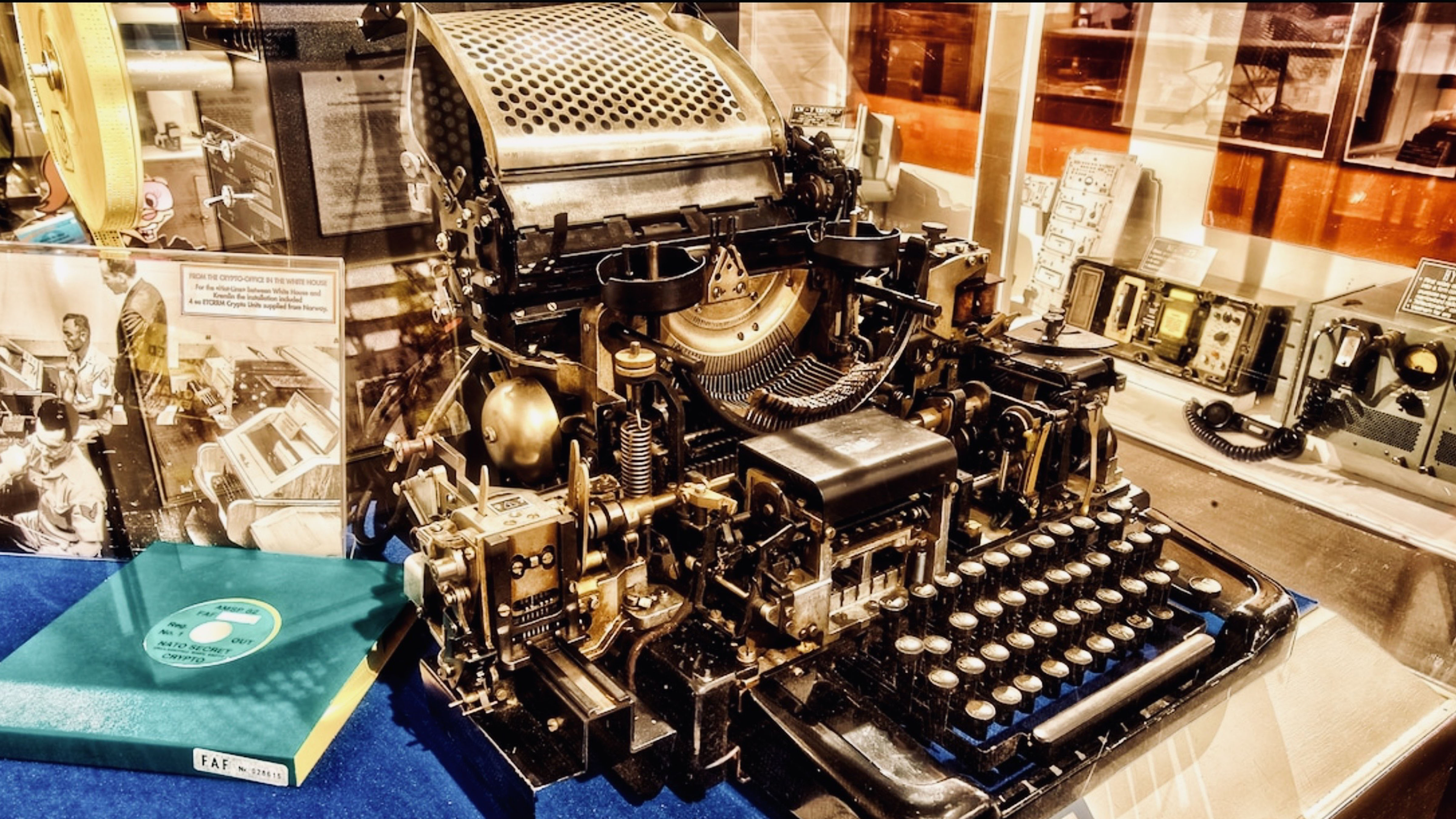
Built after the Cuban Missile Crisis exposed dangerous communication delays, the direct link gave the nuclear superpowers a faster way to communicate in an emergency, but it was not a red telephone.
THE UNIVERSAL RECORD
Sourced reporting. No opinions.
Brad Socha | August 30, 2026 | 9:14 AM EST
Featured image: National Security Agency / Public Domain
On August 30, 1963, a direct communications link between Washington and Moscow became operational, giving the governments of the United States and Soviet Union a faster way to exchange messages during an international crisis. The Hotline was one of the most practical safeguards to emerge from the nuclear confrontation of the early Cold War.
Its purpose was straightforward: reduce the chance that delays, misunderstandings or incomplete information could contribute to a catastrophic decision.
The system was created less than a year after the Cuban Missile Crisis brought the United States and Soviet Union dangerously close to nuclear conflict. During those tense days in October 1962, President John F. Kennedy and Soviet leader Nikita Khrushchev had no instantaneous, secure channel through which to communicate. Diplomatic messages had to move through existing communications and translation procedures while events were unfolding rapidly.
The experience demonstrated that in a nuclear crisis, communication itself had become a matter of international security.
It also produced one of the Cold War’s most persistent myths. Despite countless depictions of American and Soviet leaders reaching for a red telephone, the original Washington-Moscow Hotline was not a telephone at all.
Why the Hotline Became Necessary
Concern about accidental war existed before the Cuban Missile Crisis. The Soviet Union had raised proposals concerning safeguards against surprise attack during the 1950s, while both superpowers increasingly confronted the risks created by nuclear weapons and long-range missiles.
Cuba made those risks immediate.
In October 1962, the discovery of Soviet nuclear-capable missiles in Cuba led to an intense 13-day confrontation. Washington imposed a naval quarantine around the island while the United States and Soviet Union exchanged messages and military forces operated under extraordinary pressure.
The crisis was ultimately resolved without direct military conflict between the superpowers. But its communication problems were difficult to ignore.
By the following year, Washington and Moscow were prepared to establish something unprecedented: a dedicated communications system intended specifically for emergencies.
Negotiations took place within the Eighteen-Nation Committee on Disarmament in Geneva. On June 20, 1963, American representative Charles C. Stelle and Soviet representative Semyon K. Tsarapkin signed the Memorandum of Understanding Regarding the Establishment of a Direct Communications Link.
The agreement called for the system to be established as soon as technically feasible and required both governments to ensure that messages could be delivered promptly to their respective heads of government.
Its design also reveals how seriously the two sides treated reliability.
The primary connection was a full-time duplex telegraph circuit running from Washington through London, Copenhagen, Stockholm and Helsinki before reaching Moscow. A separate radiotelegraph circuit through Tangier provided an alternative if the main connection failed.
The United States and Soviet Union supplied each other with equipment needed to receive messages in the other’s language. Messages from Washington were transmitted in English and those from Moscow in Russian, allowing each government to handle translation at its own end.
On August 30, little more than two months after the agreement was signed, the system became operational.
The Hotline Was Never a Red Telephone
The iconic image of a red telephone connecting the White House and Kremlin is a product of popular culture rather than the original technology.
The 1963 Hotline used telegraph-teleprinter equipment, commonly described as teletype. Leaders did not pick up telephones and speak directly to one another. Messages were written, transmitted and translated.
That was deliberate.
Written communication reduced some of the risks inherent in an improvised conversation between leaders speaking different languages during a rapidly escalating military crisis. A written message could be translated carefully, reviewed and considered before a response was sent.
The American terminal was also not sitting on Kennedy’s desk in the Oval Office. U.S. operating equipment was installed at the National Military Command Center in the Pentagon, with procedures established for promptly delivering messages to the president.
Testing the new connection required less consequential material. The widely documented first American test transmission was the pangram: “The quick brown fox jumped over the lazy dog’s back 1234567890,” which exercised the letters and numerals of the teleprinter.
The system was subsequently tested regularly to ensure it remained operational.
Its first major crisis use came during the Six-Day War in June 1967, when President Lyndon B. Johnson and Soviet Premier Alexei Kosygin exchanged messages as fighting erupted between Israel and neighbouring Arab states. The link helped the superpowers clarify their intentions, including questions surrounding American and Soviet military movements.
It was used again during the 1973 Arab-Israeli war, when tensions between Washington and Moscow became particularly serious.
Technology changed with time. A 1971 U.S.-Soviet agreement added satellite communications to improve the system’s reliability, with the satellite circuits becoming operational later in the decade. Further modernization eventually introduced facsimile and later computerized communications.
The underlying principle, however, remained remarkably consistent: when relations between nuclear powers deteriorate, reliable communication can be as important as military capability.
The Hotline did not end the Cold War, prevent every international crisis or eliminate the possibility of nuclear miscalculation. Nor did it represent sudden trust between Washington and Moscow.
It represented something more limited and perhaps more realistic, recognition by two adversaries that even at their most hostile, they needed a dependable way to communicate.
That lesson was born from the Cuban Missile Crisis and put into operation on August 30, 1963. The red telephone never existed, but the communications link behind the myth was real, and its creation became an enduring part of nuclear crisis management.
Sources:
U.S. Department of State — Memorandum of Understanding Between the United States and Soviet Union Regarding the Establishment of a Direct Communications Link
https://2009-2017.state.gov/t/isn/4785.htm
United Nations Treaty Series — Memorandum of Understanding Regarding the Establishment of a Direct Communications Link
https://treaties.un.org/doc/Publication/UNTS/Volume%20472/v472.pdf
U.S. Department of State, Office of the Historian — Foreign Relations of the United States, 1961–1963, Volume V: Soviet Union
https://history.state.gov/historicaldocuments/frus1961-63v05/d333
United Nations — United States and Soviet Union Register Agreement on “Hot Line” with United Nations
https://digitallibrary.un.org/record/4004100/files/SG_1550-EN.pdf
U.S. Department of State — Agreement on Measures to Improve the U.S.A.-U.S.S.R. Direct Communications Link, 1971
https://2009-2017.state.gov/t/isn/4787.htm
U.S. Department of State, Office of the Historian — Foreign Relations of the United States, 1964–1968, Volume XIX: First Substantive Use of the Hotline
https://history.state.gov/historicaldocuments/frus1964-68v19/d155
RIA Novosti — Washington-Moscow Hotline, August 30, 1963
https://ria.ru/20180830/1527355594.html
About the Author
Brad Socha is the founder of The Universal Record, focused on sourced, factual global reporting. Coverage includes international news, geopolitics, technology, and major developments.