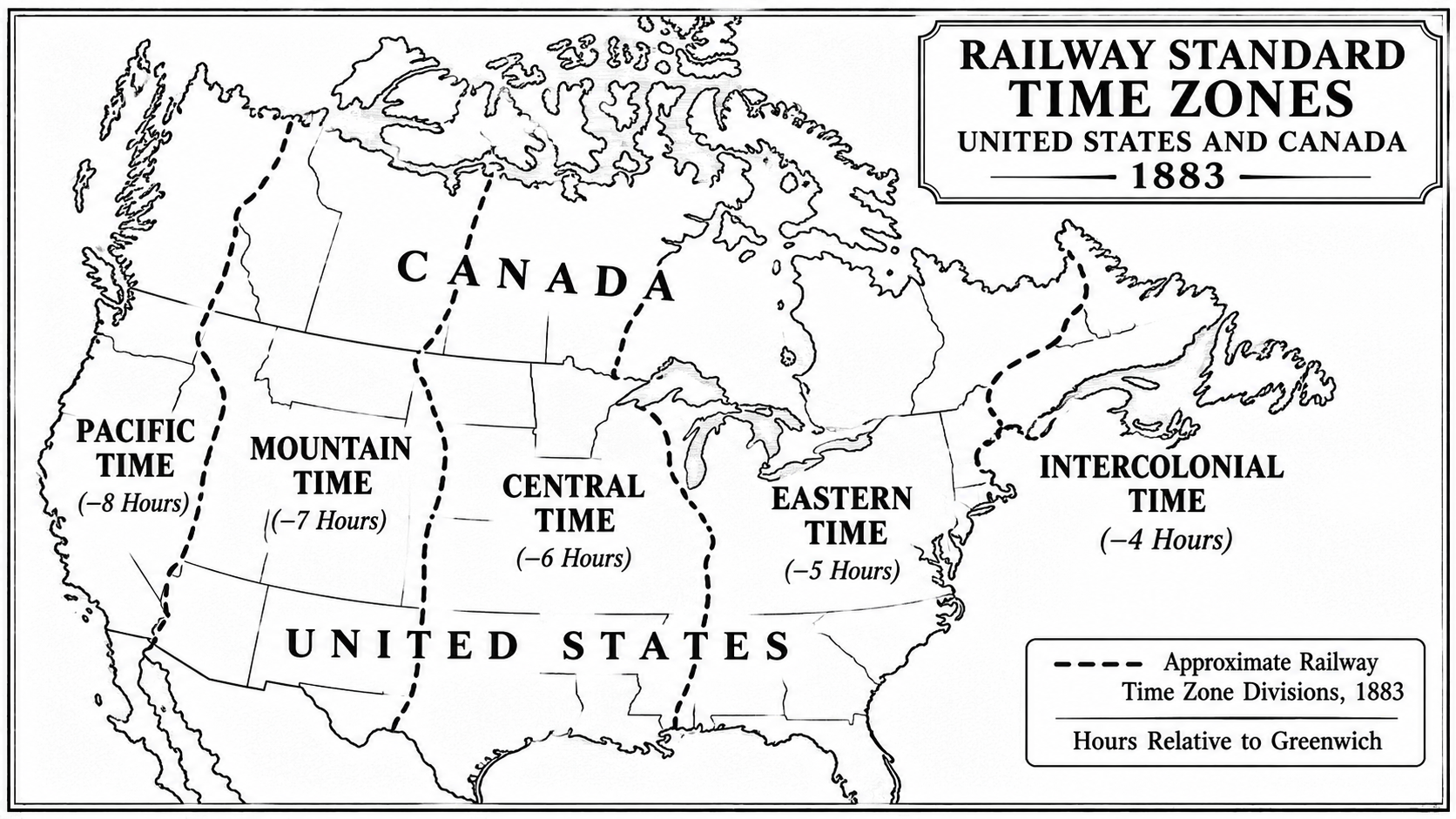
On November 18, 1883, railroads across the United States and Canada began operating under a coordinated system of standard time zones, replacing a confusing collection of local and railway clocks. The change transformed railway scheduling and established the foundation for modern timekeeping across North America.
Before the change, neighbouring communities could disagree about the exact time, even when their clocks were working perfectly.
For generations, towns had set their clocks according to the sun. Noon occurred when the sun reached its highest point in the sky, meaning communities at different longitudes observed slightly different times.
This arrangement worked reasonably well when most journeys were made on foot, horseback, or by carriage. But as railways expanded during the nineteenth century, those differences became increasingly difficult to manage.
A passenger travelling between cities might encounter several different local times during a single journey. Railway companies also maintained their own operating standards, creating complications for timetables, connections, and train movements.
The solution required more than adjusting clocks. It demanded an agreement across an enormous transportation network.
Why Railroads Needed a Common Time
By the early 1880s, North American railroads were operating under approximately 50 different regional railway times, alongside the numerous local times maintained by individual communities.
A difference of only a few minutes could complicate connections between railway companies or create uncertainty about when a train was expected to arrive.
Accurate scheduling was particularly important on single-track railways, where trains travelling in opposite directions depended on carefully coordinated movements and designated passing locations.
The rapid expansion of telegraph communications made it possible to transmit accurate time signals across long distances. However, communication technology alone could not solve the problem while railway operators continued using incompatible clocks.
Several reformers had already proposed alternatives.
American educator Charles Ferdinand Dowd advocated a system of standardized railway time zones during the 1860s and 1870s.
Canadian railway engineer Sandford Fleming also became a leading advocate of coordinated timekeeping.
Fleming, who played an important role in Canadian railway development, promoted a broader international system that would divide the world into 24 hourly divisions.
His proposals reflected the growing need to coordinate transportation and communication across national boundaries.
Yet the practical challenge remained: convincing railway companies to agree on a common system.
William Frederick Allen, secretary of the General Time Convention and publisher of a widely used railway timetable guide, helped turn the concept into an operational plan.
Allen consulted railway officials and developed a system organized around standard meridians, allowing broad geographic regions to share the same clock time.
In October 1883, railway representatives meeting in Chicago approved the plan, setting November 18 as the date for implementation.
The change would become one of the most consequential examples of private transportation companies establishing a standard that governments and the wider public would later adopt.
The Day of Two Noons
The new railway system organized North America around five proposed time divisions: Intercolonial, Eastern, Central, Mountain, and Pacific.
Four of these names remain familiar across much of the continent, while the proposed Intercolonial division reflected the inclusion of eastern Canada in the railway planning process.
The principal standard meridians were separated by 15 degrees of longitude, corresponding to one hour of Earth’s rotation.
Rather than maintaining a different time in every community, railway stations within each zone could follow a common standard.
On Sunday, November 18, railway operators adjusted their clocks and timetables to the new arrangement.
Telegraph signals from observatories helped synchronize the transition, ensuring that railway employees could establish the correct time across extensive networks.
The change became popularly known as the Day of Two Noons.
In some communities, clocks reached noon according to the old local system and then reached noon again under the new railway standard.
Elsewhere, clocks were moved forward or backward to match the adopted zone.
For passengers, the immediate benefit was a simpler timetable. A departure listed for a particular hour could now be understood according to a shared regional standard rather than an individual city’s solar time.
The system also reduced the complexity of coordinating trains across connecting railway lines.
Not everyone welcomed the change.
Some communities regarded standardized time as an intrusion into local affairs. Others questioned why railway companies should determine the hours by which people organized their daily lives.
Nevertheless, the practical advantages encouraged businesses, municipalities, and households to adopt railway time.
The transition was not instantaneous or completely uniform, but it established a framework that spread well beyond the railways.
How Standard Time Changed Everyday Life
The introduction of railway standard time did not immediately create a universal legal requirement for every community to follow the new clocks.
Instead, adoption developed gradually as towns, businesses, and governments recognized the benefits of a common system.
In the United States, federal legislation formally established standard time zones in 1918, more than three decades after the railway transition.
Canada followed its own legislative and administrative development, with railway practices helping shape the country’s regional timekeeping arrangements.
The movement toward international coordination also continued.
In October 1884, representatives from 25 countries gathered in Washington, D.C., for the International Meridian Conference.
The delegates selected the meridian passing through Greenwich, England, as the internationally recognized prime meridian, providing a common geographic reference for longitude and timekeeping.
Although the conference did not impose a single worldwide time-zone system, its recommendations contributed to the gradual international standardization of time.
Sandford Fleming participated in the conference and continued advocating coordinated global timekeeping.
Over the following decades, standard time became essential to railway operations, telegraph networks, shipping, commerce, and eventually aviation and international communications.
Modern time-zone boundaries do not always follow exact lines of longitude. Governments have adjusted them to accommodate political borders, commercial relationships, and regional preferences.
Daylight saving time, introduced later in many jurisdictions, added another layer to the way civil time is regulated.
Yet the underlying principle established by nineteenth-century railway reformers remains central to modern life: people separated by great distances can coordinate their activities through an agreed system of time.
Today, train departures, airline schedules, financial transactions, international meetings, and digital communications all depend on standardized timekeeping.
The railway decision of November 18, 1883, was therefore more than a change to station clocks. It marked a major shift from locally determined time toward the coordinated system that continues to organize daily life across North America and much of the world.
About the Author Brad Socha is the founder of The Universal Record, focused on sourced, factual global reporting. Coverage includes international news, geopolitics, technology, and major developments.