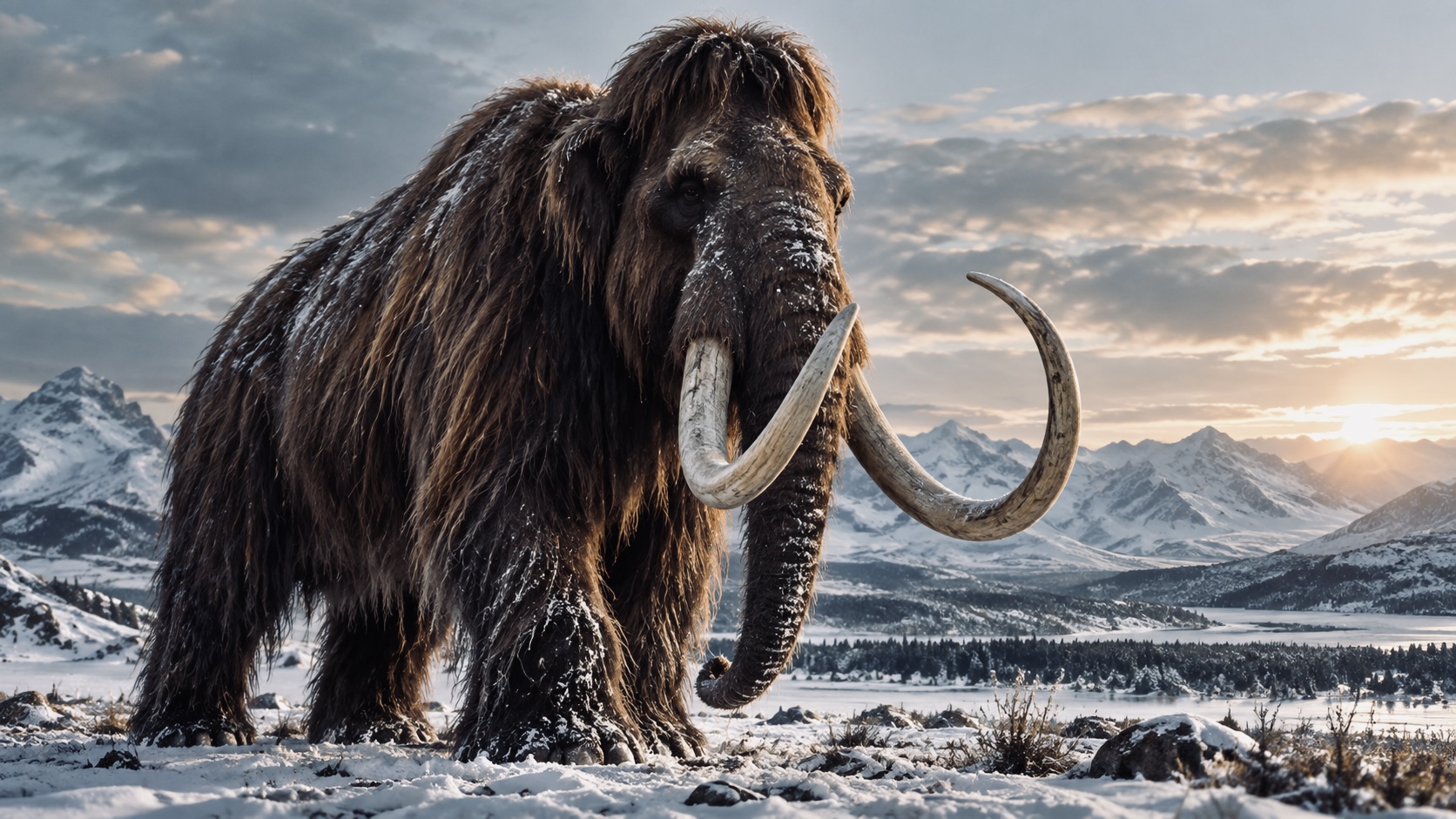
From mammoth-like elephants to gene-edited wolves and efforts to recreate the dodo, biotechnology is making “de-extinction” increasingly plausible, but what scientists can create is not necessarily the species that disappeared.
THE UNIVERSAL RECORD
Sourced reporting. No opinions.
Brad Socha | September 8, 2026 | 5:09 AM EST
Bringing an extinct animal back to life sounds straightforward: recover its DNA, rebuild the animal and reverse extinction. The reality is considerably more complicated.
Scientists can recover ancient DNA, reconstruct genomes, edit living cells, clone some mammals and selectively breed living animals for ancestral traits. Those capabilities have advanced rapidly enough that animals resembling extinct species can now be engineered.
But there is an important distinction behind the dramatic language of resurrection. The International Union for Conservation of Nature has cautioned that existing approaches cannot recreate an extinct species in its complete genetic, physiological, behavioural and ecological form. The more scientifically precise goal is usually a proxy, a living animal engineered or bred to reproduce important characteristics of an extinct one.
The difference became especially visible with the dire wolf.
How Gene Editing Is Changing De-Extinction
In 2025, biotechnology company Colossal Biosciences announced the birth of three animals it described as de-extinct dire wolves.
The company reconstructed genetic information from ancient dire wolf remains, including a roughly 13,000-year-old tooth and 72,000-year-old skull. Researchers then made 20 edits across 14 genes in gray wolf cells before using somatic cell nuclear transfer, a cloning technique, to create embryos carried by domestic dog surrogates.
The result was scientifically significant, but its description as the return of the dire wolf became controversial.
The animals began as gray wolf cells and received a limited set of genetic modifications chosen to produce traits associated with dire wolves. Researchers outside the company have therefore described them as genetically modified gray wolves or dire-wolf proxies rather than resurrected members of Aenocyon dirus. A 2025 scientific commentary similarly characterized the result as a phenotypic approximation rather than genomic or ecological resurrection.
Colossal uses a broader concept it calls “functional de-extinction,” in which an organism is created to resemble an extinct species and reproduce important traits rather than duplicate every part of its genome.
That distinction is also central to the company’s woolly mammoth project.
Scientists are not attempting to recover an intact mammoth cell from frozen remains and clone it. Ancient mammoth DNA survives only as damaged fragments. Instead, researchers can compare reconstructed mammoth genomes with those of Asian elephants and identify genetic variants associated with traits such as dense hair, fat deposition and adaptation to cold.
The underlying ancient-DNA science is remarkable. Researchers have recovered genome-wide information from Siberian mammoth specimens more than one million years old. But sequencing ancient DNA is fundamentally different from possessing a living mammoth cell containing an intact genome.
Colossal demonstrated part of its approach in 2025 by producing gene-edited mice with mammoth-associated hair traits. The company says its eventual mammoth project is intended to produce a cold-adapted elephant carrying important mammoth characteristics, not a genetically perfect copy of an Ice Age mammoth.
Cloning, Dodos and the Limits of Extinct DNA
Cloning offers another route, but only under unusually favourable circumstances.
Somatic cell nuclear transfer takes the nucleus of a preserved cell and places it into an egg whose own nucleus has been removed. That approach famously produced Dolly the sheep and could theoretically reproduce recently extinct animals if viable cells were preserved before extinction.
The Pyrenean ibex, or bucardo, demonstrated both the possibility and the limitation. The last individual died in 2000, but scientists had preserved cells from the animal. A cloned female was born in 2003, the first live birth of a clone from an extinct animal, but severe lung abnormalities caused it to die within minutes.
For mammoths and most long-extinct animals, there are no intact living cells to clone. DNA progressively breaks into fragments after death, making the popular idea of extracting a complete genome from an ancient specimen and simply cloning the animal unrealistic.
Birds present additional reproductive challenges, which is why efforts involving the dodo use a different strategy.
The dodo’s closest living relative is the Nicobar pigeon. Researchers can compare their genomes to identify genetic differences, but conventional mammalian-style cloning does not translate easily to birds. Colossal’s approach involves primordial germ cells, the embryonic cells that ultimately produce sperm and eggs. In 2025, the company reported successfully culturing pigeon primordial germ cells, a technical step toward eventually producing birds carrying edited genetic traits associated with the dodo.
No living dodo has been recreated.
There is also a lower-tech form of de-extinction: selective breeding. Scientists and breeders can mate living descendants or relatives that retain ancestral characteristics, gradually concentrating those traits. Projects involving cattle resembling the extinct aurochs and plains zebras resembling the extinct quagga illustrate the approach. But an animal that looks increasingly like an aurochs or quagga does not thereby become genetically identical to the extinct population.
What Would It Mean to Bring an Extinct Species Back?
DNA is only part of an animal.
Development inside an egg or uterus, gene regulation, learned behaviour, parental influence, social structure, diet and environment all help determine what an organism becomes. Even an animal with an extraordinarily close nuclear genome would develop in a world different from the one inhabited by its extinct ancestors.
There is also the question of what happens after birth. Producing one animal is not the same as restoring a species. A viable population requires genetic diversity, successful reproduction, appropriate habitat and, if eventual release is intended, evidence that introducing the animals will not harm existing ecosystems.
The IUCN therefore recommends evaluating de-extinction projects according to conservation benefits, ecological risks, animal welfare, effects on existing species and whether conventional conservation could accomplish the same objective more effectively.
This may ultimately be where the technology has its greatest impact. Techniques developed for de-extinction, including genome sequencing, gene editing, reproductive technology and biobanking, can also potentially help species that are endangered but still alive.
Scientists are getting increasingly good at reconstructing the genetic past and transferring selected pieces of it into living animals. That is a major technological achievement.
But a woolly mammoth, dire wolf or dodo was more than a collection of recognizable traits. For now, science can create increasingly sophisticated approximations of extinct animals, and, in rare circumstances, clone a recently extinct one from preserved cells. Recreating an ancient species exactly as it once existed remains beyond our reach.
Sources:
IUCN Species Survival Commission — Guiding Principles on Creating Proxies of Extinct Species for Conservation Benefit
https://portals.iucn.org/library/node/46248
Journal of Heredity — De-extinction Technology and Its Application to Conservation
https://academic.oup.com/jhered/article/117/5/959/8262805
Functional Ecology — Pathways to De-extinction: How Close Can We Get to Resurrection of an Extinct Species?
https://besjournals.onlinelibrary.wiley.com/doi/full/10.1111/1365-2435.12705
Nature — Million-year-old DNA Sheds Light on the Genomic History of Mammoths
https://www.nature.com/articles/s41586-021-03224-9
University of California, Santa Cruz — Ancient DNA Research Aids De-extinction Efforts and Reveals Surprising Dire Wolf Ancestry
https://news.ucsc.edu/2025/04/dire-wolf-genome/
Scientific American — Did Scientists Actually De-Extinct the Dire Wolf?
https://www.scientificamerican.com/article/the-dire-wolf-isnt-back-but-heres-what-de-extinction-tech-can-actually-do/
National Geographic — First Extinct-Animal Clone Created
https://www.nationalgeographic.com/science/article/news-bucardo-pyrenean-ibex-deextinction-cloning
Colossal Biosciences — How Did Colossal Biosciences Bring Back the Dire Wolf?
https://colossal.com/how-did-colossal-biosciences-bring-back-the-dire-wolf/
Colossal Biosciences — Dodo
https://colossal.com/dodo/
About the Author
Brad Socha is the founder of The Universal Record, focused on sourced, factual global reporting. Coverage includes international news, geopolitics, technology, and major developments.