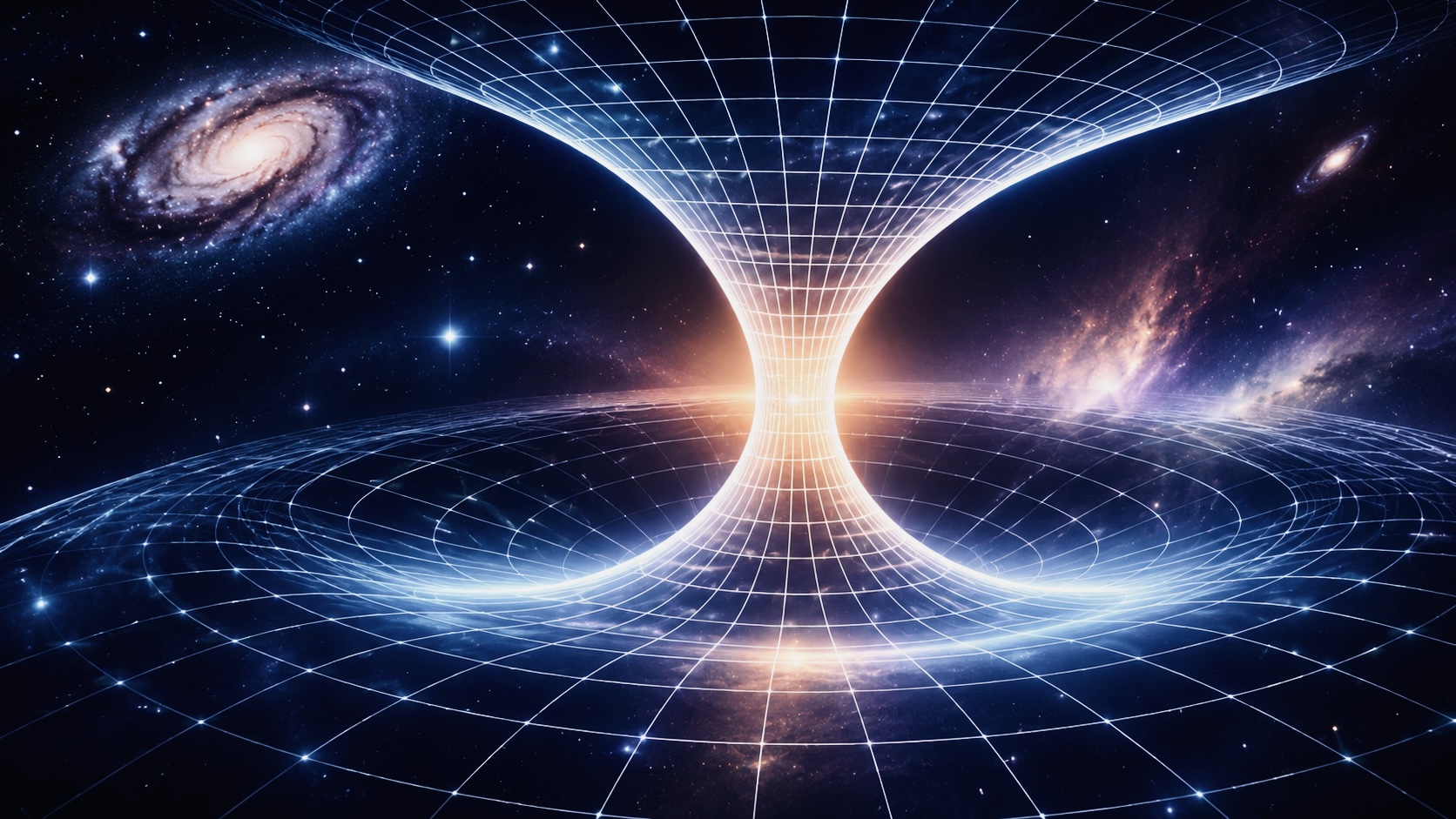
What if time is not a fundamental part of reality? Research into quantum physics and gravity is raising new questions about the nature of the universe.
Time governs nearly everything we experience. Stars form and eventually die, planets orbit their suns, and human lives unfold from birth to death. Yet some physicists are investigating whether time, despite its central role in our understanding of the universe, exists at the most fundamental level of reality.
The possibility emerges from one of modern physics’ greatest unresolved problems: reconciling Einstein’s general theory of relativity with quantum mechanics.
Both theories have transformed scientific understanding, but they describe time differently. General relativity treats time as part of a dynamic structure called spacetime, while conventional quantum mechanics generally uses time as an external parameter against which physical systems evolve.
When researchers attempt to combine these descriptions, time becomes surprisingly difficult to define.
Some approaches to quantum gravity suggest that the universe might be described without a fundamental clock. Instead, what we experience as time could emerge from relationships between physical systems.
That possibility raises an extraordinary question: could the universe exist without time as we understand it?
Why Time May Not Be Fundamental
Einstein’s theory of general relativity established that time is not universal.
According to relativity, gravity and motion influence how quickly clocks measure elapsed time. A clock near a massive object runs more slowly relative to one farther from that object’s gravitational influence, under otherwise comparable conditions.
These effects have been confirmed experimentally using highly precise atomic clocks, including clocks operating aboard satellites in space.
One of the clearest examples involves the Global Positioning System (GPS), which depends on atomic clocks aboard satellites orbiting approximately 20,200 kilometres above Earth.
Because these satellites travel at high speeds, Einstein’s special theory of relativity predicts that their clocks should run approximately seven microseconds slower per day than clocks on Earth’s surface.
However, the weaker gravitational field at their altitude produces the opposite effect. General relativity predicts that their clocks should run approximately 45 microseconds faster per day.
The combined result is that GPS satellite clocks would gain approximately 38 microseconds each day relative to clocks on Earth if the effects were not corrected.
Although the difference is extremely small, it is significant enough to cause navigation errors of roughly 10 kilometres per day without relativistic corrections.
The European Space Agency has also explained that astronauts aboard the International Space Station experience a slightly slower passage of time compared with people remaining on Earth. Over a six-month mission, the accumulated difference is approximately seven milliseconds.
These examples demonstrate that elapsed time depends on physical conditions rather than a universal clock shared by every observer.
The deeper problem emerges when physicists investigate gravity at quantum scales.
General relativity describes gravity through the geometry of spacetime. Quantum mechanics describes matter and other physical systems using mathematical states and probabilities.
Combining the two requires physicists to consider what happens when spacetime itself must be described quantum mechanically.
One influential mathematical framework involves the Wheeler–DeWitt equation, developed through work by physicists John Wheeler and Bryce DeWitt.
Unlike the familiar Schrödinger equation used in quantum mechanics, the Wheeler–DeWitt equation does not contain an ordinary external time parameter describing the evolution of the universe.
In certain formulations, the universe’s overall quantum state appears stationary.
This creates what physicists call the problem of time.
If a fundamental mathematical description does not contain time in the usual sense, how do changes occur? Why do clocks tick, stars evolve, and people experience events in sequence?
One possibility is that time is not a basic ingredient of reality but something that emerges from more fundamental physical relationships.
Physicist Carlo Rovelli has explored approaches in which physics describes relationships between changing quantities without requiring a universal background clock.
In this interpretation, what matters fundamentally may be how physical systems change relative to one another rather than how they evolve against an independent cosmic timeline.
However, this remains a theoretical approach, not an experimentally established description of the universe.
Could Time Emerge From Quantum Relationships?
Another approach suggests that time could emerge through correlations between different parts of a quantum system.
In 1983, physicists Don Page and William Wootters proposed a mechanism in which an overall stationary quantum state could contain subsystems that appear to evolve relative to one another.
Imagine two connected physical systems. One acts as a clock, while the other changes in relation to it.
An observer comparing the systems could describe a sequence of events even if the combined system is represented by a stationary quantum state.
In this framework, time is associated with relationships between physical systems rather than an independently flowing background.
Researchers have continued developing this idea.
A 2021 study published in Nature Communications examined how conventional quantum evolution and classical equations of motion could arise through quantum correlations involving a clock system.
Further theoretical work published in Physical Review D in 2023 investigated how these constructions behave under different assumptions about quantum states and interactions.
Such research provides mathematical tools for investigating how time might emerge.
It does not demonstrate that the entire universe is timeless or that quantum entanglement definitively explains our experience of time.
Other approaches to quantum gravity retain different forms of temporal structure, and scientists have not reached a consensus on which description is correct.
There is also an important distinction between the existence of time and its apparent direction.
Most everyday experiences move in one direction. We remember yesterday rather than tomorrow, broken objects do not ordinarily reassemble themselves, and heat naturally spreads from warmer regions toward cooler ones.
This direction is closely associated with entropy, a thermodynamic quantity related to the number of microscopic arrangements compatible with a system’s overall condition.
The second law of thermodynamics describes how entropy tends to increase in an isolated system.
That increase helps explain why many processes are irreversible in practice, even though numerous fundamental physical equations do not distinguish a preferred direction of time.
The relationship between entropy, the universe’s early conditions, and our experience of time remains an active subject of research.
Some physicists propose that the direction of time, or aspects of time itself, could emerge from thermodynamic or informational properties.
But explaining why time has a direction is not the same as explaining whether time fundamentally exists.
The suggestion that time is an illusion also has a philosophical dimension.
Some interpretations of relativity describe the universe as a four-dimensional spacetime containing events at different temporal locations. In such interpretations, the apparent movement of the present may not represent a separate physical process.
Other interpretations maintain that temporal passage is a genuine feature of reality.
Neither philosophical position has been conclusively established by existing physical evidence.
The most significant unanswered question is whether a future theory of quantum gravity will reveal time as fundamental, emergent, or something that requires an entirely different description.
For now, clocks continue to measure real physical differences, and the sequence of events remains essential to scientific predictions.
What remains uncertain is whether time belongs to the universe’s deepest structure or arises from the relationships between the things within it.
If time is emergent, the universe would not necessarily be motionless or incapable of change. Instead, the familiar distinction between past, present, and future might arise from physical processes that do not depend on a universal clock.
Understanding that possibility could change how physicists describe the universe at its most fundamental level, without changing the measurable differences in elapsed time that shape everyday life.
Physical Review D — Robustness of the Page-Wootters Construction Across Different Pictures, States of the Universe, and System-Clock Interactions (2023) https://doi.org/10.1103/PhysRevD.108.063507
About the Author Brad Socha is the founder of The Universal Record, focused on sourced, factual global reporting. Coverage includes international news, geopolitics, technology, and major developments.