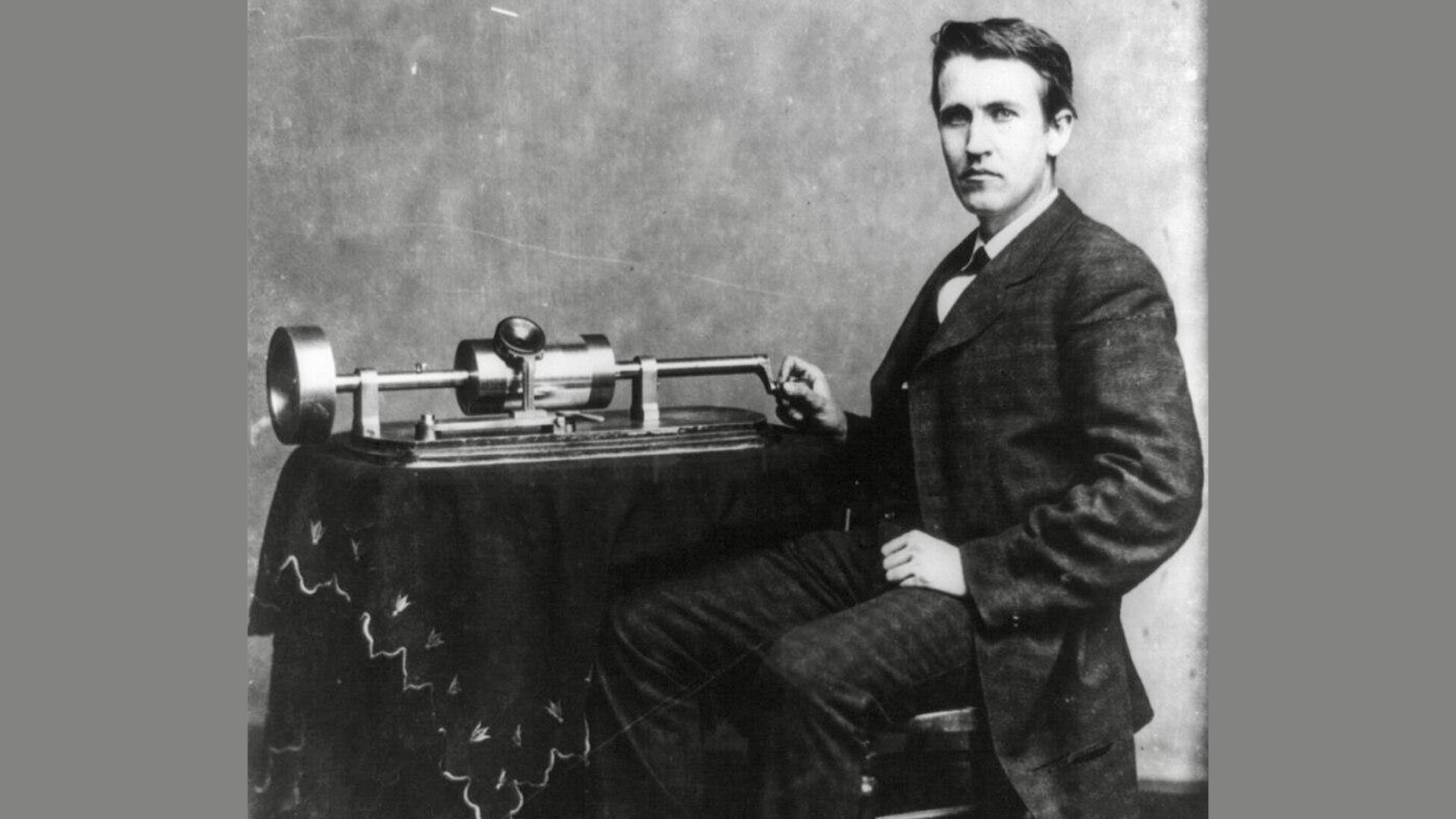
Thomas Edison’s new machine could capture the human voice and play it back, opening possibilities that would transform communication, entertainment, and the preservation of sound.
On November 21, 1877, American inventor Thomas Edison announced the phonograph, a device designed to record sound and reproduce it. Developed at his laboratory in Menlo Park, New Jersey, the invention introduced a remarkable possibility: spoken words and other sounds could be preserved and heard again long after they were originally produced.
Before the phonograph, sound disappeared almost as soon as it was made. Music had to be performed, speeches had to be delivered, and conversations could not be replayed. Edison’s invention helped establish the technological foundations of recorded audio, changing how future generations would experience music, communication, and entertainment.
The phonograph emerged during a period of rapid technological development, when electricity, telegraphy, and telephony were transforming communication across increasingly connected societies.
How Edison Developed the Phonograph
Edison’s breakthrough grew out of experiments involving the telegraph and telephone. During 1877, he was investigating methods of recording electrical signals and reproducing them later.
Telegraph equipment already used moving paper tape to preserve messages as patterns of marks. Edison considered whether a similar mechanical process could capture the vibrations produced by the human voice.
His experiments eventually led to a device that used a diaphragm, a metal stylus, and a rotating cylinder covered with thin tinfoil.
When someone spoke into the mouthpiece, sound waves caused the diaphragm to vibrate. The attached stylus pressed corresponding indentations into the foil as the cylinder rotated.
To reproduce the recording, the process was reversed. The stylus followed the indentations, causing the diaphragm to vibrate again and recreate an audible approximation of the original sound.
Unlike earlier instruments that merely traced sound vibrations, Edison’s machine could both record and reproduce them.
The distinction was fundamental.
French inventor Édouard-Léon Scott de Martinville had developed the phonautograph in 1857, producing visible recordings of sound waves. His instrument was intended to study sound rather than play it back.
Another French inventor, Charles Cros, described a method of recording and reproducing sound in 1877, but did not construct a working machine.
Edison’s achievement was to develop a functioning mechanical system capable of bringing recorded sound back to listeners.
The exact chronology of the first successful demonstration remains uncertain. Although November 21 is widely associated with Edison’s announcement, historical laboratory records suggest that the earliest completed working phonograph may have appeared in early December 1877.
Edison worked with machinist John Kruesi, who constructed the experimental apparatus. During an early test, Edison reportedly recited the nursery rhyme “Mary Had a Little Lamb” and heard his words reproduced by the machine.
The demonstration established that sound could be captured mechanically and played back.
From an Experimental Machine to Recorded Sound
The phonograph quickly attracted attention beyond Edison’s laboratory.
On December 7, 1877, Edison and his associates demonstrated the machine to editors of Scientific American in New York City. The magazine subsequently described how the small apparatus reproduced spoken words after its operator turned a crank.
The demonstration helped introduce the invention to a wider audience.
Edison applied for a United States patent on December 24, 1877. Patent No. 200,521 was granted on February 19, 1878, formally recognizing his recording and playback mechanism.
The machine soon became a public attraction, with demonstrations showing audiences something previously considered extraordinary: a mechanical device that appeared to speak.
The phonograph also strengthened Edison’s public reputation. He became widely known as the “Wizard of Menlo Park,” a nickname associated with the remarkable inventions emerging from his laboratory.
Yet the earliest phonographs had serious limitations.
Tinfoil was fragile, recordings deteriorated rapidly, and sound reproduction was relatively poor. The machines required careful operation and were unsuitable for convenient everyday use.
Edison initially considered applications such as office dictation and the preservation of spoken messages. However, commercial adoption was limited.
He eventually redirected much of his attention toward developing practical electric lighting.
Other inventors continued improving sound recording technology. Alexander Graham Bell’s associates Chichester Bell and Charles Sumner Tainter developed systems using wax-coated cylinders, which offered important improvements over tinfoil.
By the late 1880s, Edison had returned to phonograph development, incorporating improved recording materials and mechanisms.
The industry was also beginning to change through the work of German-born inventor Emile Berliner, whose gramophone used flat discs rather than cylinders.
As recording quality and manufacturing techniques improved, phonographs became increasingly useful for preserving music, performances, speeches, and other sounds.
Recorded entertainment eventually developed into a major industry, allowing people to hear performances without attending them in person.
During the twentieth century, mechanical sound recording gave way to electrical recording, magnetic tape, and eventually digital audio.
Radio broadcasting, recorded music, film soundtracks, and modern audio distribution all developed within a world transformed by the ability to preserve and reproduce sound.
The technology also became an important tool for historical preservation. Recordings made it possible to retain voices, musical performances, languages, and other sounds that might otherwise have disappeared.
Today, digital recordings can be copied, transmitted, edited, and played almost instantly across the world. Although the technology bears little resemblance to Edison’s hand-operated machine, it continues to serve the same fundamental purpose.
The phonograph did not immediately create the modern recording industry, nor was Edison the first person to capture sound vibrations. Its significance lay in combining recording and playback within a working device.
What began as an experimental machine in Menlo Park established a new relationship between people and sound: something once temporary could now be preserved, reproduced, and heard by generations yet to come.
About the Author Brad Socha is the founder of The Universal Record, focused on sourced, factual global reporting. Coverage includes international news, geopolitics, technology, and major developments.