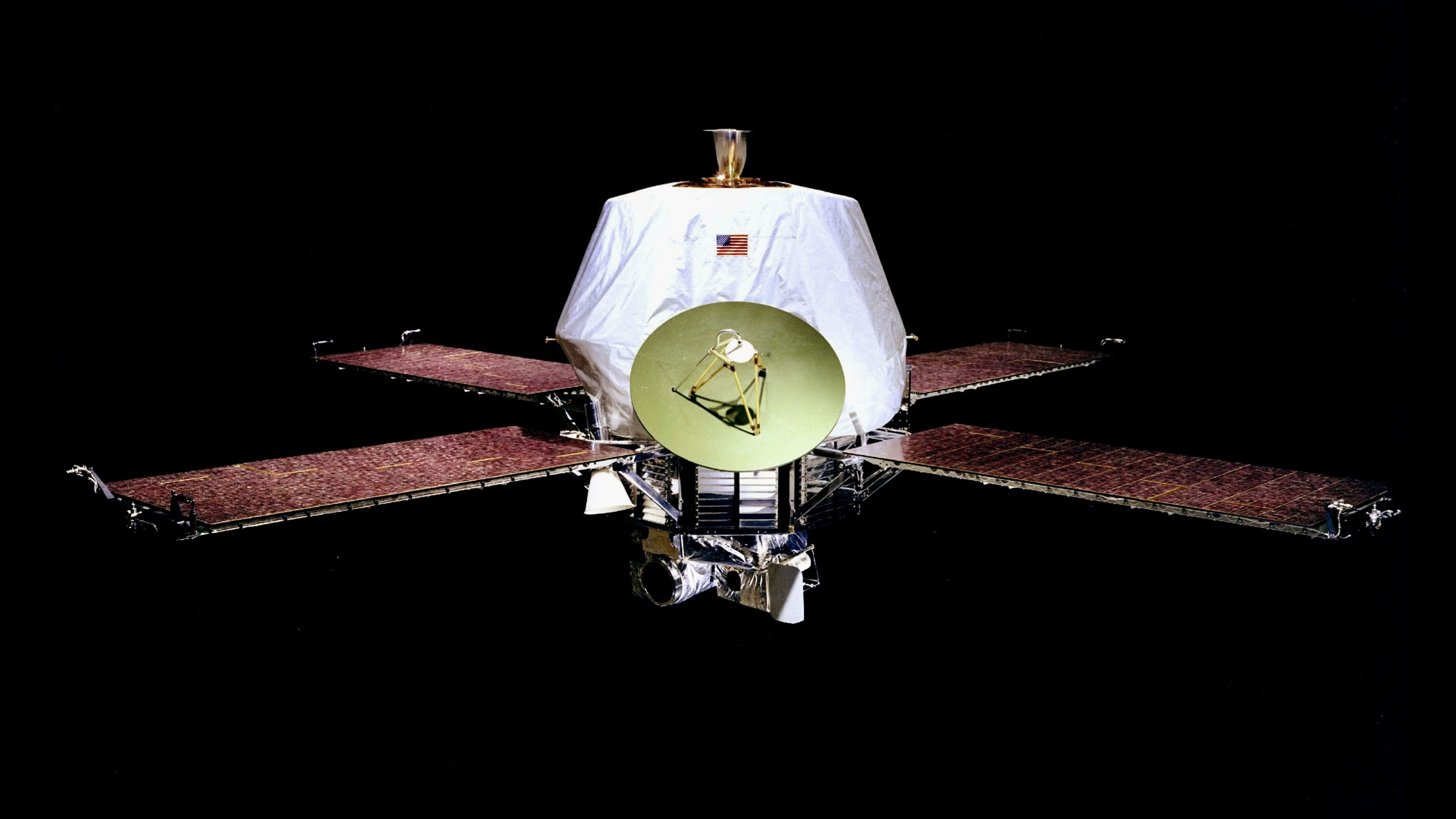
1971: Mariner 9 Becomes the First to Orbit Another Planet
NASA’s pioneering Mars mission revealed a world of towering volcanoes, enormous canyons, and landscapes that changed scientists’ understanding of the Red Planet.
On November 13, 1971, NASA’s Mariner 9 entered orbit around Mars, becoming the first spacecraft to orbit another planet. The achievement marked a turning point in planetary exploration, allowing scientists to study an alien world repeatedly rather than relying on brief flybys. What followed transformed Mars from a planet known largely through distant observations into a complex geological world with enormous volcanoes, deep canyons, and evidence that liquid water had once shaped its surface.
The mission arrived during a period of intense competition in space exploration. Earlier American spacecraft had photographed Mars during flybys, but their limited observations left fundamental questions unanswered. Mariner 4, in 1965, had revealed a heavily cratered landscape that appeared similar to the Moon, reinforcing the impression of a cold, largely inactive planet.
Mariner 9 would challenge that picture.
Launched on May 30, 1971, aboard an Atlas-Centaur rocket from Cape Kennedy, Florida, the spacecraft travelled approximately five and a half months before reaching Mars. Its primary objective was to conduct an extended orbital survey, examining the planet’s surface, atmosphere, and changing conditions.
Unlike earlier missions that passed Mars once and continued into space, Mariner 9 could return to the same regions, observe changes over time, and gradually build a more complete picture of the planet.
Mariner 9 Arrives at a Planet Hidden by Dust
When Mariner 9 reached Mars, scientists encountered an unexpected obstacle: an enormous dust storm had obscured much of the planet.
The storm had developed before the spacecraft’s arrival and expanded until dust covered nearly the entire Martian globe. Instead of immediately photographing recognizable surface features, Mariner 9 initially observed a largely featureless atmosphere.
A few unusually high features remained visible above the dust. Among them were the summits of giant volcanic mountains, offering early indications that Mars possessed geological structures unlike anything previously seen in spacecraft images.
The mission’s orbital design proved especially valuable. Rather than losing its opportunity during a single encounter, Mariner 9 could wait for atmospheric conditions to improve.
As the dust gradually settled, the spacecraft began revealing the planet beneath.
Its television cameras produced thousands of images, eventually mapping approximately 85 percent of the Martian surface. The resulting observations fundamentally altered scientific understanding of Mars.
One of the most remarkable discoveries was Olympus Mons, a gigantic shield volcano rising more than 20 kilometres above the surrounding terrain. Its immense size demonstrated that volcanic processes had shaped Mars on a scale far exceeding familiar terrestrial volcanoes.
Mariner 9 also revealed an extraordinary system of interconnected canyons extending thousands of kilometres across the planet.
The canyon system was later named Valles Marineris in honour of the spacecraft’s discoveries. Stretching approximately 4,000 kilometres, it is among the largest known canyon systems in the solar system.
These formations established that Mars was far more geologically diverse than the heavily cratered terrain observed during earlier flybys had suggested.
Discoveries That Changed the Search for Water on Mars
Beyond volcanoes and canyons, Mariner 9 identified landforms that suggested liquid water had once flowed across portions of the Martian surface.
Some images showed winding channels and extensive outflow features resembling landscapes produced by flowing water on Earth.
The observations did not establish that Mars had supported life. They did, however, provide important geological evidence that its environmental history was more complicated than previously understood.
Scientists began considering whether ancient Mars had experienced conditions substantially different from those observed in the modern, cold, thin-atmosphered environment.
Mariner 9 also studied the planet’s atmosphere, monitored seasonal changes, and examined its polar regions. Its instruments gathered information about atmospheric composition, temperature, dust, and water vapour, helping researchers better understand the processes influencing Martian weather.
The spacecraft photographed Mars’s two small moons, Phobos and Deimos, providing much more detailed views than had previously been available.
Its scientific achievements were substantial. During its operational lifetime, Mariner 9 returned more than 7,300 images, creating an unprecedented photographic record of another planet.
The spacecraft’s discoveries also helped establish the scientific priorities of later Mars missions.
NASA’s Viking programme, which successfully placed two landers on Mars in 1976, benefited from the orbital reconnaissance and improved understanding of the Martian environment provided by Mariner 9.
The evidence of ancient water-related activity eventually became central to a much broader scientific question: whether Mars had once possessed environments capable of supporting microbial life.
Decades later, orbiters, landers, and rovers continued investigating the planet’s geological history, including ancient river systems, lakebeds, minerals formed in water, and the possibility of past habitability.
Mariner 9’s mission formally ended on October 27, 1972, after its attitude-control gas supply was depleted. The spacecraft remained in orbit around Mars, its operational work complete but its scientific legacy firmly established.
The November 13, 1971, orbital insertion represented more than an engineering milestone. It introduced a new approach to planetary exploration, demonstrating that sustained observations from orbit could reveal geological processes, atmospheric changes, and environmental histories invisible during brief encounters.
Before Mariner 9, Mars had appeared in spacecraft photographs primarily as a cratered, seemingly barren world. Afterward, it was recognized as a planet with a complex geological past and compelling questions about water, climate, and the possibility of life beyond Earth.
More than half a century later, the discoveries that began with Mariner 9 remain foundational to humanity’s continuing exploration of Mars.
About the Author Brad Socha is the founder of The Universal Record, focused on sourced, factual global reporting. Coverage includes international news, geopolitics, technology, and major developments.