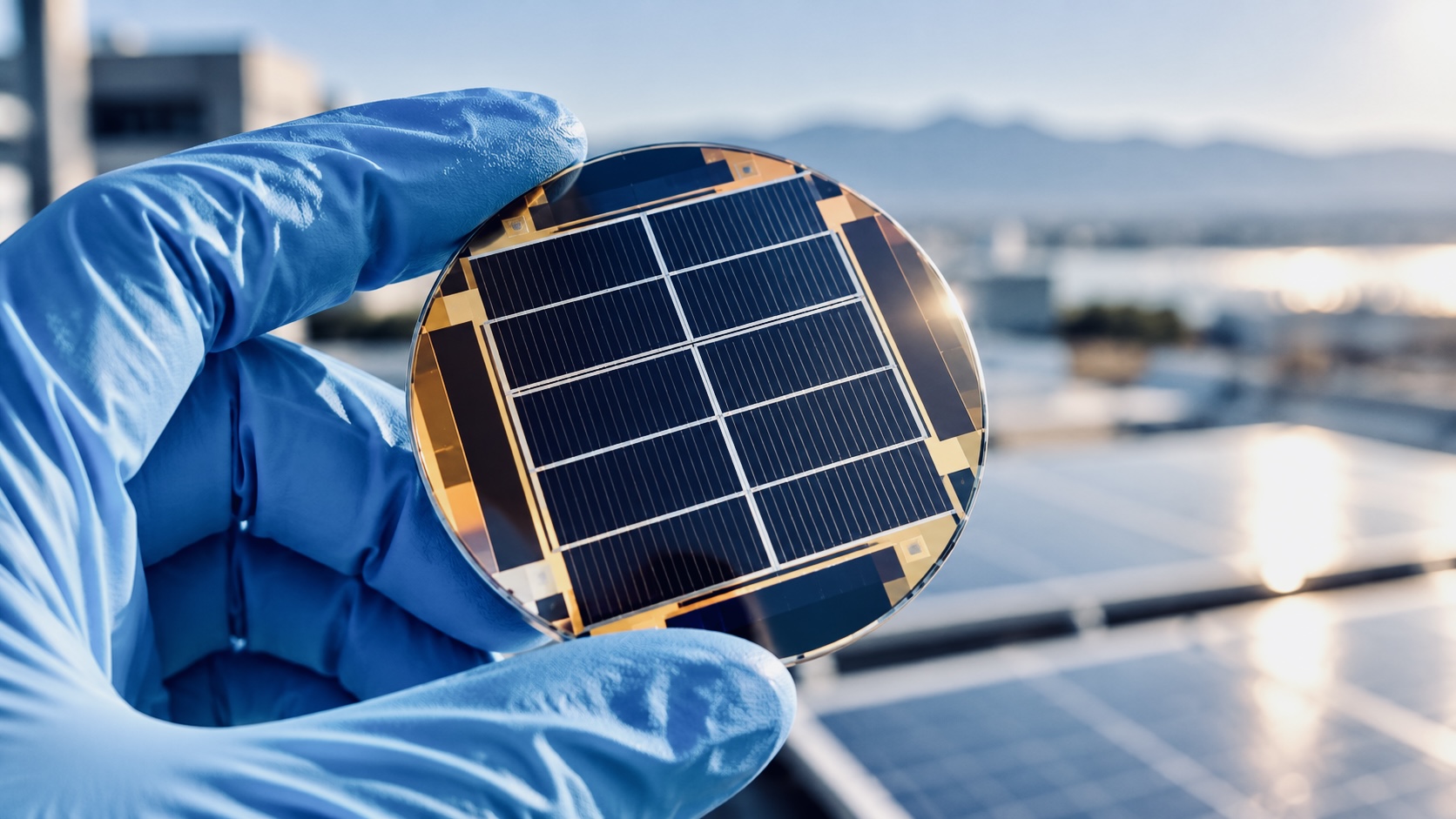
A new generation of solar cells is capturing more sunlight than conventional silicon designs. The challenge now is turning laboratory efficiency gains into durable, affordable electricity.
THE UNIVERSAL RECORD
Sourced reporting. No opinions.
Brad Socha | October 29, 2026 | 5:39 AM EST
Perovskite solar cells are approaching an important commercial test: whether their exceptional laboratory performance can translate into reliable electricity generation over decades.
By combining a thin layer of perovskite material with conventional silicon, researchers have developed tandem solar cells capable of converting nearly 35% of incoming sunlight into electricity under standardized laboratory conditions. That exceeds the efficiency ceiling of conventional single-junction silicon cells.
The technology could allow solar installations to generate more electricity from the same rooftop or land area. But greater efficiency alone will not determine its future. Manufacturers must also demonstrate that the new cells can survive years of sunlight, heat, moisture and changing weather conditions without becoming too expensive to produce.
Research published in 2026 shows progress on both fronts, while highlighting how much work remains before tandem panels can compete with established silicon products at scale.
How Perovskite Solar Cells Capture More Energy
Conventional solar panels primarily use crystalline silicon to convert sunlight into electricity. Silicon is highly effective, but a single semiconductor layer cannot capture every part of the solar spectrum equally well.
Some incoming light carries too little energy to generate electricity, while energy from higher-energy photons is partly lost as heat.
Perovskite-silicon tandem cells address this limitation by stacking two light-absorbing materials.
The upper perovskite layer captures higher-energy light, while the silicon cell underneath absorbs much of the remaining lower-energy light. Together, they use the solar spectrum more efficiently than either layer could alone.
Perovskites are a family of materials defined by their crystal structure. The compositions used in solar cells can be adjusted to absorb different wavelengths of light, making them particularly useful for tandem designs.
Germany’s Fraunhofer Institute for Solar Energy Systems ISE estimates that combining perovskite and silicon raises the theoretical efficiency ceiling from approximately 29.4% for a single-junction silicon cell to 43.3% for the tandem architecture.
These are theoretical limits, not efficiencies currently achieved by commercial panels.
Actual laboratory results are nevertheless substantial. A 2025 review in Nature Photonics documented perovskite-silicon tandem efficiencies approaching 35%, reflecting rapid improvements in materials and cell design.
In September 2026, research published in Nature Sustainability reported a certified tandem-cell efficiency of 33.0% using an approach designed to make manufacturing more practical.
The distinction between a research cell and a commercial panel is important. Small laboratory devices can achieve higher efficiencies than full-sized modules, where electrical connections, protective materials and manufacturing variations introduce additional losses.
Even so, a meaningful increase in module efficiency could make a difference where installation space is limited.
More electricity from the same surface area could improve the productivity of residential rooftops, commercial buildings and utility-scale solar farms. Whether those gains reduce electricity costs depends on manufacturing expense, operating life and the performance of complete installations.
The Challenge of Making Tandem Solar Panels Last
The largest obstacle is no longer simply producing highly efficient cells. It is ensuring they remain effective under real operating conditions.
Silicon panels benefit from decades of manufacturing experience and established reliability standards. Perovskite materials have a much shorter commercial track record.
Some perovskite compositions are vulnerable to moisture, elevated temperatures, mechanical stress and prolonged electrical operation. Changes within the material can gradually reduce its ability to generate electricity.
Partial shading creates another problem. When one section of a solar panel receives less light than neighbouring sections, electrical stresses can develop that damage sensitive cells.
A study published in Nature Energy in May 2026 investigated this vulnerability in perovskite-silicon tandems.
Researchers developed graded dielectric layers to reduce electrical stress and improve resistance to reverse-bias damage. Their devices achieved a certified efficiency of 33.76% and retained more than 92% of their initial efficiency after 1,000 hours under the study’s specified electrical stress conditions.
The findings demonstrate a possible solution to one durability problem, but accelerated laboratory testing does not establish how a panel will perform after decades outdoors.
Fraunhofer ISE identifies long-term stability, protective encapsulation and reliable cell interconnections as essential requirements for commercial deployment. Its research targets the durability expected of established solar products, including performance guarantees extending beyond 25 years.
Manufacturing presents a separate challenge.
Producing a high-quality perovskite coating on a small laboratory cell is different from applying uniform layers across large silicon wafers at industrial speed. Defects, inconsistent thickness and production losses can reduce both performance and profitability.
In May 2026, Fraunhofer opened its Pero-Si-SCALE laboratory to help transfer tandem designs into industrial manufacturing. The facility supports silicon wafers measuring up to 210 by 210 millimetres and evaluates processes compatible with existing photovoltaic production.
Meanwhile, the September 2026 Nature Sustainability study demonstrated perovskite fabrication in ambient air using blade coating, a potentially scalable method that avoids some tightly controlled laboratory processing conditions.
These developments address different parts of the same problem: manufacturing cells efficiently, consistently and at a competitive cost.
Commercial activity has already begun. In September 2024, Oxford PV announced its first shipment of perovskite-silicon tandem panels to a customer in the United States. The company said the technology could produce up to 20% more energy than a standard silicon panel under its stated comparison.
That commercial milestone demonstrated movement beyond laboratory prototypes, although the company’s performance claims do not establish equivalent gains across every installation.
Researchers must also address environmental considerations, including the use of lead in many high-performing perovskite formulations and the need to manage potential releases during manufacturing, damage and disposal.
The outlook is therefore promising but conditional.
Perovskite-silicon tandems have demonstrated that solar cells can capture substantially more sunlight than conventional silicon designs. The next measure of success will be whether manufacturers can preserve those gains in affordable panels that operate reliably for decades.
If they succeed, the technology could expand the amount of electricity generated from existing solar installation space without requiring an entirely new approach to solar power.
Sources:
Fraunhofer ISE — Silicon-Based Tandem Solar Cells and Modules
https://www.ise.fraunhofer.de/en/business-areas/photovoltaics-materials-cells-and-modules/silicon-based-tandem-solar-cells-and-modules.html
Fraunhofer ISE — New Laboratory to Accelerate Market Introduction of Perovskite-Silicon Photovoltaics (May 5, 2026)
https://www.ise.fraunhofer.de/en/press-media/press-releases/2026/fraunhofer-ise-opens-laboratory-to-accelerate-market-introduction-of-perovskite-silicon-photovoltaics.html
Nature Photonics — Towards Efficient, Scalable and Stable Perovskite/Silicon Tandem Solar Cells (2025)
https://doi.org/10.1038/s41566-025-01732-y
Nature Energy — Improving the Stability of Monolithic Perovskite/Silicon Tandems Against Reverse-Bias Stress (May 2026)
https://www.nature.com/articles/s41560-026-02067-w
Nature Sustainability — Scalable Ambient Fabrication of Single-Junction and Perovskite–Silicon Tandem Solar Cells (2026)
https://www.nature.com/articles/s41893-026-01916-6
Nature Reviews Clean Technology — Taking Perovskite Photovoltaics from Promise to Product (2026)
https://www.nature.com/articles/s44359-026-00173-2
Oxford PV — First Commercial Shipment of Perovskite Tandem Solar Panels (September 5, 2024)
https://www.oxfordpv.com/press-releases/oxford-pv-solar-technology-patent
National Laboratory of the Rockies — Best Research-Cell Efficiency Chart
https://www.nlr.gov/pv/cell-efficiency
About the Author
Brad Socha is the founder of The Universal Record, focused on sourced, factual global reporting. Coverage includes international news, geopolitics, technology, and major developments.