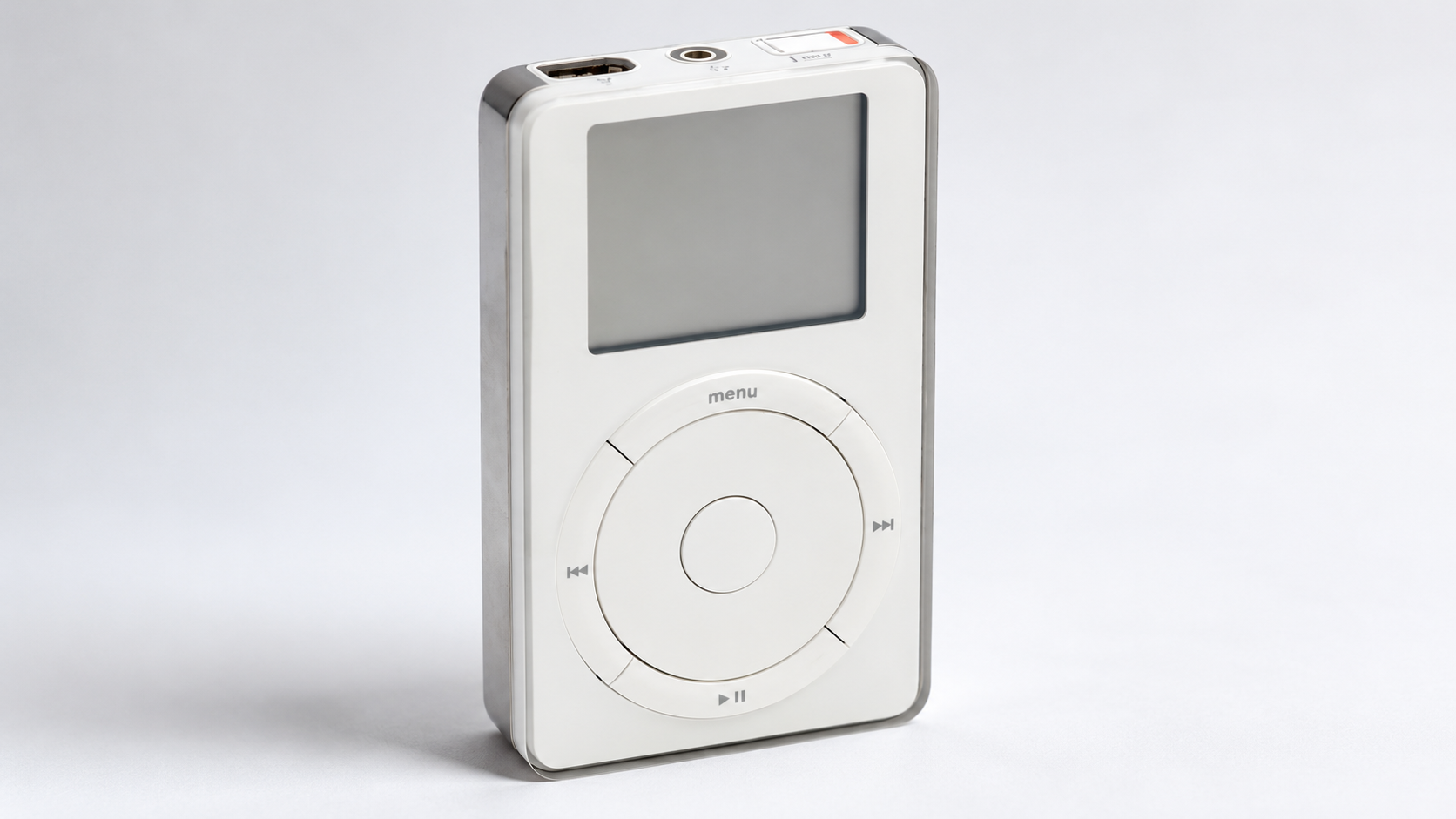
With 1,000 songs in a pocket-sized device, Apple introduced a new way to carry music, and helped set the stage for a transformation in how the world listened.
On October 23, 2001, Apple introduced the first iPod at its headquarters in Cupertino, California. The portable digital music player could store approximately 1,000 songs on a five-gigabyte hard drive, allowing listeners to carry a substantial music collection in a device small enough to fit in a pocket.
The announcement came at a time when compact discs remained a dominant way to purchase music, portable CD players were common, and digital music was rapidly gaining popularity. The iPod was not the first MP3 player, but its combination of storage capacity, design and software integration helped change the direction of the consumer electronics and music industries.
The unveiling marks its 25th anniversary in 2026.
Apple’s new device weighed just 6.5 ounces (184 grams), offered up to 10 hours of battery life and carried a suggested retail price of US$399. Its white front, stainless-steel back and distinctive scroll wheel would become recognizable features of one of the most influential consumer electronics products of its era.
Why the iPod Was Different
Portable music had already undergone several transformations before 2001. Sony’s Walkman popularized listening to cassette tapes on the move, while portable CD players brought digital audio to personal listening. By the late 1990s, MP3 technology was making it possible to compress music into computer files that required far less storage space.
Early portable MP3 players offered an alternative to carrying physical recordings, but many had limited capacity or cumbersome interfaces. Some competing devices already used hard drives, so Apple’s innovation was not the invention of portable digital music itself.
Instead, Apple focused on making a large digital music library easier to carry, organize and navigate.
The original iPod featured a monochrome display and a mechanical scroll wheel that allowed users to move quickly through songs, artists and playlists. Rather than pressing a button repeatedly to browse hundreds of tracks, listeners could rotate the wheel with a thumb.
Its five-gigabyte drive could hold approximately 1,000 songs, depending on their length and audio compression settings. For many listeners, that represented dozens of albums without the need to change discs.
The iPod also used FireWire, a high-speed connection available on Macintosh computers. Apple advertised the ability to transfer an entire CD’s worth of music in less than 10 seconds and approximately 1,000 songs in under 10 minutes.
Equally important was its relationship with iTunes, Apple’s music-management software, introduced in January 2001.
Users could import music from their CDs, organize tracks into playlists and synchronize their libraries with the iPod. The device’s Auto-Sync feature updated its music collection when connected to a Mac.
This integration reduced the effort involved in moving music between a computer and a portable player. The iPod was designed not simply as a standalone gadget, but as part of a broader system for managing personal digital media.
There were limitations. The first model worked only with compatible Macintosh computers, and its US$399 price placed it above many competing portable music players.
When Apple announced the product, its eventual success was far from certain.
From the iPod to a New Music Industry
The original iPod went on sale on November 10, 2001. Its initial audience was relatively small because Macintosh computers represented only a portion of the personal computer market.
Apple gradually expanded the product’s reach.
In 2002, the company introduced Windows-compatible iPod models, making the device accessible to a much larger group of computer users.
A more consequential development followed on April 28, 2003, when Apple launched the iTunes Music Store. The service initially offered approximately 200,000 songs, with individual tracks generally priced at 99 US cents.
For consumers, it created a straightforward way to purchase individual digital songs legally and transfer them to an iPod. For the recording industry, it provided a new commercial model during a period of widespread unauthorized music sharing and uncertainty over digital distribution.
The combination of the iPod and iTunes helped accelerate the shift from purchasing physical albums toward acquiring individual songs as digital downloads.
Apple continued developing the product into a family of devices. The iPod mini arrived in 2004, followed by the smaller iPod shuffle and iPod nano in 2005. Later models added colour displays, video playback and touchscreen technology.
The iPod’s success also contributed to Apple’s transformation from a company primarily associated with personal computers into a major consumer electronics business.
Its influence extended beyond music players. The experience Apple gained in compact hardware, software interfaces and connected digital services became part of the company’s broader development of mobile devices, including the iPhone, introduced in 2007.
Over time, smartphones and streaming services reduced the need for a dedicated music player. Listeners increasingly gained access to extensive online catalogues rather than maintaining collections of downloaded files.
In May 2022, Apple announced that the iPod touch would remain available only while supplies lasted, bringing the iPod product line to an end.
Twenty-five years after its introduction, the original iPod remains a significant milestone in the transition from physical recordings to portable digital libraries.
Its importance was not that it invented MP3 music or the portable player. It brought existing technologies together in a way that made storing, navigating and carrying a large personal music collection considerably more convenient.
The idea that began with approximately 1,000 songs in a pocket helped establish expectations that now extend to millions of tracks available through devices people carry every day.
About the Author Brad Socha is the founder of The Universal Record, focused on sourced, factual global reporting. Coverage includes international news, geopolitics, technology, and major developments.