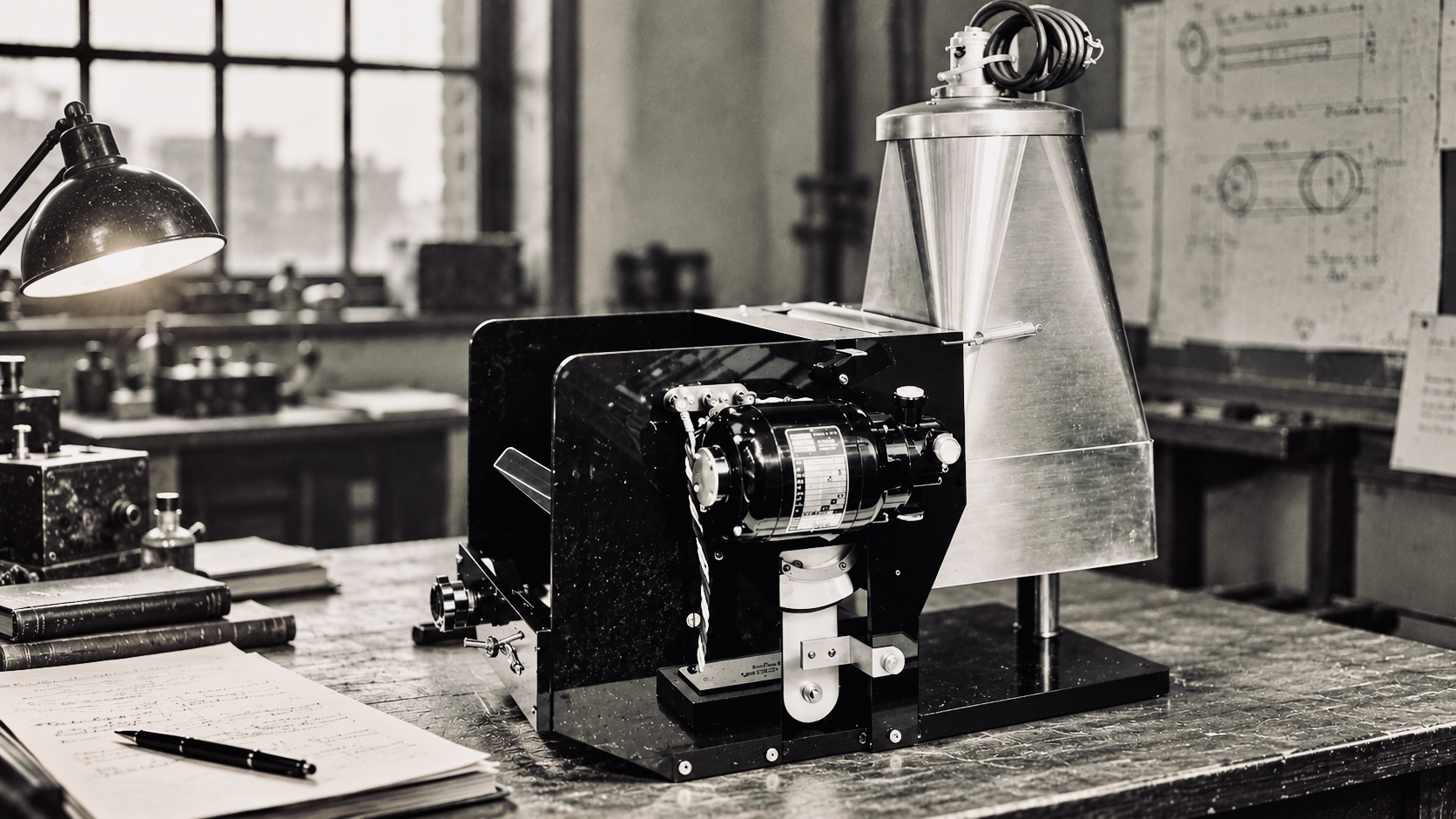
An experiment in a small New York laboratory produced a few words on paper, laying the foundation for a technology that would transform the reproduction of documents worldwide.
On October 22, 1938, American inventor Chester Carlson and physicist Otto Kornei produced the first successful xerographic copy in Astoria, Queens, New York. The experimental image contained only a date and location: “10-22-38 ASTORIA.” Yet this modest achievement introduced the basic principles behind the modern plain-paper photocopier, changing how information would eventually be reproduced and distributed.
Before xerography, duplicating documents could require carbon paper, photographic processes or specialized printing equipment. Making a quick, inexpensive copy of an existing page was far less convenient than it would become in the decades that followed.
Carlson’s invention offered a different approach. Instead of relying on chemical photographic development, it used electrical charges, light and a fine powder to reproduce an image.
The breakthrough would take more than twenty years to reach its full commercial potential.
Chester Carlson’s Search for a Better Way
Chester Floyd Carlson was born in Seattle, Washington, in 1906. He studied physics at the California Institute of Technology before pursuing work involving patents and technical documents.
His experience in patent offices exposed him to a persistent problem: reproducing drawings, specifications and other paperwork was laborious and time-consuming.
Carbon paper could produce copies while a document was being typed, but it could not conveniently duplicate an existing original. Photographic reproduction was possible, although it required equipment, materials and processing steps that limited everyday office use.
Carlson began investigating whether electrostatics, the behaviour of electric charges, could provide a simpler alternative.
He drew on scientific work involving photoconductivity, the property of certain materials to change their electrical conductivity when exposed to light. This offered a way to create an invisible electrical pattern corresponding to an image.
By the late 1930s, Carlson had developed the foundations of a copying method he initially called electrophotography.
Working in a makeshift laboratory in Astoria, he enlisted the assistance of Otto Kornei, a physicist who had emigrated from Europe.
Their experiments used a metal plate coated with sulfur, an electrically charged surface and a powder capable of adhering to selected areas.
The process was experimental and required considerable manual effort. Nevertheless, it demonstrated that an image could be reproduced without conventional photographic chemistry.
On October 22, 1938, the two men prepared a glass slide bearing the handwritten words “10-22-38 ASTORIA.”
They used light to create an electrical image on the coated plate, applied powder to make that image visible and transferred it to another surface.
The result was the first successful copy produced using the principles of xerography.
It was not yet a practical office machine. The equipment was crude, and the procedure was far from automatic. But the underlying scientific concept had been demonstrated.
From Experiment to Everyday Technology
Carlson’s achievement did not immediately attract commercial support.
During the following years, he approached numerous companies in search of a partner willing to develop his invention. More than twenty rejected the opportunity, reflecting uncertainty about the technical challenges and commercial demand.
A turning point came in 1944 when the Battelle Memorial Institute, a research organization in Columbus, Ohio, agreed to help develop the process.
Battelle researchers improved the materials and equipment, working toward a system that could reproduce documents reliably and repeatedly.
In 1947, Battelle reached an agreement with the Haloid Company, a photographic-paper manufacturer based in Rochester, New York. Haloid would eventually become Xerox Corporation.
The process acquired its familiar name, xerography, from Greek words meaning “dry writing.” The name emphasized its distinction from traditional wet-chemical photographic methods.
In 1948, the technology received a public demonstration. The following year, Haloid introduced its Model A copier, an early commercial application that still required numerous manual operations.
The decisive commercial breakthrough arrived in 1959 with the introduction of the Xerox 914.
Unlike earlier cumbersome systems, the 914 could automatically produce copies on ordinary paper. Its operation was comparatively straightforward, making document duplication practical for everyday office use.
The machine became a major commercial success and helped establish photocopying as a routine business activity.
Its effects extended beyond corporate offices.
Schools and universities could distribute educational materials more conveniently. Libraries and researchers gained easier ways to reproduce documents. Government agencies, law firms and businesses could circulate information without repeatedly preparing originals.
Xerography also contributed to later printing technologies. Laser printers, developed commercially in subsequent decades, use related electrostatic imaging principles to place toner on paper.
The ability to duplicate information quickly and affordably became an important part of modern administration, education and communication.
Carlson lived to see his invention achieve international success. He received significant recognition for his work and devoted much of his later wealth to charitable causes before his death in 1968.
The original 1938 experiment is preserved in the Smithsonian Institution’s collections, providing a physical record of the moment when a laboratory demonstration began developing into a global technology.
Although digital documents have reduced the need for some forms of physical copying, photocopiers and laser printers remain widely used.
The enduring significance of October 22, 1938, lies not in the complexity of the first copy, but in the possibility it demonstrated: information already recorded on one surface could be reproduced through a practical electrical process.
A date and a place, transferred onto wax paper in a small Astoria laboratory, became the starting point for a fundamental change in how the world handles documents.
About the Author Brad Socha is the founder of The Universal Record, focused on sourced, factual global reporting. Coverage includes international news, geopolitics, technology, and major developments.