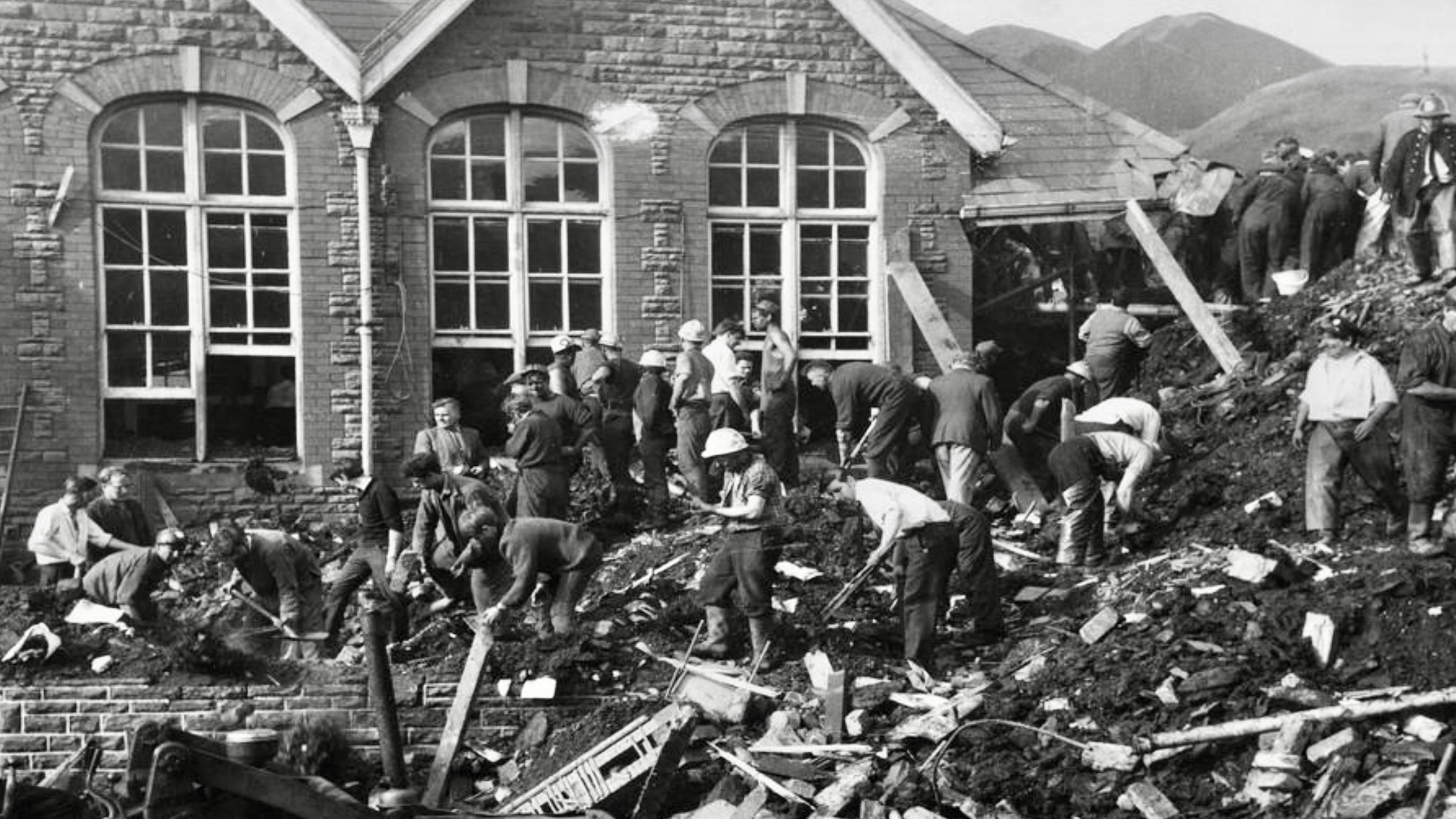
Sixty years after a coal-waste landslide destroyed a Welsh school and nearby homes, the tragedy remains a defining warning about industrial safety and institutional responsibility.
THE UNIVERSAL RECORD
Sourced reporting. No opinions.
Brad Socha | October 21, 2026 | 5:04 AM EST
On October 21, 1966, a mountain of coal waste collapsed above the Welsh village of Aberfan, sending a devastating landslide into homes and Pantglas Junior School. The disaster killed 144 people, including 116 children, and exposed serious failures in the management of industrial waste.
The collapse occurred shortly after 9:00 a.m., as children were beginning their final school day before the half-term holiday. Within minutes, a close-knit mining community in South Wales had suffered one of the deadliest peacetime disasters in British history.
Sixty years later, Aberfan remains a powerful example of the consequences of preventable industrial hazards and the importance of public accountability.
How the Aberfan Disaster Unfolded
Aberfan was a mining village near Merthyr Tydfil, situated below the Merthyr Vale Colliery. For decades, waste from coal extraction had been deposited on the hillside above the community.
These enormous piles, known as spoil tips, contained shale, rock, coal dust and other mining debris. The National Coal Board, which operated the colliery, was responsible for their management.
One of these deposits, Tip No. 7, had been established in 1958. It stood on a hillside where natural springs and watercourses were present, creating conditions that could undermine the stability of accumulated waste.
Heavy rainfall in the days preceding October 21 further saturated the material.
That Friday morning, part of the tip began to move. The mass of waste became increasingly fluid as it travelled downhill, accelerating toward the village.
The landslide struck Pantglas Junior School and surrounding buildings at approximately 9:15 a.m.
Classrooms were engulfed by a mixture of coal slurry, mud and debris. Nearby houses were also destroyed or severely damaged.
Residents, miners, emergency workers and volunteers immediately began searching for survivors.
The rescue operation was extraordinarily difficult. The unstable debris was deep and compacted, while damaged buildings created additional dangers for those working to reach trapped children and adults.
Hundreds of people joined the effort, digging through the material with whatever equipment was available.
Some children and adults were rescued during the initial response, but the chances of finding survivors diminished rapidly. No survivors were recovered after approximately 11:00 a.m.
The final death toll was 144: 116 children and 28 adults.
The scale of the loss devastated Aberfan. Families lost children, neighbours and relatives, while the wider community faced the destruction of its school and the trauma of the rescue and recovery operations.
The tragedy also prompted an outpouring of sympathy and financial assistance from across Britain and internationally.
The Investigation and Its Lasting Consequences
The disaster immediately raised questions about why such a large accumulation of mining waste had been permitted above homes and a school.
A public tribunal was established under the chairmanship of Sir Herbert Edmund Davies to investigate the causes and circumstances of the collapse.
The inquiry examined the construction and management of the spoil tips, the presence of water beneath the waste, earlier concerns about their safety and the decisions made by the National Coal Board.
Its findings, published in August 1967, were unequivocal.
The tribunal concluded that responsibility for the disaster rested with the National Coal Board. It identified serious shortcomings in the organization’s management of the tips and its failure to recognize and address the danger.
The investigation established that water had played a central role in destabilizing Tip No. 7. The underlying springs were not an unforeseeable geological phenomenon; the danger arose from placing and maintaining waste in unsuitable conditions without adequate precautions.
The findings challenged the assumption that the collapse had been an unavoidable natural accident.
Despite the tribunal’s conclusions, no individual was criminally prosecuted over the disaster.
The aftermath also brought further controversy over the removal of the remaining spoil tips above Aberfan.
Bereaved families and residents campaigned for the dangerous deposits to be cleared. Eventually, £150,000 was taken from the publicly donated disaster fund to help finance their removal, a decision that became a lasting source of grievance.
In 1997, the British government returned that sum to the fund. The episode remains an important part of the community’s struggle for recognition and accountability.
The disaster contributed to greater scrutiny of spoil-tip management and industrial safety. Subsequent legislation, including the Mines and Quarries (Tips) Act 1969, strengthened the regulatory framework governing mining waste in Britain.
Aberfan also demonstrated that the consequences of industrial activity could extend far beyond a mine’s boundaries, threatening communities that had little control over the hazards surrounding them.
The former Pantglas Junior School site was transformed into a memorial garden, while the nearby cemetery became a place of remembrance for many of those who died.
For survivors and bereaved families, however, the disaster was never simply an event recorded in official reports. Its effects continued through decades of grief, remembrance and efforts to preserve the experiences of those who lived through it.
On October 21, 2026, Wales marks the 60th anniversary of the Aberfan disaster. The Welsh Government has invited organizations to observe a minute’s silence at 9:15 a.m., the time associated with the collapse.
The anniversary comes amid continuing attention to the condition of disused coal tips across Wales, where the legacy of the mining industry still presents environmental and safety challenges.
Aberfan’s lasting significance lies not only in the lives lost, but in the failures that allowed the disaster to occur. It remains a reminder that industrial risks must be identified, managed and acted upon before communities suffer irreversible consequences.
Sources:
National Library of Wales — Aberfan Disaster 1966
https://www.library.wales/discover-learn/digital-exhibitions/archives/aberfan-disaster-1966
National Library of Wales — Printed Material and Tribunal Reports
https://www.library.wales/discover-learn/digital-exhibitions/archives/aberfan-disaster-1966/printed-material
National Library of Wales — Aberfan Disaster Educational Resource
https://www.library.wales/discover-learn/education/learning-resources/aberfan-disaster
Glamorgan Archives / People’s Collection Wales — The Aberfan Tribunal
https://www.peoplescollection.wales/story/2019341
Institution of Civil Engineers — Learning Lessons From the Aberfan Disaster
https://www.ice.org.uk/what-is-civil-engineering/infrastructure-projects/aberfan-disaster-lessons-learned
UK Parliament — Mines and Quarries (Tips) Bill, January 28, 1969
https://api.parliament.uk/historic-hansard/lords/1969/jan/28/mines-and-quarries-tips-bill
UK Parliament — Aberfan Disaster Fund Repayment, July 31, 1997
https://api.parliament.uk/historic-hansard/written-answers/1997/jul/31/aberfan
Welsh Government — Wales to Mark 60th Anniversary of the Aberfan Disaster
https://www.gov.wales/wales-to-mark-60th-anniversary-of-the-aberfan-disaster
About the Author
Brad Socha is the founder of The Universal Record, focused on sourced, factual global reporting. Coverage includes international news, geopolitics, technology, and major developments.