
An unusual object passing through the solar system provided astronomers with their first confirmed opportunity to study material originating around another star.
THE UNIVERSAL RECORD
Sourced reporting. No opinions.
Brad Socha | October 19, 2026 | 5:03 AM EST
On October 19, 2017, astronomer Robert Weryk identified an unusual moving object in images collected by the Pan-STARRS1 telescope in Hawaii. The discovery would become a milestone in astronomy: the first confirmed observation of an object entering our solar system from interstellar space.
The object, later named ‘Oumuamua, was already travelling away from the Sun when astronomers recognized it. Its extraordinary trajectory showed that it was not a conventional asteroid or comet orbiting our star.
For the first time, scientists could directly observe a natural object that had travelled through the space between stars.
How ‘Oumuamua Was Discovered
The discovery emerged from the Panoramic Survey Telescope and Rapid Response System, known as Pan-STARRS, at Haleakalā Observatory on the Hawaiian island of Maui.
The telescope routinely surveys the sky for moving objects, including asteroids that might approach Earth. Weryk noticed the object in observations from October 19 and subsequently identified it in images taken the previous night.
Initially designated A/2017 U1, the object attracted immediate attention because its motion did not fit the pattern expected of a body gravitationally bound to the Sun.
Astronomers calculated that it was following a strongly hyperbolic trajectory, meaning it was moving fast enough to escape the Sun’s gravitational influence permanently.
Its path also indicated that it had approached the solar system from beyond its boundaries rather than originating among the familiar populations of asteroids and comets.
The object had passed closest to the Sun on September 9, 2017, at a distance of approximately 38 million kilometres, well inside Mercury’s orbit. By the time it was discovered, it had already passed Earth at a distance of roughly 24 million kilometres on October 14.
Its speed and direction made it clear that the opportunity to observe it would be brief.
Astronomers initially considered it a comet, but observations did not reveal the conspicuous cloud of gas and dust normally associated with cometary activity. It was temporarily classified as an asteroid before receiving the designation 1I/2017 U1, identifying it as the first recognized interstellar object.
The name ‘Oumuamua was chosen from Hawaiian, commonly interpreted as a messenger or scout arriving from afar. It acknowledged the location of the discovery and the object’s remarkable journey.
Observatories around the world quickly began collecting measurements before the visitor became too faint to study.
A Visitor That Challenged Expectations
‘Oumuamua differed from familiar solar system objects in several important ways.
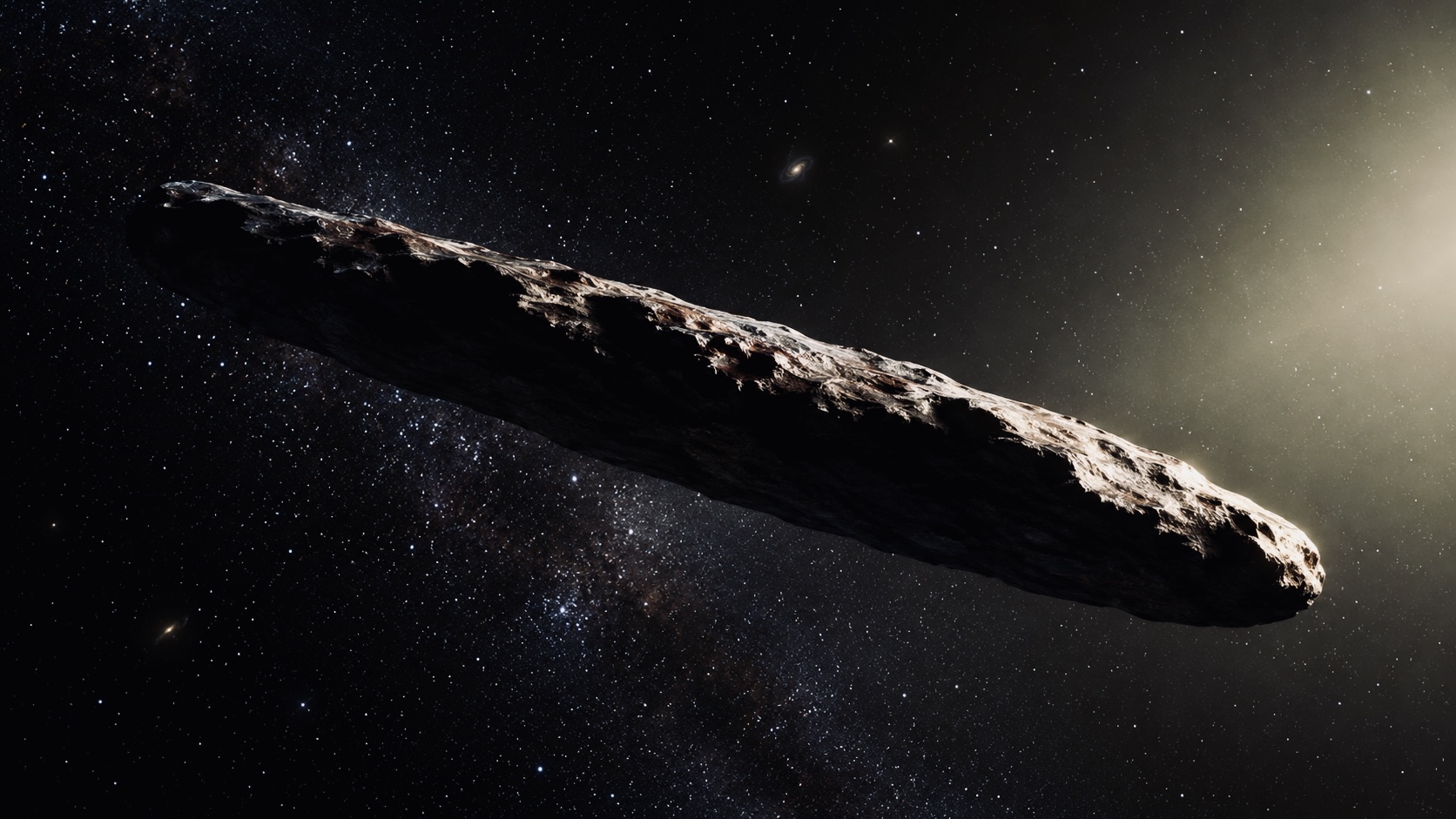
Its brightness changed dramatically as it rotated, suggesting an unusually elongated or flattened shape. Early interpretations favoured a long, narrow body, although subsequent studies demonstrated that the available observations could support other shapes.
No spacecraft obtained a close-up image. The widely circulated pictures showing a cigar-shaped or pancake-shaped object are artistic interpretations, not photographs of its surface.
Its reddish colour was consistent with material that had undergone prolonged exposure to radiation in space, although colour alone could not establish its composition or origin.
The object also appeared to experience a small additional acceleration that could not be explained by gravity alone.
Such acceleration can occur when a comet releases gas, producing a weak thrust. However, telescopes did not detect the usual visible signs of a cometary coma or tail.
This combination prompted scientific debate.
Researchers proposed several natural explanations, including the release of gases that might be difficult to detect. Other studies examined how the object’s structure, composition or surface properties could account for the observations.
In 2023, researchers proposed that molecular hydrogen released from water-rich ice altered by cosmic radiation could explain the acceleration without producing a prominent visible tail. That hypothesis remains part of an ongoing scientific discussion rather than a definitive explanation.
The unusual observations also inspired speculation about artificial origins. However, no verified evidence has established that ‘Oumuamua was manufactured or represented extraterrestrial technology. Its known properties continue to be investigated through physical models and astronomical research.
The central discovery does not depend on resolving every question about its shape or composition: its interstellar trajectory is firmly established.
A New Era of Interstellar Astronomy
Before 2017, scientists had long expected that planetary systems could eject small bodies into interstellar space.
Gravitational encounters with planets can accelerate asteroids and comets until they escape their parent stars. Over millions or billions of years, such objects may travel through the galaxy before passing another planetary system.
‘Oumuamua supplied direct observational evidence that these wandering bodies could be detected.
Its discovery also demonstrated the importance of automated sky surveys. Because interstellar visitors move quickly and may remain observable for only a short period, identifying them early is essential for detailed study.
In August 2019, astronomers discovered a second confirmed interstellar object, comet 2I/Borisov. Unlike ‘Oumuamua, Borisov displayed clear cometary activity, allowing scientists to study material from another planetary system in greater detail.
Together, the discoveries established interstellar objects as a new field of observational research.
The next generation of survey facilities, including the Vera C. Rubin Observatory, is expected to improve the detection of faint and rapidly moving objects, potentially revealing more visitors from beyond the solar system.
‘Oumuamua itself has continued outward on an escape trajectory. Its precise birthplace remains unknown, and astronomers cannot reliably trace it to a particular star.
The object was observed for only a short period, yet it changed an important assumption about what telescopes might find. Small bodies from other planetary systems were no longer merely theoretical travellers through interstellar space.
One had passed through our own solar system, and astronomers had detected it.
Sources:
NASA Science — ‘Oumuamua Overview
https://science.nasa.gov/solar-system/comets/oumuamua/
European Southern Observatory — ESO Observations Show First Interstellar Asteroid Is Like Nothing Seen Before
https://www.eso.org/public/news/eso1737/
European Southern Observatory — Light Curve of Interstellar Asteroid ‘Oumuamua
https://eso.org/public/images/eso1737f/
Nature — Acceleration of 1I/‘Oumuamua from Radiolytically Produced Hydrogen in Water Ice (2023)
https://www.nature.com/articles/s41586-022-05687-w
Nature — Reply to: Accelerating ‘Oumuamua with H2 Is Challenging (2023)
https://www.nature.com/articles/s41586-023-06698-x
NASA Science — Comet 2I/Borisov
https://science.nasa.gov/solar-system/comets/2i-borisov/
About the Author
Brad Socha is the founder of The Universal Record, focused on sourced, factual global reporting. Coverage includes international news, geopolitics, technology, and major developments.

