The Soviet Union achieved the first multi-person spaceflight, sending a cosmonaut, an engineer and a physician into orbit aboard a spacecraft that sacrificed important safety protections to accommodate its crew.
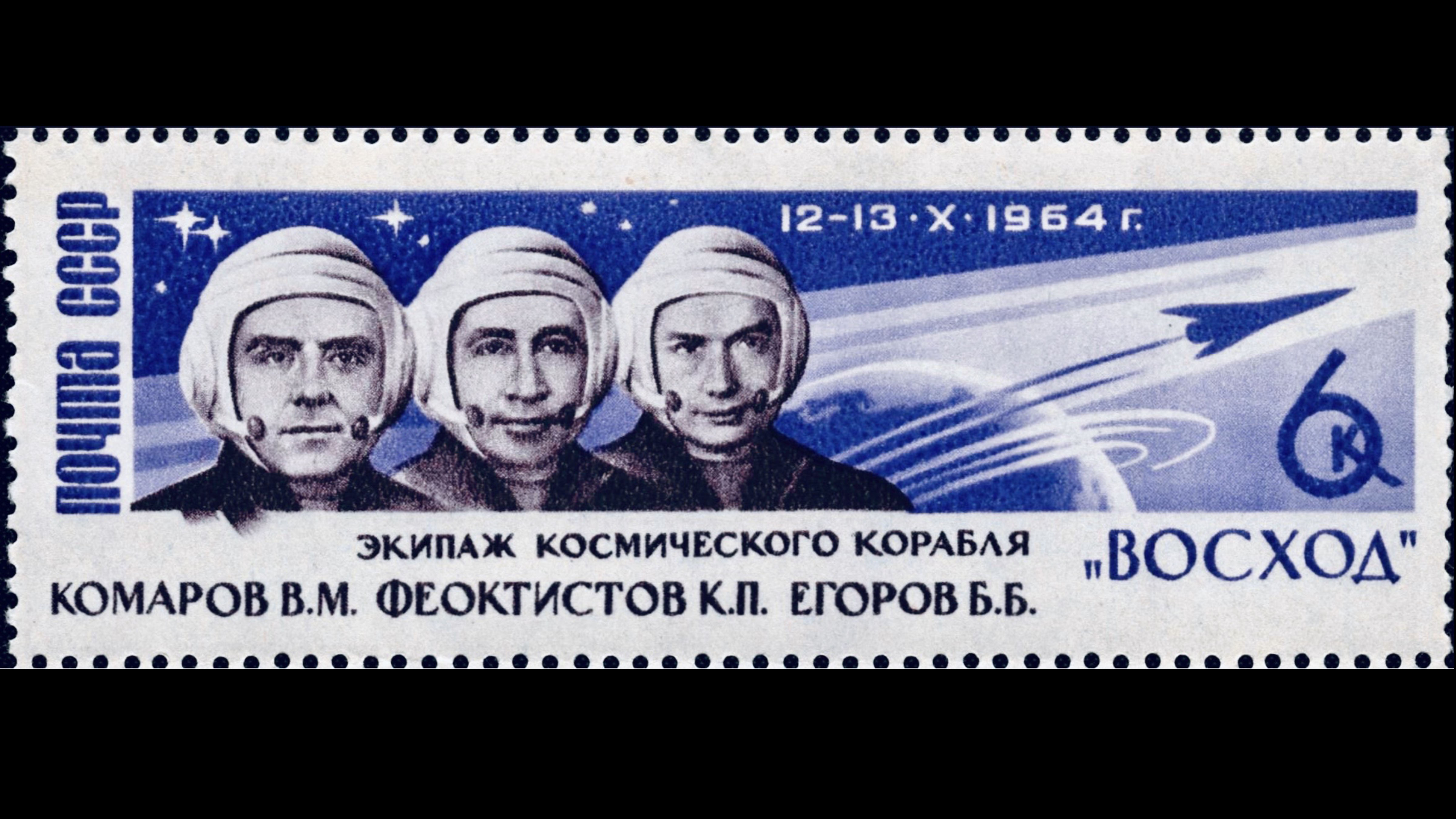
Featured image: Soviet postage stamp commemorating the Voskhod 1 mission and its three crew members in 1964. Artwork by I. L. Levin, Post of the Soviet Union, via Wikimedia Commons.
On October 12, 1964, the Soviet Union launched Voskhod 1, carrying three people into orbit together for the first time. The spacecraft lifted off from the Baikonur launch complex in what is now Kazakhstan, marking a significant milestone in human spaceflight and the intensifying competition between the Soviet Union and the United States.
The crew consisted of commander Vladimir Komarov, engineer Konstantin Feoktistov and physician Boris Yegorov. Their mission demonstrated that several people could travel and work together in orbit, an essential capability for the larger spacecraft and space stations that would follow.
Yet the achievement involved substantial compromises. To fit three crew members into a spacecraft derived from the single-person Vostok design, Soviet engineers removed the ejection seat and eliminated the use of individual pressure suits. The crew depended on the spacecraft’s pressurized cabin for protection.
The flight lasted just over 24 hours, but it established an important new direction for human space exploration.
The Race to Launch Voskhod
By 1964, the Soviet Union had already achieved several historic milestones in space.
Yuri Gagarin became the first human to orbit Earth aboard Vostok 1 in April 1961. Valentina Tereshkova became the first woman in space in June 1963. Soviet spacecraft had also completed increasingly long missions, demonstrating that humans could survive and function in orbit for several days.
The United States was preparing its Gemini program, designed to carry two astronauts and develop the techniques needed for future missions to the Moon.
Soviet planners sought to maintain their country’s lead by launching a spacecraft capable of carrying more people than any previous mission.
Rather than develop an entirely new vehicle, engineers modified the existing Vostok spacecraft. The resulting Voskhod design accommodated three crew members within a relatively small descent capsule.
The modifications required major changes to the interior.
The original Vostok ejection seat, intended to allow a cosmonaut to escape during certain emergencies and parachute separately during landing, was removed. Three specially designed seats replaced the single-seat arrangement.
The spacecraft also incorporated a new landing system that used parachutes and braking rockets to slow the capsule before touchdown, allowing the crew to remain inside.
The absence of pressure suits created another vulnerability. A serious cabin depressurization during flight could have been fatal because the occupants had no independent pressure protection.
These compromises reflected the engineering limitations and competitive pressures of the period. The mission achieved a larger crew capacity without providing all the safeguards that would become standard considerations in later spacecraft.
The crew itself represented another departure from earlier Soviet flights.
Komarov was a trained military pilot and cosmonaut. Feoktistov was an engineer who had contributed to Soviet spacecraft development, while Yegorov was a physician responsible for medical observations.
Their inclusion demonstrated the expanding range of specialists who could participate directly in orbital missions.
A Day in Orbit and a Lasting Legacy
Voskhod 1 launched on October 12 aboard a modified Soviet launch vehicle and entered low Earth orbit.
Unlike earlier Vostok missions, which carried one cosmonaut at a time, the spacecraft placed three people in the same cabin. The occupants had limited room to move, but the mission allowed specialists with different backgrounds to conduct observations during a shared flight.
Feoktistov became the first spacecraft design engineer to travel into space, while Yegorov was the first physician to do so.
During the mission, the crew conducted medical observations and scientific activities, including assessments of how the human body responded to orbital flight.
The flight also carried considerable political significance.
The Soviet Union publicly presented the mission as another demonstration of its space capabilities. The achievement attracted international attention at a time when both superpowers regarded space exploration as an important measure of scientific and technological progress.
The mission coincided with political changes in Moscow. Soviet leader Nikita Khrushchev was removed from power while the spacecraft was in orbit, although the crew learned of the leadership change only after returning to Earth.
Voskhod 1 completed 16 orbits before landing on October 13, 1964, after approximately 24 hours and 17 minutes in space.
All three crew members returned safely.
The mission’s success, however, did not eliminate concerns about its design.
The removal of pressure suits and the absence of a conventional launch escape system left the crew exposed to risks that later spacecraft programs would address through different combinations of engineering protections and emergency procedures.
The Soviet Union launched only one more crewed Voskhod mission.
In March 1965, Voskhod 2 carried Pavel Belyayev and Alexei Leonov into orbit. During that flight, Leonov became the first person to perform a spacewalk, adding another milestone to the Soviet program.
The Voskhod program was subsequently superseded by Soyuz, a spacecraft family designed for more extensive orbital operations, including rendezvous and docking.
The United States also advanced multi-person spaceflight through Gemini, which began carrying two astronauts in March 1965. Gemini missions developed essential procedures for the Apollo lunar program, including orbital manoeuvres, spacewalks and docking.
Voskhod 1’s legacy lies in both its achievement and its limitations.
It proved that human spaceflight could move beyond the era of solitary pioneers to missions involving crews with different technical and scientific responsibilities.
At the same time, its design illustrated the dangers of expanding mission capabilities without equivalent advances in crew protection.
Modern spacecraft and orbital stations routinely accommodate several people, with crews conducting scientific research, operating complex systems and working together for extended periods.
The transition toward that model began with missions such as Voskhod 1, whose brief flight demonstrated the possibilities of multi-person space travel while exposing the difficult safety decisions facing the earliest space programs.
About the Author Brad Socha is the founder of The Universal Record, focused on sourced, factual global reporting. Coverage includes international news, geopolitics, technology, and major developments.