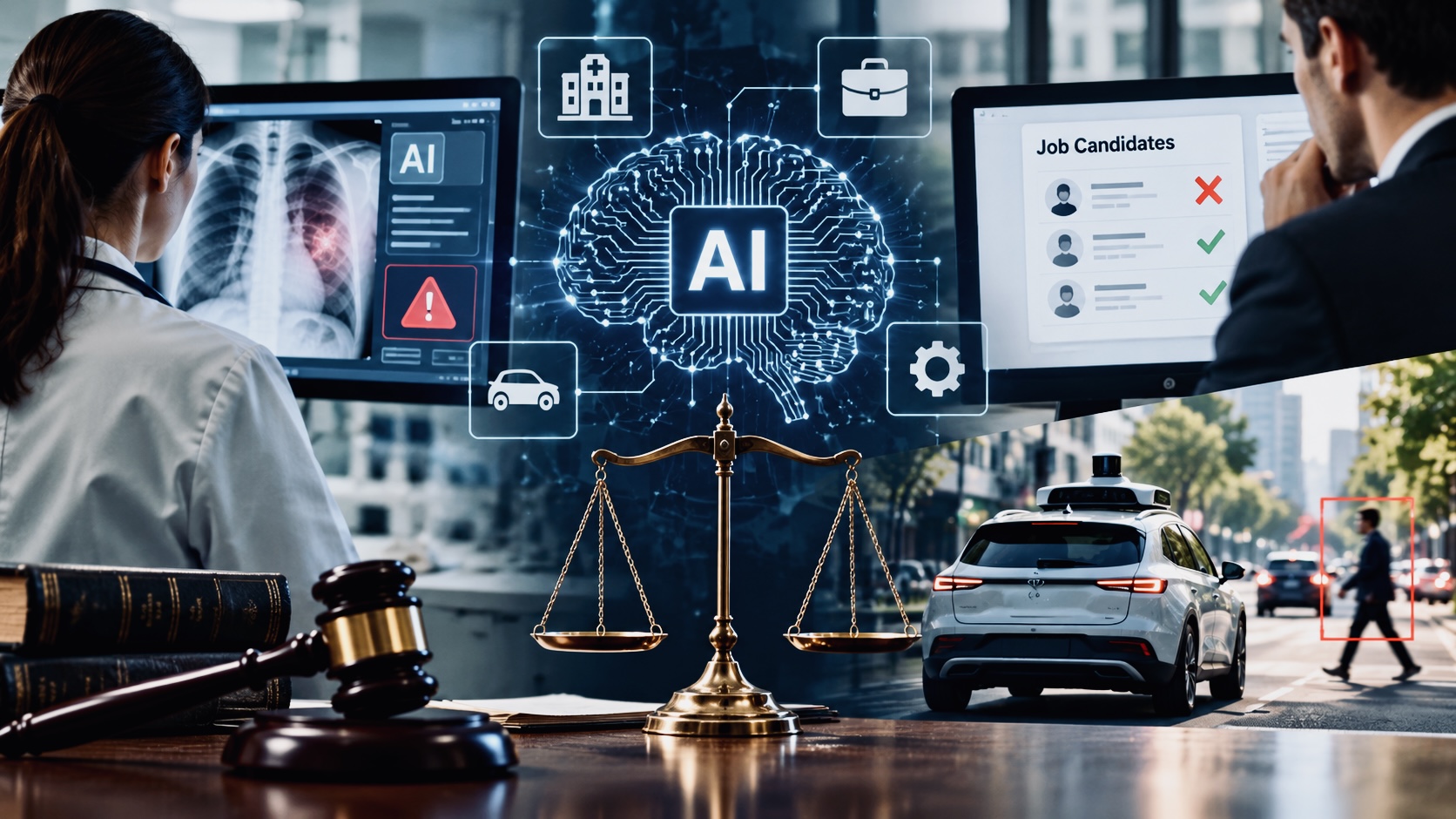
As artificial intelligence takes on decisions in hospitals, workplaces and autonomous systems, questions of legal responsibility are becoming more complicated. The answer depends on who controlled the technology, how it was used and what safeguards were in place.
An AI system recommends the wrong treatment, rejects a qualified job applicant or fails to recognize a pedestrian. When the mistake causes harm, determining responsibility is rarely as simple as identifying the software that produced the decision.
Artificial intelligence can influence consequential decisions without being legally accountable in the way a person or organization can. Responsibility may instead rest with a hospital, employer, manufacturer, software developer or another party involved in deploying the technology.
The central legal question is not whether AI made a mistake, but whether someone owed a duty to prevent the harm, failed to meet that duty and caused a legally recognizable injury.
Existing laws already provide ways to examine those questions. But systems that operate with varying degrees of autonomy can make it harder to establish what went wrong, who could have prevented it and which party should bear the consequences.
Who Is Responsible When AI Causes Harm?
In healthcare, the answer can involve several parties.
A physician who relies on an AI-generated diagnosis may still be expected to exercise appropriate professional judgment. A hospital may face questions about whether it properly evaluated the technology, trained staff and monitored its performance. A manufacturer or developer could face scrutiny if a defect, inadequate testing or misleading instructions contributed to the injury.
Responsibility is not automatically shared among all of them. It depends on the applicable law, contractual arrangements, evidence and circumstances of the case.
The U.S. Food and Drug Administration regulates qualifying AI-enabled medical devices according to their intended use and risk. By September 2026, the agency reported authorizing more than 1,600 AI-enabled medical devices for marketing in the United States. Authorization, however, is not a guarantee that a device will never produce an incorrect result.
Health Canada, the FDA and the United Kingdom’s medical-device regulator have also jointly emphasized transparency about a system’s intended purpose, limitations, performance and role in clinical decisions.
Those details matter when an error occurs. A device designed to assist a physician raises different questions from one intended to perform a medical function automatically. The presence of a human reviewer does not necessarily resolve liability if that review is ineffective or the system’s limitations were poorly communicated.
Employment decisions present another challenge.
An employer might use AI to screen résumés, rank candidates, evaluate productivity or recommend dismissals. If a system produces discriminatory outcomes, the employer cannot necessarily avoid responsibility by arguing that the software made the decision.
In Canada, federal privacy regulators have stated that organizations using generative AI remain accountable for decisions made with its assistance. Privacy and human-rights obligations may apply even when the technology comes from an outside supplier.
Software developers may also face liability depending on their own conduct. A system trained on unsuitable data, marketed with unsupported claims or deployed despite known defects could raise questions about negligent design, misrepresentation, contractual obligations or product liability.
But an inaccurate output alone does not establish that a developer is legally responsible. A claimant may need to demonstrate a legal duty, a breach, a defect or other recognized basis for liability, and a connection between that failure and the harm.
Autonomous AI and the Problem of Control
Autonomous vehicles make the question especially visible because software can directly influence physical events.
When a vehicle equipped with automated driving technology crashes, investigators may examine its sensors, software, maintenance records, operating conditions and the actions of any human driver or safety operator.
A driver-assistance system that requires continuous human supervision is legally and technically different from an automated driving system designed to perform the driving task without constant intervention under specified conditions.
In the United States, the National Highway Traffic Safety Administration requires designated manufacturers and operators to report certain crashes involving automated driving and advanced driver-assistance systems. Those reports help identify potential safety defects, but a reportable crash does not itself prove that the automated system caused it.
Similar questions arise with industrial robots, automated warehouses and AI-controlled equipment. An accident may involve a defective component, inadequate safety barriers, poor maintenance, improper instructions or decisions made by the organization operating the machinery.
The more independently a system acts, the harder it may become to reconstruct the sequence of decisions. Software updates can change behaviour, and complex models may produce outputs that are difficult to explain in ordinary language.
That creates an evidentiary problem. Even where existing law provides a route to compensation, the injured person may lack access to the technical records needed to establish what happened.
European lawmakers have addressed parts of that difficulty through revised product-liability rules explicitly covering software and AI systems. The updated framework is intended to make claims involving defective digital products easier to pursue, including through provisions addressing access to evidence.
The European Union’s AI Act also establishes responsibilities for providers and organizations deploying certain high-risk systems, including requirements concerning oversight, monitoring and recordkeeping. Its obligations have phased implementation dates, and the rules should not be mistaken for a universal system of compensation whenever AI makes a mistake.
These approaches illustrate an important distinction: regulations can require safer development and deployment, while civil liability determines whether particular harm creates a right to compensation.
An organization might breach a regulatory requirement without automatically owing damages to every affected person. Conversely, a claim under existing negligence or product-liability law may be possible even without a specialized AI statute.
The same distinction applies to accountability within companies. Contracts may allocate financial risk between a software supplier and its customer, but those arrangements do not necessarily eliminate legal rights held by injured patients, workers or members of the public.
For individuals affected by automated decisions, meaningful accountability depends on more than identifying who purchased the software. It also requires reliable records, clear responsibilities and a practical way to challenge harmful outcomes.
AI may perform tasks once handled entirely by people, but its growing autonomy does not make legal responsibility disappear. It changes the evidence needed to determine who should answer for a mistake.
About the Author Brad Socha is the founder of The Universal Record, focused on sourced, factual global reporting. Coverage includes international news, geopolitics, technology, and major developments.