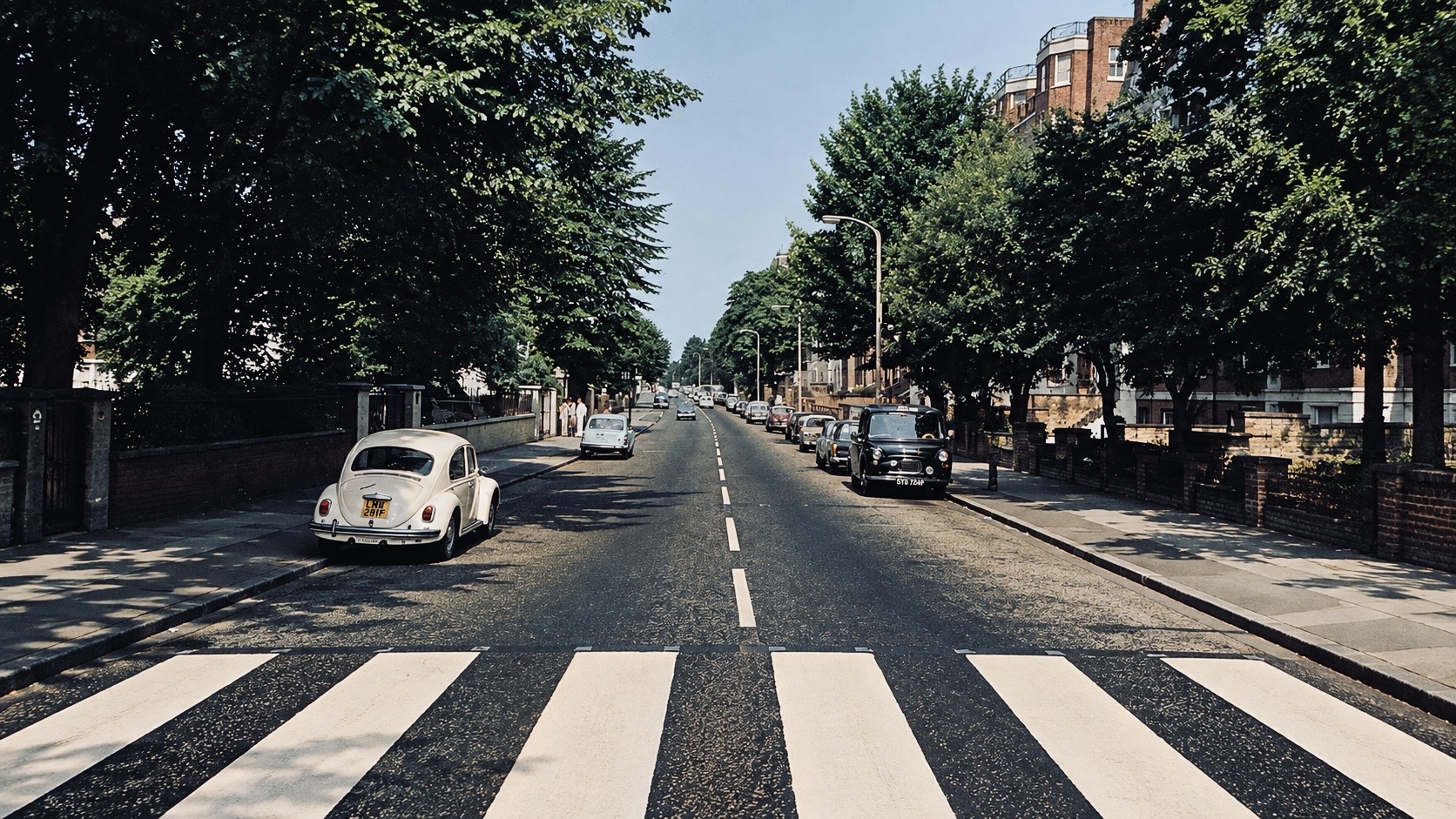
The final album recorded by all four Beatles together paired some of the band’s most enduring music with a cover photograph that transformed an ordinary London crossing into a cultural landmark.
Featured image: Historical reconstruction of Abbey Road in London as it appeared in 1969.
On September 26, 1969, the Beatles released Abbey Road in the United Kingdom. The album arrived near the end of a remarkable decade for John Lennon, Paul McCartney, George Harrison and Ringo Starr, and near the end of the band itself.
Although Let It Be would become the Beatles’ final studio album to be released, in May 1970, most of its material had been recorded earlier. Abbey Road was the last album the four Beatles recorded together as a band. It brought them back to EMI Studios in London for carefully constructed studio recordings at a time when their relationships had become increasingly strained.
The result was a 17-track album containing “Come Together,” “Something,” “Here Comes the Sun,” “Octopus’s Garden” and a sequence of interconnected songs across much of the second side. It reached No. 1 in both Britain and the United States and became one of the defining recordings of the Beatles’ career.
The Beatles Return to Abbey Road
The sessions that produced the album stretched across the spring and summer of 1969, with much of the work taking place at EMI Studios at 3 Abbey Road in London’s St John’s Wood district.
The Beatles had recorded extensively at the studios since the early years of their career, usually working with producer George Martin. By 1969, recording technology there was changing. Abbey Road made use of EMI’s newer TG12345 solid-state mixing console, part of a transition away from the valve-based equipment used on many earlier Beatles recordings.
The technology helped give the album a distinctive sound, but the songs themselves reflected the increasingly individual musical identities of the four musicians.
Lennon contributed “Come Together” and “I Want You (She’s So Heavy).” McCartney’s material included “Oh! Darling” and several pieces incorporated into the long sequence on side two. Starr wrote and sang “Octopus’s Garden.”
Harrison’s contribution was particularly significant. “Something” became the first Harrison composition released as the A-side of a Beatles single, sharing the billing with “Come Together.” “Here Comes the Sun,” also written by Harrison, became another of the album’s enduring songs.
The second side developed into one of the record’s most recognizable features. Beginning after “Here Comes the Sun” and “Because,” a succession of shorter pieces, including “You Never Give Me Your Money,” “Sun King,” “Mean Mr. Mustard,” “Polythene Pam,” “She Came In Through the Bathroom Window,” “Golden Slumbers,” “Carry That Weight” and “The End”, were assembled into an extended musical sequence. The brief “Her Majesty” followed after a stretch of silence.
“The End” carried additional historical significance: it was the last song recorded collectively by all four Beatles.
The album’s production and engineering also received contemporary recognition. At the 1970 Grammy Awards, Abbey Road was nominated for Album of the Year, with George Martin credited as producer, and engineers Geoff Emerick and Philip McDonald won the award for Best Engineered Recording, Non-Classical.
Abbey Road Becomes an Image
The album’s visual identity was created much faster than its music.
On August 8, 1969, the four Beatles walked out of EMI Studios to the zebra crossing on Abbey Road. Scottish photographer Iain Macmillan positioned himself on a stepladder while a police officer temporarily held back traffic.
The Beatles crossed the street several times. Macmillan took only six photographs.
In the image ultimately chosen, the fifth photograph, Lennon leads the group in a white suit, followed by Starr in black, McCartney barefoot and Harrison in denim. No band name or album title appeared on the front cover. The photograph itself was considered sufficient.
The order of the four men was not arbitrary to the photograph, but later interpretations of their clothing and McCartney’s bare feet became part of the bizarre “Paul is dead” conspiracy theory circulating in 1969. There was no factual basis for the claim, and McCartney was very much alive; the episode instead demonstrated how closely fans were examining Beatles records for supposed hidden clues.
The location soon became inseparable from the album. EMI Studios eventually became known as Abbey Road Studios, and the crossing remains one of London’s most recognizable destinations associated with popular music.
Commercially, the album was an immediate success. It entered the British album chart at No. 1 in October 1969. Contemporary Beatles records credit its original run with 17 weeks at the top, while the current Official Charts database counts 18 total weeks at No. 1 across its chart history. In the United States, it spent 11 weeks at No. 1 during its original run.
Yet Abbey Road appeared as the Beatles were moving toward separation. Their business disagreements and personal differences were becoming increasingly difficult to contain, and Lennon privately told the others in September 1969 that he wanted to leave the group. The breakup became public the following year.
Let It Be arrived in May 1970, giving the Beatles one final album release after their partnership had effectively ended. Chronologically, however, Abbey Road remained their last sustained effort at making an album together.
Its legacy continued long after the group. The record returned to No. 1 in Britain in 2019 following a 50th-anniversary edition, half a century after its original release.
What began with four musicians walking across a London street lasted only minutes. The album they were completing, and the fifth of six photographs taken that morning, became enduring symbols of the closing chapter of the Beatles.
About the Author Brad Socha is the founder of The Universal Record, focused on sourced, factual global reporting. Coverage includes international news, geopolitics, technology, and major developments.