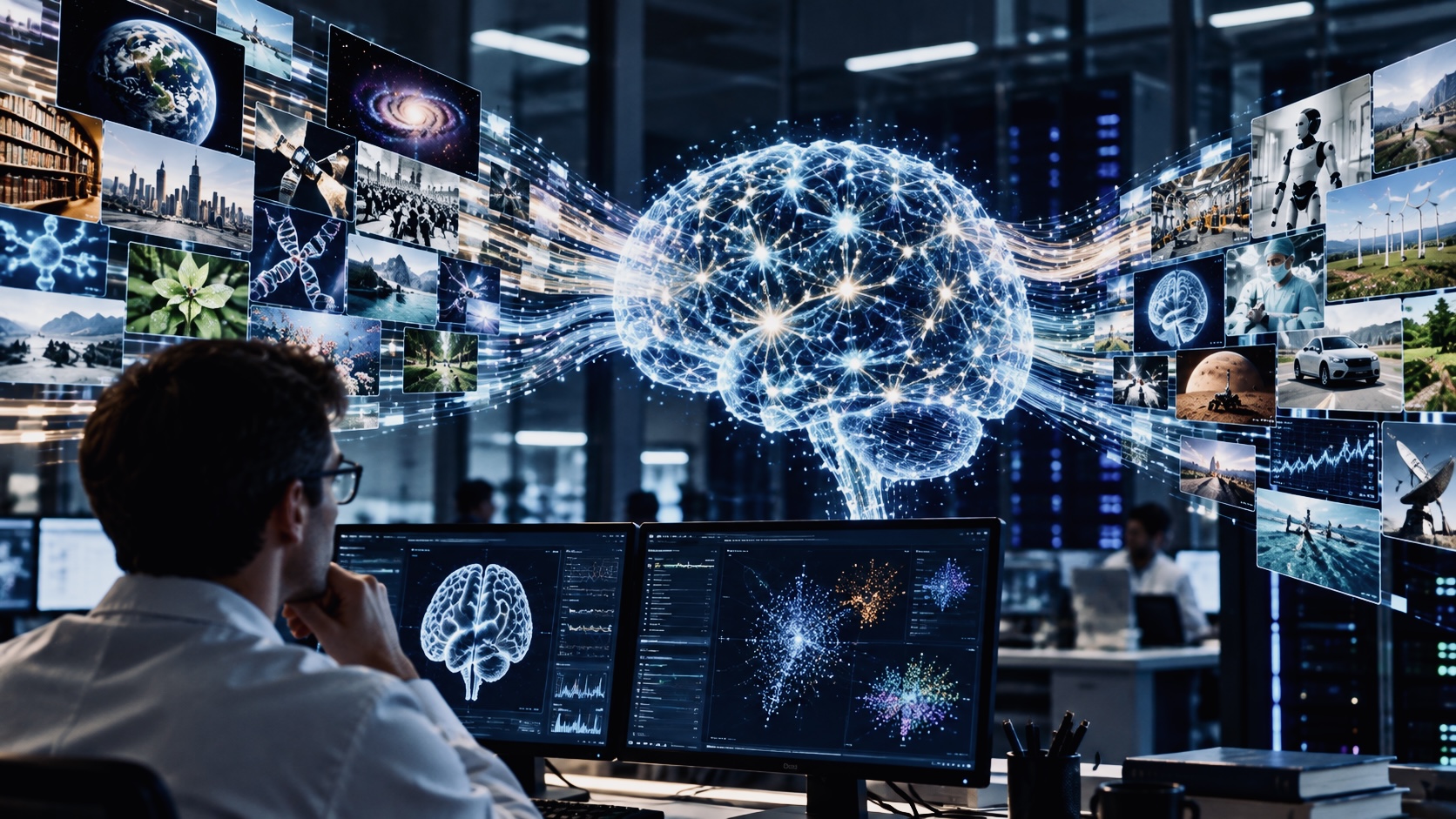
Today’s most powerful AI systems can master enormous amounts of information, yet their underlying models do not simply keep learning from every new experience. Researchers are trying to change that.
THE UNIVERSAL RECORD
Sourced reporting. No opinions.
Brad Socha | September 4, 2026 | 9:23 AM EST
Artificial intelligence can answer questions about subjects it was trained on, adapt to information placed in its context and retrieve knowledge from external memory. But most AI systems still lack something humans take for granted: the ability to continually learn from new experiences while reliably preserving what they already know.
Researchers call the goal continual learning, or sometimes lifelong learning. Instead of periodically training a model on a large dataset, deploying it and later replacing or retraining it, a continually learning system would accumulate useful knowledge as its environment changes.
The distinction matters as AI moves into agents, robotics and long-running workplace systems. An assistant that repeatedly performs the same job should ideally become better at it. A robot operating for years should be able to learn new situations. An AI agent should be able to turn successful experiences into reusable skills rather than rediscovering the same solution each time.
Achieving that reliably, however, remains an unsolved problem.
Why AI Still Struggles to Keep Learning
One of the central obstacles is known as catastrophic forgetting.
Neural networks learn partly by changing large numbers of internal parameters. If a trained network is subsequently adjusted using new information, those changes can interfere with representations that supported abilities learned earlier. The system may improve at the new task while becoming worse at old ones.
This problem predates modern large language models, but the scale and versatility of foundation models make the stakes considerably larger. Researchers must find ways to add knowledge without unpredictably damaging capabilities spread across billions of parameters.
A 2026 review in Artificial Intelligence Review describes catastrophic forgetting as a central challenge in incremental learning, while research published in Nature Communications has explored biologically inspired methods designed to balance learning new information with retaining old knowledge.
Several broad approaches are being investigated. Some systems replay selected older examples while learning new material. Others protect model parameters considered important to existing abilities, add specialized components rather than continually rewriting a model’s core, or separate different forms of short- and long-term memory.
Google Research introduced another approach in November 2025 called Nested Learning. It treats a model as interconnected learning processes that can update at different rates. A proof-of-concept architecture called Hope combined this idea with what researchers describe as a continuum memory system, designed to retain and update information across different timescales. Google reported improvements over several comparison architectures in its experiments, but the work remains research rather than evidence that catastrophic forgetting has been solved across deployed AI systems.
The underlying challenge is sometimes described as the stability-plasticity dilemma. An intelligent system needs enough plasticity to change when something new is learned, but enough stability to prevent useful existing knowledge from being overwritten.
Humans perform this balancing act extraordinarily well. A person can learn a new language, workplace procedure or route home without generally erasing unrelated knowledge acquired years earlier.
AI does not yet have an equivalent general solution.
AI Memory Is Becoming Another Route to Learning
The race is also moving beyond changing the neural network itself.
Researchers are developing AI systems that retain memories, experiences, instructions and learned skills outside the underlying model. Instead of constantly modifying billions of model parameters, an agent can preserve useful information in an external memory system and retrieve it when needed.
This is important because an AI system can become more capable over time even if its underlying language model remains unchanged.
Microsoft Research, for example, has been developing memory architectures that consolidate interactions into more useful long-term representations. A May 2026 research project tested a human-inspired architecture incorporating mechanisms such as memory consolidation, forgetting, reconsolidation and knowledge graphs. Other Microsoft work is examining how agents can convert previous interactions into reusable knowledge and procedures.
That is not the same as a model continually rewriting its internal knowledge. But from a user’s perspective, the distinction could become less obvious. An agent that remembers previous failures, preserves successful procedures and applies those lessons months later can behave as though it has learned from experience.
Recent benchmarks show both the potential and the limitations.
SkillLearnBench, developed by researchers from Carnegie Mellon University and Amazon AGI and accepted at the 2026 Conference on Language Modeling, tests whether agents can acquire reusable skills across real-world tasks. The researchers found that continual-learning methods improved performance over agents without learned skills, but no approach consistently performed best across all tasks and models. Open-ended tasks remained particularly difficult.
Another benchmark released in August, ContinualSkillBench, found that sequential experience generally improved agent performance, but current systems still struggled to consistently turn that experience into robust skills transferable across tasks.
Those findings highlight an important distinction between remembering and learning.
Saving every interaction is not necessarily useful. An AI system must determine what deserves to be retained, what can be discarded, which experience applies to a new situation and whether previously learned information is still correct.
Persistent learning also creates risks that static models largely avoid. Incorrect information could become embedded in memory. Malicious instructions could potentially influence future behaviour. An agent could learn an undesirable shortcut from a successful outcome or reinforce its own mistakes through repeated self-generated feedback.
Microsoft has warned that persistent AI memory expands the security attack surface because malicious information could potentially influence an agent long after the interaction that introduced it.
The goal, therefore, is not simply an AI that never forgets. Forgetting can itself be useful. The harder objective is a system that continually decides what to learn, what to preserve, what to revise and what to discard.
If researchers succeed, the consequences could reach far beyond better chatbots. Robots could accumulate experience in the physical world. Scientific systems could incorporate new experimental results. Workplace agents could learn an organization’s procedures. Personal assistants could develop years of useful experience with an individual.
Today’s AI models can be extraordinarily capable after training. Continual learning aims at something fundamentally different: machines whose useful knowledge and skills do not have to remain largely frozen between major training cycles.
The race is not yet won. But solving that problem would move artificial intelligence closer to a defining characteristic of biological intelligence, the ability to keep learning throughout its existence.
Sources:
Google Research — Introducing Nested Learning: A New ML Paradigm for Continual Learning
https://research.google/blog/introducing-nested-learning-a-new-ml-paradigm-for-continual-learning/
Nature Communications — Bayesian Continual Learning and Forgetting in Neural Networks
https://www.nature.com/articles/s41467-025-64601-w
Artificial Intelligence Review — Addressing Catastrophic Forgetting in Class-Incremental Learning
https://doi.org/10.1007/s10462-026-11575-w
Carnegie Mellon University / Amazon AGI — SkillLearnBench
https://cxcscmu.github.io/SkillLearnBench/
SkillLearnBench — Research Paper
https://arxiv.org/abs/2604.20087
ContinualSkillBench — Can LLM Agents Truly Evolve Their Capabilities?
https://arxiv.org/abs/2608.03874
Microsoft Research — Human-Inspired Memory Architecture for LLM Agents
https://www.microsoft.com/en-us/research/publication/human-inspired-memory-architecture-for-llm-agents/
Microsoft Research — Improving Language Agents Through BREW
https://www.microsoft.com/en-us/research/publication/improving-language-agents-through-brew/
Microsoft Security — Guarding AI Memory
https://www.microsoft.com/en-us/security/blog/2026/06/22/guarding-ai-memory/
About the Author
Brad Socha is the founder of The Universal Record, focused on sourced, factual global reporting. Coverage includes international news, geopolitics, technology, and major developments.