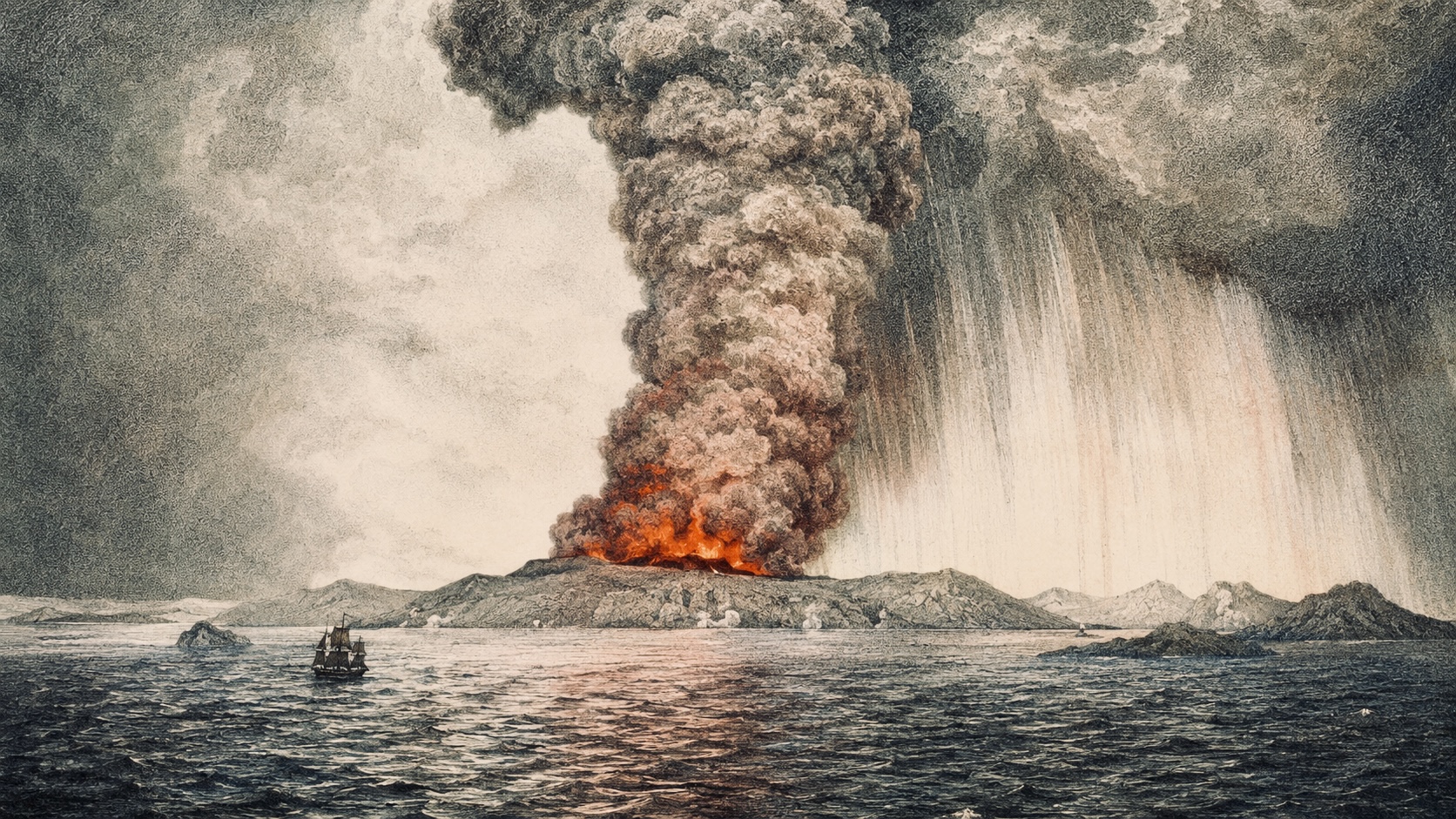
The catastrophic eruption in the Sunda Strait generated deadly tsunamis, sent pressure waves around the planet and left effects recorded across the world.
THE UNIVERSAL RECORD
Sourced reporting. No opinions.
Brad Socha | August 26, 2026 | 4:55 AM EST
In the early hours of August 27, 1883, Krakatoa entered the climactic stage of an eruption that would become one of the most famous volcanic disasters in recorded history. The island volcano, situated in the Sunda Strait between Java and Sumatra in what is now Indonesia, produced a succession of enormous explosions. Much of the island was destroyed, and tsunamis devastated communities along nearby coastlines.
The catastrophe killed more than 36,000 people, with the U.S. Geological Survey citing a figure of 36,417 deaths and identifying tsunamis as the principal cause. The disaster was extraordinary not only for its human toll but also for the geographical scale of its effects. Sound travelled thousands of kilometres, sea-level disturbances were detected far from Indonesia, and atmospheric disturbances were recorded around the globe.
Krakatoa had already been showing signs of renewed activity for months. An eruption involving ash and steam began on May 20, 1883. Activity continued through the summer as multiple vents became active and ash columns rose above the island.
By August 26, the eruption had intensified dramatically. Explosions continued into the following morning as the volcano approached its catastrophic climax.
Krakatoa’s Explosions Shake the Region
Four immense explosions occurred during the morning of August 27, culminating in the largest at about 10 a.m. local time. The destruction transformed Krakatoa itself. Large portions of the volcanic island disappeared as the eruption and collapse created a caldera beneath the Sunda Strait.
The eruption expelled roughly 25 cubic kilometres of material, according to the USGS, with volcanic debris propelled high into the atmosphere. Krakatoa’s 1883 eruption is classified as a magnitude 6 event on the Volcanic Explosivity Index.
The explosions also produced one of the most remarkable acoustic events ever documented. The sound was heard across an enormous portion of the Indian Ocean region. On Rodrigues Island, nearly 5,000 kilometres from Krakatoa, people heard what they believed to be distant gunfire. It was the volcano.
Yet the greatest loss of life came not directly from the explosions or falling volcanic material, but from the sea.
Enormous tsunamis swept across the Sunda Strait and struck the densely populated coasts of Java and Sumatra. Entire settlements were destroyed. USGS historical material records that a series of tsunamis washed away 165 coastal villages and that sea-level disturbances were registered by tide gauges more than 7,000 kilometres away on the southern Arabian Peninsula.
The combination of explosive activity, collapse and displacement of seawater generated a disaster that extended far beyond the remains of the volcano.
Contemporary scientific observations captured another extraordinary effect. Pressure disturbances generated by the eruption travelled through the atmosphere around the planet and were detected repeatedly by barometers. The event became an unusually well-documented example of how an immense volcanic explosion could produce measurable effects on a global scale.
A Disaster Recorded Around the World
The atmosphere carried Krakatoa’s influence much farther than the Sunda Strait.
Fine volcanic material injected high into the atmosphere contributed to unusual optical effects reported around the world in the months following the eruption. Brilliant red and orange sunsets, twilight glows, coloured suns and other atmospheric phenomena attracted widespread public and scientific attention.
Those observations became the subject of systematic investigation. In 1888, the Royal Society’s Krakatoa Committee published an extensive report examining the eruption, atmospheric pressure waves, sounds, tsunamis and unusual optical phenomena observed after the disaster. The resulting body of evidence made Krakatoa an important event in the development of modern volcanology and atmospheric science.
The eruption also demonstrated with devastating clarity that volcanic hazards can extend far beyond lava and ash. Krakatoa’s deadliest consequence was a tsunami, a lesson that remains relevant to modern hazard monitoring in volcanic regions surrounded by water.
That danger returned to the Sunda Strait in December 2018, when part of Anak Krakatau, “Child of Krakatau,” the volcanic island that emerged within the old caldera, collapsed during an eruption. The resulting tsunami struck nearby coastlines and killed hundreds of people, reinforcing the continuing geological threat posed by the volcanic system.
The 1883 eruption also left scientists with an unusually rich historical record. Telegraph networks, weather stations, tide gauges, ships and observers distributed across much of the world recorded aspects of the event. Those records allowed researchers to examine a natural disaster on a scale that would have been impossible in earlier centuries.
Krakatoa therefore occupies a distinctive place in both human and scientific history. It was a devastating regional catastrophe whose physical effects became a global event, heard across an ocean, detected by instruments thousands of kilometres away and visible in altered skies far beyond Indonesia.
More than a century later, Krakatoa remains a reminder that a volcanic eruption concentrated in one narrow strait can send consequences across oceans, through the atmosphere and around the planet.
Sources:
U.S. Geological Survey — Krakatau 1883
https://www.usgs.gov/publications/krakatau-1883
U.S. Geological Survey — Volcano Watch: Mixing Magmas at Krakatau
https://www.usgs.gov/news/volcano-watch-mixing-magmas-krakatau
U.S. Geological Survey — Which Volcanic Eruptions Were the Deadliest?
https://www.usgs.gov/faqs/which-volcanic-eruptions-were-deadliest
U.S. Geological Survey — Plate Tectonics and People: Krakatau Tsunami
https://pubs.usgs.gov/gip/dynamic/tectonics.html
Smithsonian Institution, Global Volcanism Program — Krakatau
https://volcano.si.edu/volcano.cfm?vn=262000
Smithsonian Libraries and Archives — The Eruption of Krakatoa, and Subsequent Phenomena: Report of the Krakatoa Committee of the Royal Society
https://www.si.edu/object/eruption-krakatoa-and-subsequent-phenomena-report-krakatoa-committee-royal-society-edited-gj-symons%3Asiris_sil_261751
About the Author
Brad Socha is the founder of The Universal Record, focused on sourced, factual global reporting. Coverage includes international news, geopolitics, technology, and major developments.